Understanding Data Types and Variables
In the vast realm of computer programming, data types and variables form the bedrock upon which all software systems are built. Whether you're crafting a simple script or architecting a large-scale application, these fundamental concepts guide how information is stored, manipulated, and interpreted by your programs. Data types determine the kind of data a variable can hold—be it numbers, text, or more complex structures—while variables act as named containers for these data pieces during a program’s execution. A clear understanding of data types and variables is essential not only for writing efficient and error-free code but also for optimizing performance and fostering scalability in software solutions. This article delves deep into the principles behind data types and variables, unraveling their nature, roles, and nuances across various programming languages, and equipping you with the knowledge to master this cornerstone of programming.
- What Are Data Types?
- The Role of Variables in Programming
- Primitive Data Types Explained
- Composite Data Types: Arrays, Lists, and More
- Static vs. Dynamic Typing
- Strong vs. Weak Typing
- Memory Allocation and Data Types
- Type Conversion and Casting
- Variable Scope and Lifetime
- Constants and Immutability
- Data Types Across Programming Languages: A Comparative View
- The Importance of Choosing the Right Data Type
- Variables in Modern Programming Paradigms: Object-Oriented and Functional
- Conclusion
- More Related Topics
What Are Data Types?
Data types classify the kind of data that variables can hold, defining the characteristics and behaviors of the data in a program. They tell the computer how to interpret the bit patterns stored in memory—whether as integers, floating-point numbers, characters, or complex data structures. Each data type represents a set of possible values and a set of operations that can be performed on those values. For example, arithmetic operations can be performed on numerical types, whereas string types support concatenation and substring extraction. Without data types, a computer wouldn't know how to process input or output correctly, making them indispensable for programming languages to enforce data integrity and optimize resource usage.
The Role of Variables in Programming
Variables act as symbolic names for memory locations that store data during a program’s execution. They are essential tools allowing programmers to name, store, and manipulate data dynamically. When you declare a variable, you allocate space in memory to hold a value that can change as the program runs. Variables help make code more readable and maintainable by replacing 'magic numbers' or hardcoded data with meaningful identifiers. Furthermore, variables are integral in controlling program flow, facilitating user input management, and enabling complex calculations by retaining intermediate and evolving states within an algorithm.
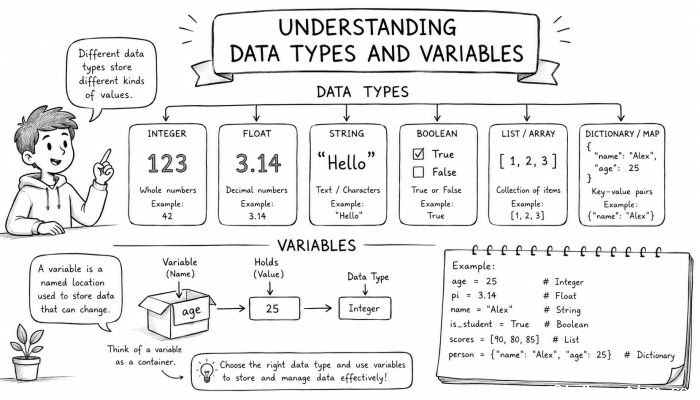
Primitive Data Types Explained
Most programming languages start with a set of primitive, or basic, data types that represent simple values. Common primitives include:
- Integers: Whole numbers (positive, negative, or zero), used for counting and indexing.
- Floating-Point Numbers: Numbers with decimal fractions for representing real values such as measurements.
- Characters: Single letters, digits, or symbols, typically stored as ASCII or Unicode codes.
- Boolean: Represents truth values (`true` or `false`), crucial for decision-making and control structures.
Understanding these primitive types is fundamental since they form the building blocks for more complex data structures.
Composite Data Types: Arrays, Lists, and More
Beyond primitives, composite data types are collections or aggregations of simpler data units. Arrays and lists are primary examples—a sequence of elements of the same type stored contiguously in memory. Arrays are usually of fixed length while lists can be dynamic, varying from language to language. Other composite types include tuples, structs, and classes, which group diverse data types into a single unit. These complex types allow programmers to model real-world entities more naturally, enabling better data organization and manipulation.
Static vs. Dynamic Typing
Programming languages differ in how they handle data types through static or dynamic typing. Static typing requires explicit variable declarations with specified types, checked at compile time. This approach helps catch type errors early, improving program safety and performance (e.g., C, Java). Dynamic typing assigns types at runtime, affording greater flexibility and faster prototyping but potentially causing runtime errors if not carefully managed (e.g., Python, JavaScript). Each typing discipline has trade-offs, and understanding them helps in selecting the right language and approach for a given project.
Strong vs. Weak Typing
Typing strength refers to how strictly a language enforces type rules. Strongly typed languages prevent operations between mismatched types without explicit conversion; this reduces bugs and unexpected behaviors. For example, attempting to add a string to an integer without conversion would raise an error in strongly typed languages like Java or Python. Weakly typed languages (e.g., JavaScript, PHP), on the other hand, perform implicit type coercion, which can lead to subtle bugs but offers syntactic convenience. Awareness of typing strength is crucial when debugging type-related issues.
Memory Allocation and Data Types
Different data types demand varying amounts of memory. For instance, an `int` typically requires 4 bytes, whereas a `double` may need 8 bytes. Understanding how data types impact memory allocation aids programmers in optimizing performance and resource usage, especially in memory-constrained environments like embedded systems. Additionally, some language implementations use alignment and padding strategies influencing data layout. Efficient memory use also ties into understanding how variables of different data types are stored and retrieved in memory.
Type Conversion and Casting
Often, programs require data to be converted from one type to another—a process called type conversion or casting. Explicit casting involves direct instruction from the programmer, for example turning a floating-point number into an integer by truncating the decimal part. Implicit casting, or coercion, is done automatically by the language where safe or sensible (e.g., converting an integer to a floating-point number before arithmetic). Understanding how type conversion works helps prevent unexpected results and bugs caused by data loss, overflows, or logical errors during operations between incompatible types.
Variable Scope and Lifetime
Variables are not just about data storage but also about the context and lifespan for which that data exists. Scope defines the portion of the code where a variable is accessible—ranging from global scope (accessible anywhere) to local scope (limited to a function or block). Lifetime refers to how long a variable exists in memory during program execution. Local variables typically have a short lifetime, destroyed after the function completes, while global variables persist throughout. Understanding scope and lifetime is critical for managing program state and avoiding errors like variable shadowing or memory leaks.
Constants and Immutability
Not all variables need to change after they are assigned. Constants represent fixed values that remain unchanged throughout program execution. Declaring a variable as constant enforces immutability, providing safety and predictability, especially for critical values such as mathematical constants or configuration parameters. Immutability extends beyond constants in some programming paradigms like functional programming, where variables or data structures cannot be altered after creation, promoting code clarity and thread safety.
Data Types Across Programming Languages: A Comparative View
Data types and variables manifest differently across programming languages due to language philosophy and design goals. For instance, C uses primitive data types with explicit sizing and static typing, while Python uses dynamic types with automatic memory management. Some languages like Haskell or Scala incorporate advanced type systems including generics, type inference, and algebraic data types, enabling sophisticated compile-time checks and abstractions. A comparative understanding assists programmers adapting to new languages, helping them leverage language-specific strengths and avoid common pitfalls.
The Importance of Choosing the Right Data Type
Selecting an appropriate data type for variables is pivotal. Using an integer where a floating-point number is needed can lead to inaccurate results; storing large text in a fixed-size character array risks overflow. Beyond correctness, proper data types influence memory consumption, program speed, and maintainability. In database programming, data types also impact storage efficiency and query performance. Consequently, thoughtful data type selection embodies good programming practice and lays the foundation for robust software solutions.
Variables in Modern Programming Paradigms: Object-Oriented and Functional
In object-oriented programming (OOP), variables often represent attributes or properties of objects, encapsulated within classes. Variables here reflect not only data but the state of an object across methods and lifecycles. Functional programming, by contrast, favors immutability and uses variables less as storage and more as bindings to values within pure functions. Understanding these paradigms enables programmers to approach variable usage differently, aligning with the design principles of the language or framework they employ.
Conclusion
Mastering data types and variables is an essential step toward becoming a proficient programmer. These core concepts influence virtually every aspect of software development—from ensuring data integrity and optimizing memory use to providing clarity and flexibility in code. By understanding the nature of different data types, the role and behavior of variables, and the subtle distinctions in typing disciplines and language paradigms, programmers can write safer, more efficient, and maintainable software. Whether working in a statically typed system or a dynamic scripting environment, the principles covered here provide a solid foundation to navigate and harness the power of data management in programming. As technology progresses and languages evolve, this foundational knowledge will continue to be invaluable, empowering developers to craft cleaner, smarter, and more effective code.
 How to Make the Most of Your Holiday Break
 The Best Winter Destinations for a Cozy Getaway
 How to Organize Your Holiday Travel Plans with Ease
 The Ultimate Guide to Cooking for a Crowd
 How to Make Healthy Comfort Food Without the Guilt
 5 Delicious Vegan Breakfast Ideas You Can Make in Minutes