Behind the Music: The Process of Creating a Hit Song
Every one of us has got at least one song that made us feel like the stars just fell from the sky the first time we heard it. The melody grabs you right in the first few notes, the lyrics feel like they were written about you but you’re not quite sure why, and before you know it, the song is on your phone, in your car, on the café radio, on your social media timelines, and everywhere else. It’s like it always existed but you just discovered it. But the process of making a song like that is actually anything but magical. Hit songs are emotional, personal, and incredibly human. While we’re used to hearing hit songs already made, packaged and placed on streaming playlists, this article takes you behind the music to look at how they’re made—from the first thought to the final mastered version that goes out to the world. We’ll cover the common steps every hit goes through, from creative songwriting to production, recording, and marketing. If you’re a songwriter, artist, or music fan who’s ever wondered what it takes to make a song that people can’t get enough of, read on.
What Makes a Song a “Hit” in the First Place?
To understand how to make a hit, you have to define what a hit even is. Chart success is one way to measure it, but the truth is that songs can be hits for many reasons beyond numbers. A song has to connect with people on an emotional level to be a true hit. It has to feel familiar but not predictable, it has to sound like something you can sing along to, and it has to make you feel seen, heard, and understood. In a way, the most important part of making a hit song is to remember that the audience will always be the ultimate judge.
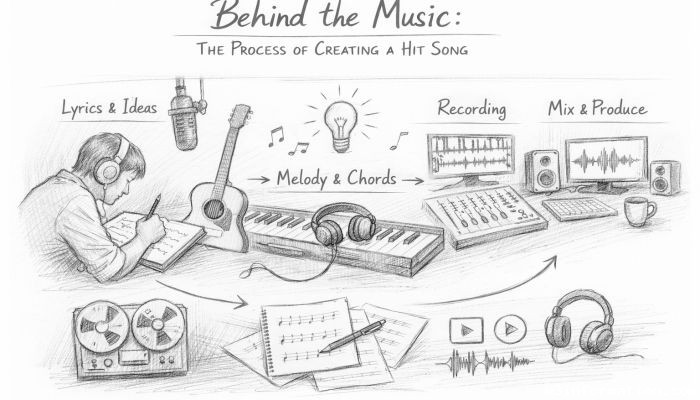
Timing also matters, and so does genre, culture, and context. Even the most undeniable song can be the wrong song at the wrong time and fail to connect with audiences. That’s why hit songs are often a mix of luck, timing, and, of course, intention. But before you can focus on what makes a hit, you have to learn what makes a good song. Focus on melody, rhythm, structure, lyrics, and, of course, emotion. Ask yourself if the song would be the same without the emotion. If it would, change it. If not, focus on making it honest.
The Spark: Where Song Ideas Really Come From
Ideas for songs can come from absolutely anything, but the first step in turning those ideas into hit songs is to actually have an idea to begin with. The ideas can come from a one-word phrase or a full-on concept, a personal experience or a total fabrication. Sometimes, a great song idea can come from a single melody note. Inspiration is rarely a linear process.
If you’re used to doing most of your songwriting by yourself, it can be useful to create small habits that help you catch those song ideas as they appear. Hit songs can be written in seconds because good songwriters know that if you try to capture an idea, the feeling is gone. Recording a voice memo, scribbling some lyrics on a piece of paper, humming a melody into your phone, all these can be the beginnings of a future hit song.
Songwriting: Turning Emotion into Structure
Once the initial idea is there, songwriting is the process of taking it from a raw emotion and turning it into a finished song. This is where the more technical aspects of music making come into play. On a very basic level, most hit songs in pop, rock, hip hop, R&B, and other genres are quite similar in terms of structure. Think of the classic verse, chorus, verse, chorus, bridge format.
What makes these songs hit, however, is not just the structure itself but how these parts work together. The verses should take you through the story, the chorus should deliver on the emotional promise of the song, and the bridge should add some contrast or reflection. Focus on clarity of emotion, and don’t worry about writing “filler” sections that will eventually be cut.
Melody: The Heart of a Hit Song
Melody is the next important element of most hit songs. You might be surprised by how many hit songs are instantly memorable because of their melodies. A good way to test the strength of a melody is to try humming it to yourself when you’re away from the recording or writing it down. Hit melodies are usually fairly simple and easy to sing, even for people who don’t normally consider themselves singers.
The more technical part of creating melodies that work involves understanding musical tension and release. If you’ve ever asked yourself “why is this song so good?” chances are the answer was in its melody. Think of it as an emotional spine that carries the emotion of the song.
Lyrics That Connect: Simplicity, Honesty, and Relatability
Lyrics are the second most important aspect of any song, especially since lyrics are what make songs personal. They can give listeners words for feelings or emotions they didn’t know how to describe. One of the most common mistakes in writing lyrics, especially for new songwriters, is to make them too complex, too elaborate, or, worse, too generic.
Hit songs have lyrics that sound honest and natural, like a conversation between you and the listener. Remember that less is often more. Make sure listeners can understand the emotion of the song, even if the lyrics are poetic and not all words and phrases are immediately accessible. Simple words often hit the hardest.
Collaboration: Why Most Hit Songs Aren’t Written Alone
It’s a romantic idea, to write your songs alone by candlelight and pour every ounce of emotion into a single masterpiece. But while this might make a great Instagram photo or song lyric, the reality is that most hit songs are made through a healthy collaboration between songwriters, producers, topliners, and artists. There’s nothing wrong with writing your songs alone, of course, but you’ll grow the most by challenging yourself to hear other perspectives and building upon others’ ideas.
Songwriting is one of the few industries where it’s better to give than to take. A good collaboration is not about whose idea it is or how much money each person gets, but about trust, communication, and pushing a song to its limits. Some of the biggest hits ever were made in rooms full of people, not by lone songwriters working in isolation.
Production: Shaping the Sound and Energy
Production is the stage of the music-making process that determines how a song makes us feel. Does it sound intimate or massive? Dark and moody, or cinematic and uplifting? All these are decisions made during production, and they can have a huge impact on whether a song becomes a hit. Of course, production itself has many facets and can sometimes be an entire process of its own.
The primary job of a producer is to support the emotion of the song by shaping the sound and the energy. This might mean making choices about instruments, sounds, tempos, and arrangements. The current sound of music production is a hybrid of organic and digital elements. A great way to understand production is to think of a song like a house. A bare-bones musical idea can be a simple wooden cabin in the woods. From there, a producer can help turn it into a modern pop anthem with all the trappings.
Recording the Vocal: Capturing Emotion, Not Perfection
The recording process is where a song’s personality really shines, and it’s arguably the part of the process with the biggest emotional impact on listeners. The most important part of recording a vocal is to capture the right emotional energy and tone. Of course, technique and musicality matter too, but in the end, great singing is not a skill, it’s an art, and as such, it has to come from the soul.
Artists and producers know this instinctively, which is why the recording process usually takes longer than you might think. Getting the perfect vocal that matches the energy of the song can take days, and not always because of equipment or technical skills, but because of the right lighting, a comfortable environment, and the right mood. In other words, the right conditions for honesty and authenticity. That’s the only way a listener will actually believe the emotion behind a vocal and make a personal connection to a song.
Mixing and Mastering: Polishing Without Losing Feeling
Mixing and mastering are often the last technical steps in getting a song from a raw audio file to a finished product that can go out to the world. This is a job for specialists, but it’s important for artists, songwriters, and producers to at least know about these stages, if not take part in them as well. Mixing is the process of making all the song’s elements sit in the soundstage so that nothing is too loud or too quiet and no element of the mix overshadows any other.
Mastering is more like a final consistency check to make sure the track will sound good across different systems, software, and platforms. This stage of the song-making process is often where new artists lose the most feeling in their music. Mixing and mastering are both highly technical jobs, but they also require restraint. You can always process something more, but you can never unprocess it. Let a professional take care of this stage, and let them know your concerns. When done well, mixing and mastering will make the song feel complete, confident, and ready for the world.
Marketing, Timing, and the Role of Luck
If you ask a musician, producer, or artist what they think it takes to make a hit song, most of them will probably say something like “luck”. While timing, marketing, playlist placement, and viral moments on social media all play a role in turning a great song into a hit, a great song needs the right moment to find an audience.
Most labels plan release dates, pay close attention to current trends, and try to sync songs with marketing and audience behavior whenever possible. While that does have a major impact, it’s also true that some songs go viral, some get discovered slowly and organically through word of mouth and other times nothing works until the right moment comes along.
The important thing to understand about this part of the song-making process is that the song has to be ready to take advantage of the right opportunity when it presents itself. For that, it has to be as perfect as you can make it. If your song is great, then luck will probably find you.
Emotional Impact: Why Hit Songs Stay With Us
It’s funny, but the true measure of a hit song isn’t how high it goes on the charts but how long it remains in people’s hearts and memories. A lot of this is related to personal experience, in the sense that a hit song will often become the soundtrack for moments in our lives, whether it’s a breakup, road trip, first love, or some other personal event.
But again, that emotional impact comes from the emotion of the song itself. If it connects with a listener on an honest, real level, then chances are they’ll hold on to it. That personal connection, that feeling of being understood or not alone, is what a hit song should make a listener feel. That’s when a hit song becomes more than just entertainment, it becomes part of our story.
Lessons Aspiring Songwriters Can Learn from Hit Songs
Behind every hit song are hours and hours of practice, failure, and rejection. The more successful songwriters, producers, and artists you talk to, the more likely you are to hear a story about hundreds of songs that will never be released to the public. Every one of these songs, whether a simple topline or a fully produced track, taught them something, and most of those lessons are now embedded in the hit songs they go on to make.
The great thing about analyzing hit songs and the common steps all hit songs go through is that you start to recognize patterns. But just as quickly as you start to imitate them, you realize that those songs are mostly not copies of other songs, they’re responses to them. You can learn a lot from hit songs, but you’ll likely learn even more from the dozens or hundreds of songs that will never be hits. Write, write, and write some more. Fail, and fail faster. And most importantly, be honest. With the music, with the process, and, above all, with yourself.
Conclusion
If there’s one lesson about the music-making process and hit songs to take away from this article, it’s that music is human. At every stage of the process, and in every genre, every language, and culture, the most successful music is also the most vulnerable. While algorithms change, styles change, and platforms come and go, music always returns to stories that make people feel something real. Hit songs are not made to capture people’s attention, they capture people’s truth, and that’s why they can feel so personal. If you want to make hit songs, start by making songs. Listen. And never stop connecting.
W3information helps you to get knowledge about the new information. This site under copyright content belongs to w3information. By using this site, you agree to have read and accepted our
terms of use,
cookie and privacy policy.  How to Make the Most of Your Holiday Break
 The Best Winter Destinations for a Cozy Getaway
 How to Organize Your Holiday Travel Plans with Ease
 The Ultimate Guide to Cooking for a Crowd
 How to Make Healthy Comfort Food Without the Guilt
 5 Delicious Vegan Breakfast Ideas You Can Make in Minutes