How to Curate Your Own Art Exhibition
Curating your own art exhibition is where art and intention collide. It’s a chance for your artistic vision to leap from private creation to public conversation. You curate everything from personal projects to your portfolio for clients, and independent curators select art for exhibitions every day. But until now, you might not have seen creating your own exhibition as a possibility. No longer. Whether in a pop-up gallery, community space, or virtual platform, you have the power and agency to curate and present your work. This guide will take you through the process from start to finish, demystifying the curatorial process for you. With a focus on purpose and professionalism, you’ll learn to craft exhibitions that communicate, connect, and captivate. If you’ve ever dreamed of seeing your art hanging with care and intent, this is your guidebook for making that dream a reality.
- What is Art Curation Anyway?
- Defining Your Exhibition Concept
- Selecting Artworks for your Exhibition
- Choosing the Right Space for your Exhibition
- Planning Your Exhibition Layout and Flow
- Writing Titles and Descriptions for your Exhibition
- Budgeting, Framing, Printing, Shipping
- Marketing, Promoting, Inviting
- Opening Events, Hosting, Conversation
- Receiving Feedback, Engaging With Viewers
- Archiving the Exhibition, Documenting the Experience
- Reflecting on Experience, Growing as a Curator-Artist
- Conclusion: Claiming Space as an Artist
- More Related Topics
What is Art Curation Anyway?
Curating art means selection and interpretation. When you curate your own exhibition, you’re making choices about what to show, how to show it, and why. Your exhibition isn’t just a random collection of works. It has a reason for being. You curate a narrative that viewers experience as they move through the space. As both artist and storyteller, you can frame the narrative for others, guiding them toward meaning rather than leaving it entirely to chance. An exhibition that feels haphazard or accidental often reveals a lack of curatorial intent. You hold the power to shape your own narrative and, by extension, the experience of your viewers.
Defining Your Exhibition Concept
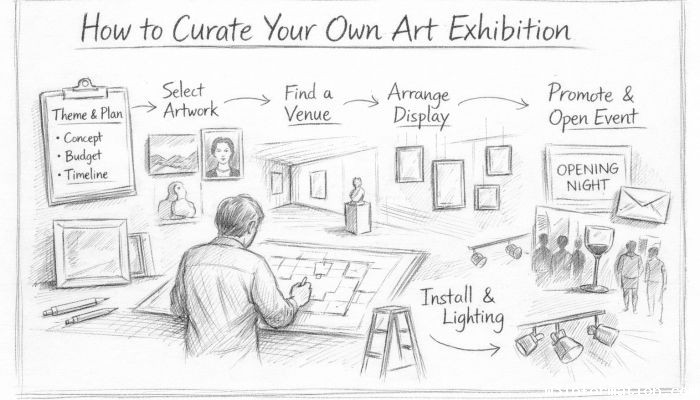
Every successful exhibition has a strong concept. An exhibition is more than a group of individual works—it’s a cohesive experience. So before you think about logistics or practicalities, it’s vital to start with a solid, clear idea at the center. Ask yourself, “What is this about?” What do you want to explore? What do you want to say? Your exhibition could be about a theme (identity, memory, nature, transformation) or a period in your life. It could respond to a social issue, tell a story, or simply explore your current creative process. It’s helpful to write a short (one-paragraph) concept statement that answers the question, “Why am I making this exhibition, and what do I want to say?” Write simply and with emotion. If you understand it, others can too.
Selecting Artworks for your Exhibition
The next step is deciding which works will be part of your exhibition. This is always challenging, as you have to view your art objectively. Attachment and emotion are natural, but curation is an act of editing. To curate your own art exhibition is to apply a critical eye to your own art, asking difficult questions about quality, strength, meaning, and visual coherence. Select pieces that serve the concept, not just your personal favorites. Does each piece say something different, or is there visual, emotional, or narrative redundancy? You will always love your art, but showing less can often be more. Editing with respect for your work and your viewers is an important curatorial act.
Choosing the Right Space for your Exhibition
Space is an essential aspect of curating. The environment shapes how viewers experience art, so think carefully when choosing where to exhibit. It doesn’t have to be a traditional art gallery or museum. Community spaces, cafes, libraries, vacant storefronts, schools, or outdoor spaces can all make powerful exhibition venues. When you visit a potential exhibition space, consider the light, wall size and type, foot traffic, accessibility, and the space’s existing atmosphere. Do these complement or detract from your work? Will the setting support or overshadow your art? Cost and prestige are considerations, but remember that the right space for your exhibition is intentional, not just grand.
Planning Your Exhibition Layout and Flow
Curating your exhibition is also a spatial and emotional journey. Consider how viewers will move through the exhibition from entry to exit. Plan what artwork they encounter first, the rhythm of movement through the space, and how their experience unfolds. Bigger, heavier works can work as anchors, while quieter works invite pause and reflection. Allow space for viewers to move between pieces without feeling crowded and let each artwork breathe. Consider emotional pacing and dramatic impact as viewers engage with your curation. A well-designed layout encourages lingering and deeper engagement.
Writing Titles and Descriptions for your Exhibition
Titles and wall text are your final line of communication with your audience. It doesn’t have to be long or overly explanatory, but it should provide context and direct viewers toward meaning. Titles can be poetic, blunt, or symbolic as long as they fit the exhibition’s tone. A short (few sentences) exhibition statement near the entrance can help ground the viewer in your concept. Thoughtful, clear text adds professionalism and allows your viewers to connect more deeply.
Budgeting, Framing, Printing, Shipping
Curating your exhibition is about more than just hanging your work. Budgeting and logistics are part of the equation too. Set a budget early, considering printing, framing or installing materials, shipping or transportation costs, marketing, and venue fees. Explore cost-effective options like DIY framing, sponsorships, or shared exhibition spaces. Keep track of timelines and deadlines for opening events, shipping, and venue bookings to avoid unnecessary stress. Careful, intentional logistics will make more mental and emotional room for your creativity and connections.
Marketing, Promoting, Inviting
Art exhibitions are not self-serving indulgences. You need an audience. Promotion is not boasting; it’s extending an invitation. Share your creative journey, the exhibition’s concept, and installation process on social media. Make a simple digital flyer or postcard with all the key information: exhibition title, date, time, and location. Reach out to local art communities, schools, and creative groups and send a personal invitation. Personal invitations are better than mass announcements every time. Promotion can be a chance to tell more of your story, not just an advertisement.
Opening Events, Hosting, Conversation
Hosting an opening event or reception is about more than just logistics. It’s an opportunity to set the emotional tone for the exhibition. Simple refreshments, background music, and a few words about your process and concept create a welcoming atmosphere. Be present, engaged, and open to conversation with visitors. An exhibition is as much about how it makes you feel as what you see. Your openness and vulnerability as a host can turn exhibition attendees into supporters and collaborators.
Receiving Feedback, Engaging With Viewers
Curating your own art exhibition is not just about planning and presentation, it’s about connecting with your audience. When viewers stop to see your work, take a moment to listen and learn. How do people react, what resonates, and what questions does your work prompt? Every comment or critique is a gift that helps you see your work from another’s perspective. Conversations with your audience can help you refine your work, inspire new ideas, and connect you to the wider creative community.
Archiving the Exhibition, Documenting the Experience
The exhibition ends, but its influence can continue long after the space is cleared. Take care to document everything with high-quality photos of the art, space, and people engaging with your work. Record videos if possible, collect written comments, and archive promotional materials. This material is invaluable for portfolios, grant proposals, future exhibitions, and online presence. An exhibition is a transformative, powerful moment that continues to inspire when you archive it with care.
Reflecting on Experience, Growing as a Curator-Artist
With each exhibition, you learn more about not just art, but about yourself. After your exhibition, take time to reflect on the experience. What went well? What felt challenging or frustrating? What would you do differently? Curating your own exhibition is more than art curation—it’s also project management, communication, confidence, and leadership building. These are skills that you can apply to future exhibitions, self-publishing, and your creative career. Curating is a growth opportunity, not just an accomplishment.
Conclusion: Claiming Space as an Artist
Learning how to curate your own art exhibition is part of claiming space for your art and voice in the world. It’s an act of intention, self-respect, and empowerment. If you can curate an exhibition with professionalism and purpose, you can curate exhibitions anywhere. You don’t need permission, waiting lists, approval from gatekeepers, or a world-famous art gallery to start. You need only clarity of purpose, commitment, and a desire to share your story. When you curate your own exhibition, you’re not just showing your work. You’re shaping experience, building connection, and claiming your identity as an artist. It is transformative when your art stops being just a private thought and becomes visible to the world.
 Big O Notation Explained for Beginners
 AI in Gaming: Smarter NPCs and Environments
 Understanding Bias in AI Algorithms
 Introduction to Chatbots and Conversational AI
 How Voice Assistants Like Alexa Work
 Federated Learning: AI Without Sharing Data