5 Trends in Mobile App Development to Watch in 2025
The sphere of mobile application design is constantly transforming, propelled by leaps in technology, shifting patterns of consumer behavior, and an ever-increasing need for user interactions that are more tailored, intuitive, and effective. Looking ahead to 2025, those building mobile apps and the enterprises behind them must remain on the cutting edge to maintain a competitive advantage and satisfy the continually rising expectations of users.
This piece will delve into the foremost five shifts in mobile application creation anticipated to lead the way in 2025, ranging from the ascendance of artificial intelligence (AI) to the heightened significance of application security. These developments not only showcase the newest breakthroughs but also offer valuable foresight into how mobile applications will continue to mold the future of commerce and user engagement.
Incorporating Artificial Intelligence (AI) and Machine Learning (ML)
a. Customization and Improved User Journeys
Artificial Intelligence and Machine Learning have moved past mere buzzwords; they are potent instruments redefining mobile application development. By harnessing AI and ML, creators can build more personalized experiences for those using their apps. In 2025, expect applications to exhibit greater intelligence and intuition, gleaning insights from user activity and preferences to furnish bespoke suggestions, services, and materials.
For instance, AI-driven service agents and virtual aides will become more common, assisting users with various tasks, resolving issues, and even finalizing transactions. Applications will also utilize AI for foresight analysis, presenting users with features like curated product suggestions, more intelligent search outcomes, and notification alerts tailored to their usual routines.

b. Streamlining Operations and Productivity
AI and ML will also contribute to refining the application creation process itself. Automated tools driven by AI will empower developers to build applications more rapidly and effectively by managing routine chores, rectifying defects, and conducting performance checks. This will lead to more efficient development pipelines and, ultimately, more perfected applications.
The Impact of 5G and Superior Mobile Connectivity
a. Accelerated Speeds and Enhanced Functionality
5G technology is poised to transform mobile application creation by delivering faster data transmission in both directions, reduced delays, and more dependable connections. With 5G projected to be more widely available in 2025, mobile applications will profit from quicker data handling, enabling smoother audiovisual streaming, richer interactive gaming environments, and faster access to cloud-hosted resources.
For example, applications heavily dependent on data flow, such as those employing augmented reality (AR) and virtual reality (VR), will see considerable upgrades. 5G will make these technologies more accessible and functional on handheld devices, allowing users to enjoy high-quality, real-time interactions without disruption.
b. Interoperability with IoT
5G's high-velocity connections will also fuel the expansion of the Internet of Things (IoT). Given the growing number of linked gadgets, mobile applications will need to integrate flawlessly with IoT hardware, enabling users to manage smart home appliances, personal wellness trackers, and even automobiles directly from their phones. As 5G deployment advances, application designers must craft mobile tools capable of efficiently exchanging data between diverse connected items, unlocking novel avenues for breakthroughs in sectors like wellness, smart residences, and transit.
Developing Applications for Multiple Platforms
a. The Growth of Universal Application Frameworks
The practice of building applications that function across various operating systems (iOS, Android, and the web) from a single pool of code—known as cross-platform development—is anticipated to gain further momentum in 2025. Tools like Flutter, React Native, and Xamarin have simplified the creation of these universal applications, delivering an experience akin to native apps while significantly cutting down on both development duration and expense.
As businesses increasingly strive to engage users across numerous devices and systems, cross-platform design offers a solution that ensures a consistent experience for the end-user, irrespective of whether they operate an Android phone, an iPhone, or a tablet. In 2025, this type of development will continue its upward trend as a budget-conscious and effective method for enterprises seeking to reach a broader demographic.
b. Maximizing Code Use and Expedited Market Entry
The advantages of cross-platform development extend beyond just savings. By relying on one codebase, developers can simplify upkeep and updates, as modifications only need to be applied once rather than separately for each distinct platform. This will result in swifter updates, faster rectification of errors, and a more uniform user feel across different systems. As commercial entities push for reduced time to launch, multi-platform creation will be crucial in meeting these expectations.
Augmented Reality (AR) and Virtual Reality (VR)
a. AR and VR for Deeply Engaging Experiences
Augmented Reality and Virtual Reality have seen rising favor in recent times, and by 2025, they will be core components of the mobile application experience. AR, which superimposes digital elements onto the physical world, is already employed in apps for navigation, shopping, and leisure. In 2025, anticipate more creative uses, such as virtual try-ons for merchandise (e.g., digitally wearing clothing), refined navigational aids, and interactive educational resources.
Meanwhile, VR will continue to establish itself in gaming, property visualization, professional training, and virtual gatherings. VR applications will allow users to fully immerse themselves in digital worlds, whether they are exploring a prospective home or attending a live performance from the ease of their residence.
b. Synergy with 5G and AI
The full potential of AR and VR within mobile apps will be realized through the combined capabilities of 5G and AI. 5G's increased speed will facilitate smoother, live AR and VR interactions on mobile devices, while AI will enrich these encounters by making them more personalized and reactive. For instance, AI could monitor user movements within a VR game or adjust the simulated environment based on the user's actions.
Application Security and Data Protection
a. Implementation of More Robust Safeguards
Given the expanding reliance on mobile applications for sensitive functions like finance, purchasing, and healthcare, securing these apps will remain a paramount concern. In 2025, expect to see more sophisticated protective features embedded within mobile applications, including biometric verification (like facial mapping and fingerprint scanning), complete data scrambling, and secure cloud storage solutions.
As data privacy increasingly weighs on consumers' minds, businesses must guarantee their applications adhere to international mandates such as the General Data Protection Regulation (GDPR) and the California Consumer Privacy Act (CCPA). This necessitates designing apps with open privacy statements, secure data retention methods, and user-controlled privacy preferences.
b. Defending Against Digital Threats
Cybersecurity risks, encompassing data leaks and illicit access attempts, are a constant challenge for mobile applications. In 2025, application designers will increasingly employ AI-powered security utilities to identify and thwart potential weaknesses in real-time. These utilities will be capable of scanning application source code for flaws, flagging possible dangers, and immediately applying security fixes to minimize exposure.
Conclusion
The future trajectory of mobile application creation in 2025 is abundant with fresh ideas and promising prospects. From the integration of artificial intelligence and augmented reality to the proliferation of multi-platform development and heightened security protocols, technology will continue to dictate how mobile applications are conceived, built, and utilized.
As 5G networks gain wider coverage, the capacity for faster, more absorbing, and customized experiences will expand, empowering businesses to devise more sophisticated applications that address the shifting needs of their clientele. For both designers and enterprises, keeping pace with these movements will be vital for producing applications that not only meet user expectations but also spur creativity and economic expansion in the highly competitive mobile app sector.
The outlook for mobile applications is positive, and the years immediately ahead will undoubtedly usher in even greater advancements that push the limits of what is achievable in application development.
 Big O Notation Explained for Beginners
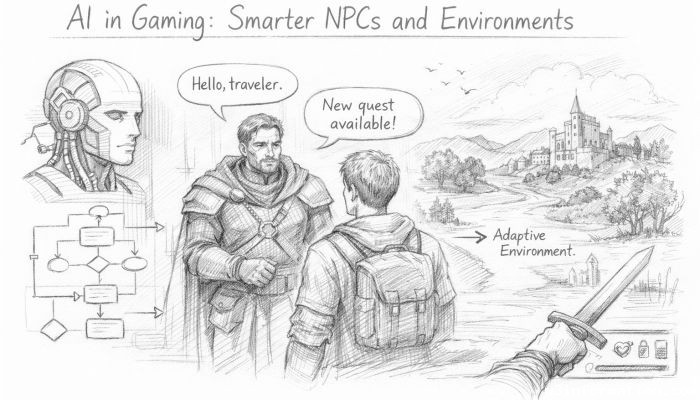 AI in Gaming: Smarter NPCs and Environments
 Understanding Bias in AI Algorithms
 Introduction to Chatbots and Conversational AI
 How Voice Assistants Like Alexa Work
 Federated Learning: AI Without Sharing Data