How to Build a Career in Machine Learning and AI
Careers in Machine Learning (ML) and Artificial Intelligence (AI) have become some of the most sought-after and lucrative in the modern tech industry. With the rise of automation, digital transformation, and data-driven decision-making, ML and AI are revolutionizing fields such as healthcare, finance, transportation, entertainment, and more. At the forefront of these advances are machine learning and AI professionals who design, build, and maintain intelligent systems that can learn from data and solve complex problems. For tech-savvy individuals with a passion for problem-solving, math, and programming, a career in ML and AI can be both personally and professionally rewarding. However, breaking into this highly-competitive and rapidly-evolving industry requires more than just interest and enthusiasm: it also demands a strong educational foundation, relevant experience, continuous learning, and strategic networking. In this article, we will explore the essential steps to take on the path to a successful career in machine learning and AI, from building technical and mathematical skills to pursuing specialized training and certifications. Whether you are a recent graduate, a seasoned professional, or a career-changer, this guide will help you gain a deeper understanding of the field and position yourself for success in the ML/AI industry.
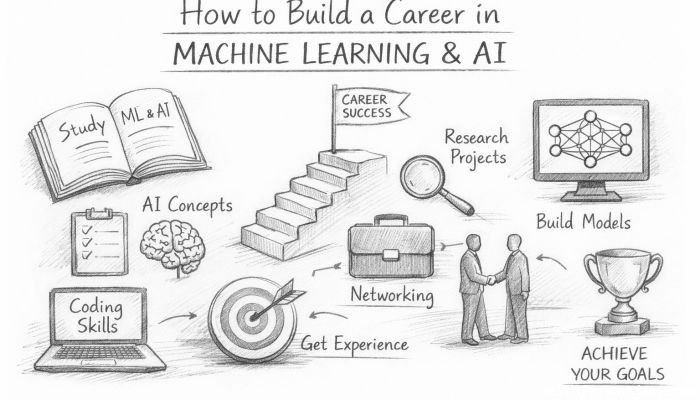
- Understand the Fundamentals of Machine Learning and AI
- Develop Strong Mathematical and Statistical Skills
- Learn Programming Languages and Tools
- Pursue Formal Education and Online Learning
- Build Hands-on Experience with Projects
- Learn About Data Engineering and Data Wrangling
- Specialize in a Subfield of AI
- Build a Professional Network and Community Engagement
- Gain Internship and Job Experience
- Stay Up-to-Date with Emerging Trends and Continuous Learning
- Develop Soft Skills and Cross-Disciplinary Knowledge
- Explore Career Paths and Advancement Opportunities
- Conclusion
- More Related Topics
Understand the Fundamentals of Machine Learning and AI
Before diving into a career in ML and AI, it’s essential to have a strong understanding of the fundamental concepts and principles underlying these fields. Machine learning is a subfield of AI that focuses on algorithms and models that can learn from data and make predictions or decisions based on patterns discovered in that data. AI, on the other hand, is a broader field that encompasses any technique or system that simulates human intelligence or decision-making processes. Familiarize yourself with the concepts of supervised, unsupervised, and reinforcement learning, as well as deep learning, neural networks, and other core ML algorithms and techniques. Keep up with the latest trends and research in the field through blogs, podcasts, research papers, and conferences.
Develop Strong Mathematical and Statistical Skills
Machine learning and AI heavily rely on mathematics and statistics. Therefore, it is essential to have a solid foundation in mathematical and statistical concepts to understand the algorithms and models used in these fields. Essential topics include linear algebra, calculus, probability, statistics, optimization, and discrete mathematics. Learning how to work with matrices, gradients, and probability distributions is crucial to understanding how ML algorithms operate under the hood.
Learn Programming Languages and Tools
Programming is an indispensable skill for machine learning and AI professionals. While many ML and AI systems are built using Python, other languages like R, Java, C++, and Julia are also commonly used. Learn how to write clean, efficient, and scalable code, and familiarize yourself with popular ML and AI libraries, such as NumPy, Pandas, Scikit-Learn, TensorFlow, PyTorch, and Keras. Additionally, gain experience with cloud platforms such as AWS, Google Cloud, and Microsoft Azure, as well as version control systems such as Git.
Pursue Formal Education and Online Learning
While some machine learning and AI professionals are self-taught, most successful practitioners have some form of formal education or training. Pursuing a degree in computer science, data science, statistics, or a related STEM field is an excellent starting point for building a career in ML and AI. Additionally, many online platforms offer courses and nanodegrees in machine learning and AI from top universities and industry leaders, such as Coursera, edX, Udacity, and others. These online courses can help you gain specialized knowledge and skills at your own pace.
Build Hands-on Experience with Projects
Machine learning and AI are highly practical fields, and gaining hands-on experience is crucial to building a successful career. Work on projects that apply ML algorithms to real-world datasets, experiment with different models and techniques, and learn from both successes and failures. Building a portfolio of projects can help you demonstrate your skills and capabilities to potential employers and collaborators. Participate in competitions on platforms such as Kaggle, and contribute to open-source projects to gain practical experience and exposure.
Learn About Data Engineering and Data Wrangling
Data is the lifeblood of machine learning and AI, and understanding how to work with data is a critical skill for practitioners in these fields. Data engineering and data wrangling involve collecting, cleaning, preprocessing, and transforming data into a usable format for training and testing ML models. Learn about data pipelines, databases, SQL, and data cleaning techniques such as normalization, imputation, and feature engineering.
Specialize in a Subfield of AI
AI is a vast field with many subfields and specializations, each with its own set of challenges, techniques, and applications. Specializing in a particular subfield, such as computer vision, natural language processing, robotics, or reinforcement learning, can help you gain deeper expertise and open up new opportunities. Identifying the areas of AI that align with your interests and career goals can guide your learning and specialization.
Build a Professional Network and Community Engagement
Networking is a critical aspect of building a career in ML and AI. Engaging with professional communities, attending conferences and meetups, and connecting with like-minded individuals can help you stay current on the latest trends, find mentors and collaborators, and discover job opportunities. Join online communities on platforms such as Reddit, Stack Overflow, LinkedIn, and Discord, and consider contributing to open-source projects, writing blogs, or presenting your work at conferences to establish yourself as a thought leader.
Gain Internship and Job Experience
Internships and entry-level jobs provide invaluable experience and help you gain a better understanding of the industry and the practical applications of ML and AI. Many companies, startups, and research labs offer internships and training programs specifically designed for aspiring ML and AI professionals. Apply for internships, entry-level jobs, or freelance projects that allow you to gain industry-relevant experience and apply your skills to real-world problems.
Stay Up-to-Date with Emerging Trends and Continuous Learning
Machine learning and AI are rapidly-evolving fields, and it’s critical to stay current on the latest trends, techniques, and tools to remain relevant. Follow leading research journals, attend webinars and MOOCs, experiment with new tools and frameworks, and keep learning and growing your skills. Additionally, keeping up with ethical, legal, and societal issues surrounding AI and automation is becoming increasingly important.
Develop Soft Skills and Cross-Disciplinary Knowledge
In addition to technical skills, ML and AI professionals also need strong communication, collaboration, and problem-solving skills. The ability to explain complex technical concepts to non-technical stakeholders and work with others across disciplines is crucial. Cross-disciplinary knowledge of the business domain, customer needs, and industry-specific applications of AI can also help you apply ML solutions effectively. Additionally, developing an entrepreneurial mindset and creativity can help you find new ways to use AI and ML to solve problems.
Explore Career Paths and Advancement Opportunities
Careers in ML and AI are diverse, and there are many potential career paths for skilled and experienced professionals. Some common roles include ML engineer, data scientist, AI researcher, AI product manager, and AI ethics specialist, to name a few. Understanding these roles and how they fit into the broader AI ecosystem can help you align your learning and experience with your career goals. Climbing the career ladder may involve moving from a technical contributor to a leadership position, such as team lead, project manager, or even chief AI officer. Building expertise in emerging areas and industries can also open new career opportunities and advancement potential.
Conclusion
Building a successful career in machine learning and AI requires a combination of technical and mathematical skills, practical experience, and a commitment to continuous learning and development. By following the steps outlined in this article, from gaining a strong foundational understanding of the field to pursuing specialized training and certification, aspiring ML and AI professionals can position themselves for success in this rapidly-evolving and highly-competitive industry. Whether you are just starting your journey or looking to advance your career, this guide can help you gain a better understanding of the field, hone your skills and expertise, and build a fulfilling and rewarding career in machine learning and AI.
 How to Make the Most of Your Holiday Break
 The Best Winter Destinations for a Cozy Getaway
 How to Organize Your Holiday Travel Plans with Ease
 The Ultimate Guide to Cooking for a Crowd
 How to Make Healthy Comfort Food Without the Guilt
 5 Delicious Vegan Breakfast Ideas You Can Make in Minutes