What Is Edge Computing and Why Is It Important?
In an age of digital transformation, businesses and organizations are always seeking solutions that will enable them to analyze and process data in the most efficient manner. With the increasing number of connected devices, massive data volumes, and real-time processing requirements, traditional cloud computing is reaching its limits in terms of speed and latency. However, there is a new technology on the horizon that promises to revolutionize the way we think about data processing and analysis: edge computing.
Edge computing is a cutting-edge technology that is gaining increasing attention in the tech world. It involves processing and analyzing data closer to where it is generated, at the “edge” of the network, rather than sending it to centralized cloud servers. This shift in approach has the potential to significantly improve the speed and efficiency of data processing, with benefits including lower latency, reduced bandwidth usage, and increased security. Whether you’re a business owner looking to improve the performance of your applications, or an IT professional seeking to stay on top of the latest trends in the tech industry, it’s essential to have a thorough understanding of edge computing.
Understanding Edge Computing: The Basics
a. What Is Edge Computing?
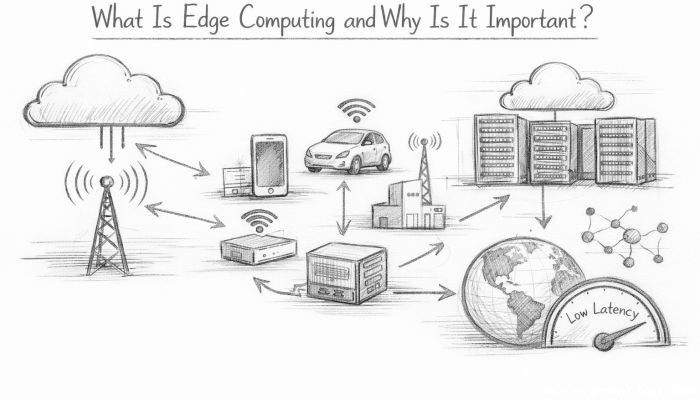
Edge computing is a distributed computing framework that involves bringing computation and data storage closer to the location where it is needed, instead of relying on centralized data centers. In traditional cloud computing, data is sent to centralized servers located far away from the device or sensor generating the data. With edge computing, however, the data is processed locally – at the “edge” of the network – reducing the need for data transmission to distant data centers.
This decentralized approach to computing allows for faster decision-making, real-time analysis, and reduced dependence on bandwidth, making it ideal for applications that require low latency. Some common examples of edge computing include autonomous vehicles, industrial IoT, smart cities, and more.
b. How Does Edge Computing Work?
In an edge computing system, data is collected by devices such as sensors, cameras, and IoT devices. This data is then processed locally, either on the device itself or on nearby edge servers (often located in local networks or on-premise). The processed data may then be sent to the cloud or central servers only for further analysis or long-term storage.
Edge computing thus reduces the need to transmit large volumes of raw data to remote cloud data centers, saving bandwidth and enabling faster response times. It is particularly useful in scenarios where instant analysis and action are required, such as real-time decision-making in industrial automation, health monitoring, and more.
Key Benefits of Edge Computing
a. Reduced Latency and Faster Decision-Making
Edge computing is able to reduce latency by processing data closer to its source. Since the data does not have to be transmitted over long distances to remote servers, there is less time delay, making it easier to make quicker and more informed decisions. This is especially important in industries such as self-driving cars, industrial robots, and smart healthcare, where speed and accuracy are crucial.
For example, in the case of autonomous vehicles, edge computing allows for real-time processing of data from cameras and sensors, enabling the car to make split-second decisions without having to wait for data to travel to a distant cloud server.
b. Bandwidth Efficiency and Cost Savings
By processing data at the source, edge computing helps to reduce the burden on bandwidth that is required to send data to centralized cloud servers. This can result in cost savings for businesses, as they do not have to pay as much for bandwidth and data transfer fees. In addition, by reducing the amount of data that needs to be transmitted, edge computing also makes it easier to handle large amounts of data, which can be particularly beneficial for industries that generate massive volumes of data, such as video surveillance and manufacturing.
c. Improved Security and Privacy
Edge computing can also offer improved security and privacy by processing sensitive data locally, rather than transmitting it over the internet where it could be vulnerable to breaches or attacks. By keeping critical data within local networks and devices, businesses have greater control over access and security protocols. In addition, edge computing can be configured with strong encryption and authentication measures to further enhance data privacy.
d. Reliability and Resilience
Edge computing can also be more reliable and resilient than centralized cloud computing, since it can continue to operate even if the connection to the cloud is lost or interrupted. This can be particularly useful in remote or rural areas where network connectivity may be less stable. For example, in agriculture, IoT sensors can be deployed in remote fields to collect data on weather conditions, soil moisture, and crop growth. By processing this data on-site using edge computing, farmers can receive real-time insights even if they are not connected to the central network.
Real-World Applications of Edge Computing
a. Internet of Things (IoT)
IoT is one of the primary drivers of edge computing. With millions of connected devices generating data, sending all of this information to the cloud for processing would create a bottleneck in the network and result in significant delays. By processing data locally on IoT devices, edge computing enables faster responses and reduces network congestion.
IoT industries such as manufacturing, smart homes, and agriculture have been particularly quick to adopt edge computing, as it enables real-time data collection and analysis for automation and optimization. For example, in a smart home, edge computing can be used to control lighting, temperature, and security systems without relying on cloud-based services.
b. Autonomous Vehicles
Self-driving cars are one of the most exciting applications of edge computing. Autonomous vehicles require a range of sensors, cameras, and radar systems to gather data in real-time. To make decisions on the road, this data must be processed locally to minimize latency and ensure that the vehicle can react instantly to changes in the environment.
Edge computing enables vehicles to process sensor data on the spot, allowing for real-time decision-making and improved safety. For instance, if an obstacle is detected on the road, the car can react immediately without having to wait for cloud-based data processing.
c. Smart Cities
Smart cities use edge computing to manage infrastructure, traffic, utilities, and security in real-time. For instance, smart traffic lights with sensors can analyze traffic patterns and adjust light timings based on current conditions, improving traffic flow and reducing congestion.
Edge computing is also used in public safety, where local surveillance cameras and IoT devices can process data instantly to detect unusual activities or emergencies. This reduces the time it takes for authorities to respond to incidents and enhances the overall efficiency of city operations.
d. Healthcare and Telemedicine
Edge computing is being used in healthcare to revolutionize patient monitoring and diagnostics. Wearable devices that track vital signs such as heart rate and blood pressure can analyze data locally and provide instant feedback.
In telemedicine, edge computing enables doctors to receive high-quality medical data in real-time, improving the speed and accuracy of remote consultations and diagnostics. This is particularly useful in emergency situations where immediate responses are required.
Challenges of Edge Computing
a. Scalability and Management
Managing a large number of edge devices can be challenging, particularly when they are distributed across different locations. Edge computing requires distributed management of multiple devices, each with its own processing power and storage capacity. This can be difficult to scale and manage effectively compared to centralized cloud environments where data and processes are managed in a single location.
Businesses need robust management platforms to monitor, maintain, and secure their edge devices. Edge orchestration tools are being developed to make these tasks easier, but scalability remains a key concern.
b. Data Synchronization
Ensuring that data is consistent and up-to-date across all edge devices and the central cloud or other edge nodes can be challenging in edge computing. Inconsistent or outdated data could lead to incorrect decisions, particularly in real-time applications like autonomous vehicles and industrial automation.
Developers must implement reliable synchronization techniques to ensure data flows seamlessly between the edge and the cloud. This requires sophisticated network infrastructure and protocols.
c. Security Risks
While edge computing can enhance security by processing data locally, it also introduces new vulnerabilities. The more devices you have on the edge, the more potential points of entry there are for cyberattacks. Each device must be properly secured, and robust encryption methods must be in place to protect sensitive data.
Businesses must adopt comprehensive security strategies, including device authentication, data encryption, and real-time monitoring to safeguard their edge computing infrastructure.
The Future of Edge Computing
As technology continues to evolve, edge computing is poised to play an even more significant role in the digital landscape. With the rise of 5G networks, edge computing will become even more powerful, enabling faster and more efficient processing of data at the edge. The low latency and high-speed connectivity offered by 5G will be a game-changer for real-time applications, particularly in industries like healthcare, autonomous vehicles, and smart cities.
Moreover, as artificial intelligence and machine learning continue to advance, edge computing will enable smarter devices that can make real-time decisions without relying on cloud-based processing. This shift will open up new possibilities for industries to operate more efficiently and autonomously.
Conclusion
Edge computing is transforming the way we process and analyze data, providing faster, more efficient solutions to the challenges of connected devices and real-time decision-making. By moving computation closer to the source of data, businesses can experience lower latency, reduced bandwidth, and increased security. While there are challenges such as scalability and management to consider, the benefits of edge computing are clear and its role in the future of technology is certain.
As industries continue to embrace this technology, we can expect to see more innovative applications in a variety of sectors, from autonomous vehicles and healthcare to smart cities and IoT. By staying informed about and leveraging the power of edge computing, businesses can stay ahead of the curve, offering faster, more reliable services and improving their bottom line.
 How to Make the Most of Your Holiday Break
 The Best Winter Destinations for a Cozy Getaway
 How to Organize Your Holiday Travel Plans with Ease
 The Ultimate Guide to Cooking for a Crowd
 How to Make Healthy Comfort Food Without the Guilt
 5 Delicious Vegan Breakfast Ideas You Can Make in Minutes