Functional Programming Explained with Examples
Functional programming (FP) has steadily gained traction among software developers and computer scientists for its distinctive approach to coding. Unlike imperative programming paradigms that revolve around changing program state and mutable data, functional programming emphasizes immutability, pure functions, and declarative code. This paradigm fosters writing code that is more predictable, easier to test, and often simpler to parallelize, all qualities highly valued in modern software development. Whether you are a beginner learning the fundamentals or an experienced coder exploring new paradigms, understanding functional programming offers a fresh perspective on managing complexity in software systems. In this article, we will delve deep into the core concepts of functional programming, illustrate them with practical examples, and explore how they impact everyday coding.
- What is Functional Programming?
- Pure Functions: The Heart of Functional Programming
- Immutability: Keeping Data Constant
- Higher-Order Functions: Functions as First-Class Citizens
- Recursion: Iteration Without Loops
- Referential Transparency: Reliable Expressions
- Lazy Evaluation: Computing Only When Needed
- Pattern Matching: Cleaner Code for Data Decomposition
- Function Composition: Building More Complex Functions
- Side Effects and Functional Purity: Managing Effects
- Benefits of Functional Programming
- Real-World Examples and Applications
- Conclusion
- More Related Topics
What is Functional Programming?
Functional programming is a programming paradigm that treats computation as the evaluation of mathematical functions. Unlike procedural programming, which relies on sequences of commands to change program states, FP avoids mutable state and side effects. Programs are constructed by composing pure functions—functions that consistently produce the same output for the same inputs without altering anything outside their scope. This paradigm finds its roots in lambda calculus and was historically championed by languages such as Lisp, Haskell, and ML. Functional programming emphasizes declarative code, focusing on what to solve rather than how to solve it.

Pure Functions: The Heart of Functional Programming
A pure function is a function that always produces the same output given the same input and has no side effects, such as modifying a global variable or performing I/O operations. This predictability makes reasoning about code easier and enables safer concurrent execution. For example, in JavaScript:
```javascript
function add(a, b) {
return a + b;
}
```
The `add` function is pure since it doesn’t modify state and consistently returns the sum of two numbers. Pure functions enable easier testing, debugging, and parallelization because they don't depend on or alter the external environment.
Immutability: Keeping Data Constant
Immutability means that once a data structure is created, it cannot be changed. Instead of modifying data in place, functional programming creates new data structures with the desired changes. This avoids unintended side effects and potential bugs related to shared state. Many functional languages default to immutable data. For example, in Haskell, all data is immutable by default, while in JavaScript, you can use libraries like Immutable.js or patterns that favor `const` and copying data structures to maintain immutability:
```javascript
const arr = [1, 2, 3];
const newArr = [...arr, 4]; // creates a new array without modifying the original
```
Immutability simplifies reasoning about program state, especially in distributed or concurrent systems.
Higher-Order Functions: Functions as First-Class Citizens
Functional programming treats functions as first-class citizens, meaning they can be assigned to variables, passed as arguments, and returned from other functions. Higher-order functions take other functions as inputs or output them. This enables abstraction and code reuse. For example, the `map` function applies a given function to each item in an array:
```javascript
const numbers = [1, 2, 3];
const doubled = numbers.map(x => x * 2); // [2, 4, 6]
```
Here, `map` is a higher-order function that takes another function `x => x * 2` and applies it to each element, showcasing flexibility and expressiveness in FP.
Recursion: Iteration Without Loops
Functional programming heavily uses recursion as a substitute for iterative loops found in imperative languages. Since mutable loop counters and state-changing variables are avoided, recursion naturally fits the functional style. For example, computing the factorial of a number recursively in Haskell looks like this:
```haskell
factorial 0 = 1
factorial n = n * factorial (n - 1)
```
Recursion provides a means to process lists, trees, and other data structures elegantly, though care is required to avoid stack overflow in languages without tail call optimization.
Referential Transparency: Reliable Expressions
Referential transparency means that an expression can be replaced with its corresponding value without changing the program’s behavior. This property stems from pure functions and immutability, making code easier to reason about. For example, if `f(x) = 2*x`, then every occurrence of `f(3)` can be replaced by `6` without altering the program’s meaning. This leads to optimizations such as memoization and easier parallel execution.
Lazy Evaluation: Computing Only When Needed
Some functional languages like Haskell adopt lazy evaluation, computing values only when they are needed. This can improve performance by avoiding unnecessary calculations and allows defining infinite data structures. For example, the infinite list of natural numbers can be defined as:
```haskell
naturals = [0..]
take 10 naturals -- takes first 10 numbers from the infinite list
```
Lazy evaluation combines well with immutability and pure functions to provide efficient and expressive programs but requires understanding to avoid subtle bugs related to delayed computation.
Pattern Matching: Cleaner Code for Data Decomposition
Pattern matching is a mechanism to destructure data based on its shape, allowing concise and readable control flow. It replaces verbose conditional statements or switch-case constructs. Consider this simple example in Haskell to sum the elements of a list:
```haskell
sumList [] = 0
sumList (x:xs) = x + sumList xs
```
Here, `(x:xs)` matches the head and tail of the list. Pattern matching enhances readability and enforces exhaustive handling of possible cases.
Function Composition: Building More Complex Functions
Function composition is the process of combining two or more functions to produce a new function. It promotes modularity and code reuse. In many functional languages, the composition operator (often written as `.` or `compose`) applies functions right-to-left. For instance:
```javascript
const double = x => x * 2;
const increment = x => x + 1;
const doubleThenIncrement = x => increment(double(x));
console.log(doubleThenIncrement(3)); // outputs 7
```
Composing smaller, well-defined functions helps create clearer, more maintainable codebases
Side Effects and Functional Purity: Managing Effects
While pure functions are central to FP, real-world applications invariably require side effects like reading files, network requests, or updating a UI. Functional programming advocates isolating side effects from pure logic. For example, languages like Haskell provide constructs such as monads to manage side effects in a controlled manner. This separation leads to better testability and easier debugging by clearly distinguishing pure logic from effectful operations.
Benefits of Functional Programming
Functional programming offers numerous advantages: easier reasoning about code due to pure functions and immutability; safer concurrent and parallel programming as data races reduce; improved modularity through first-class functions and composition; and enhanced code reusability and testability. Additionally, because FP emphasizes declarative style, programs tend to be more concise and expressive, focusing on what needs to be done rather than how. Many modern languages, including JavaScript, Python, Scala, and Kotlin, have adopted FP concepts, showcasing their practical value.
Real-World Examples and Applications
Functional programming is widely used in domains requiring correctness and reliability, such as finance, data science, and big data processing. Frameworks like Apache Spark use functional operations like map, reduce, and filter for distributed data processing. Furthermore, reactive programming paradigms employ FP principles for managing asynchronous data streams. Learning FP enhances your ability to work with these technologies and write robust, maintainable code in modern software development environments.
Conclusion
Functional programming redefines how we think about code, shifting focus from mutable state and step-by-step instructions to declarative problem-solving with pure functions and immutable data. By embracing concepts like pure functions, immutability, higher-order functions, recursion, and lazy evaluation, developers can write more predictable, testable, and scalable software. While the paradigm may initially challenge programmers accustomed to imperative styles, its principles bring clarity and robustness to complex applications. As software systems grow increasingly concurrent and distributed, functional programming’s benefits become all the more compelling. Incorporating even elements of functional programming into your coding toolkit can yield immediate dividends in code quality and maintainability.
 Big O Notation Explained for Beginners
 AI in Gaming: Smarter NPCs and Environments
 Understanding Bias in AI Algorithms
 Introduction to Chatbots and Conversational AI
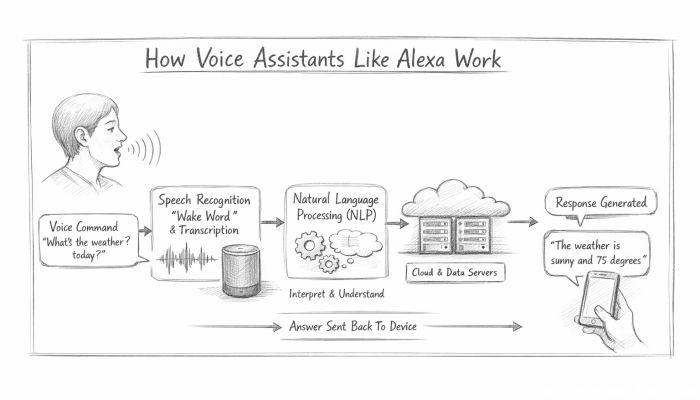 How Voice Assistants Like Alexa Work
 Federated Learning: AI Without Sharing Data