The Role of AI in Autonomous Vehicles
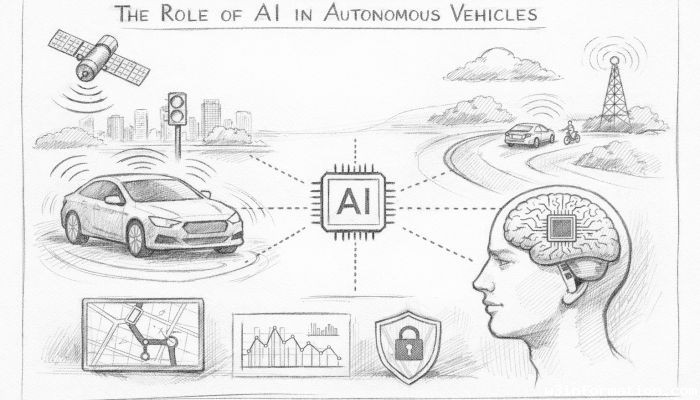
The evolution of autonomous vehicles has emerged as one of the most transformative trends in modern technology, promising to reshape how we commute, deliver goods, and interact with transportation systems. At the heart of this revolution lies Artificial Intelligence (AI), a powerful force that enables vehicles to perceive their environment, make complex decisions, and operate safely without human intervention. This intersection of AI and autonomous mobility not only epitomizes cutting-edge innovation but also raises vital questions about safety, ethics, and societal impact. In this article, we explore the multifaceted role of AI in autonomous vehicles, detailing the technologies, challenges, and opportunities that define this rapidly advancing field. From sensor integration and data processing to machine learning algorithms and real-world deployment, we delve into how AI drives the future of self-driving cars.
- Understanding Autonomous Vehicles and Artificial Intelligence
- Sensor Technologies: The Eyes and Ears of AI
- Computer Vision: Teaching Vehicles to See
- Machine Learning and Decision-Making
- Localization and Mapping: Knowing Where You Are
- Predictive Analytics: Anticipating the Actions of Others
- Real-Time Processing and Edge Computing
- Safety and Reliability: The AI Imperative
- Ethical Considerations and AI Decision Frameworks
- Regulatory Landscape and AI Compliance
- Challenges in AI-Driven Autonomous Vehicles
- The Future Outlook: AI and Autonomous Mobility
- Conclusion
- More Related Topics
Understanding Autonomous Vehicles and Artificial Intelligence
Autonomous vehicles, often referred to as self-driving or driverless cars, are equipped to navigate and operate roads without human input. While the concept relies heavily on hardware like sensors and actuators, AI provides the computational intelligence required to interpret complex driving environments. AI encompasses a range of technologies, including machine learning, computer vision, natural language processing, and decision-making algorithms. Combined, these enable an autonomous vehicle to understand its surroundings, predict the behavior of other road users, and make real-time driving decisions. This synergy transforms vehicles from simple machines into intelligent agents capable of learning and adapting.
Sensor Technologies: The Eyes and Ears of AI
Before AI can process information, autonomous vehicles must gather vast amounts of data from their surroundings. Sensors such as LiDAR (Light Detection and Ranging), radar, cameras, and ultrasonic devices collect detailed environmental inputs. LiDAR, for example, creates high-resolution 3D maps by measuring distances with laser light, while radar excels in detecting objects at long range regardless of visibility conditions. Cameras provide rich visual data, critical for recognizing traffic signals, pedestrians, and other road signs. These sensors generate raw data that AI systems then analyze to form a comprehensive understanding of the vehicle’s context, enabling safe and precise navigation.
Computer Vision: Teaching Vehicles to See
Computer vision algorithms play a central role in interpreting the visual data collected by cameras and other sensors. Using techniques such as image recognition and semantic segmentation, AI systems identify various objects on the road—vehicles, cyclists, pedestrians, lane markings, and traffic signs. Deep learning models, particularly convolutional neural networks (CNNs), have revolutionized this field by improving accuracy and real-time processing capabilities. By effectively “seeing” the environment, autonomous vehicles gain the perceptual awareness essential for confident maneuvering in complex traffic scenarios.
Machine Learning and Decision-Making
Once data is gathered and interpreted, autonomous vehicles need to decide the best course of action. This decision-making process is underpinned by machine learning algorithms that analyze patterns, predict future events, and weigh possible outcomes. Reinforcement learning, a subset of machine learning, allows vehicles to improve their driving strategies by receiving feedback from their actions. For instance, an AI might learn to adjust following distances or merge lanes more smoothly based on experiential data. This continuous learning helps enhance safety, efficiency, and adaptability, particularly when confronting unpredictable road conditions.
Localization and Mapping: Knowing Where You Are
Accurate localization is critical for autonomous navigation. AI integrates sensor data with advanced mapping techniques to determine a vehicle’s precise position on the road. High-definition (HD) maps rich in detail about road geometry, traffic rules, and fixed landmarks complement GPS signals, which can be unreliable or imprecise. Simultaneous Localization and Mapping (SLAM) technology allows vehicles to build and update maps of their surroundings in real-time, especially useful in unfamiliar or dynamic environments. Through this fusion of data, AI maintains situational awareness and ensures that autonomous vehicles stay on the correct path.
Predictive Analytics: Anticipating the Actions of Others
Road safety depends not only on understanding the present environment but also on anticipating future events. AI systems employ predictive analytics to forecast the behaviors of pedestrians, vehicles, and other dynamic agents. By analyzing movement patterns, velocities, and traffic context, these algorithms estimate probable trajectories and prepare responses accordingly. For example, if a pedestrian approaches a curb, the AI can predict the likelihood of crossing and adjust the vehicle’s speed or trajectory proactively. This predictive capability is essential for smooth integration of autonomous vehicles into human-dominated traffic ecosystems.
Real-Time Processing and Edge Computing
Autonomous driving requires split-second decision-making, necessitating fast and reliable processing of sensor data. This real-time analysis is often handled through edge computing, where data processing occurs within the vehicle rather than relying heavily on cloud servers. Onboard AI chips and specialized hardware allow rapid computation without latency, crucial for safety-critical functions such as emergency braking or obstacle avoidance. Real-time AI ensures the vehicle responds promptly to sudden changes, such as a child running into the street or unexpected road debris.
Safety and Reliability: The AI Imperative
Safety lies at the core of autonomous vehicle deployment, and AI plays a pivotal role in achieving and maintaining high reliability standards. AI systems undergo rigorous testing and validation, often using simulation environments that replicate millions of possible driving scenarios. Moreover, redundancy is built into AI architectures, with multiple sensors and backup algorithms ensuring continuous operation despite failures. Safety also draws upon AI’s ability to recognize anomalies or system malfunctions and safely bring a vehicle to a halt if necessary. Trust in AI-driven safety mechanisms is crucial for public acceptance and regulatory approval.
Ethical Considerations and AI Decision Frameworks
Autonomous vehicles raise complex ethical questions that AI must navigate, such as how to prioritize lives in unavoidable accident scenarios or how to handle privacy concerns related to data collection. AI decision frameworks are designed to balance competing moral imperatives, often guided by predefined ethical principles codified into the vehicle’s control systems. Researchers and policymakers continue to debate approaches to these dilemmas, emphasizing the importance of transparency and accountability in AI decision-making. Ethical AI in autonomous vehicles remains an evolving frontier reflecting broader societal values.
Regulatory Landscape and AI Compliance
The integration of AI in autonomous vehicles is heavily influenced by regulatory policies that ensure safety, security, and interoperability standards. Governments worldwide are working on frameworks that dictate how AI systems must perform, be tested, and report incidents. Compliance with these regulations requires AI developers to maintain meticulous documentation and implement safeguards against cybersecurity threats. AI-driven autonomous vehicles must demonstrate adherence to local traffic laws while offering traceable evidence of their operational decisions, paving the way for legal clarity and consumer protection.
Challenges in AI-Driven Autonomous Vehicles
Despite rapid progress, several challenges persist in deploying AI for autonomous driving. These include handling rare or unusual traffic situations, environmental factors such as extreme weather that degrade sensor performance, and ensuring robustness against adversarial attacks that might trick AI models. Data scarcity in certain scenarios and the difficulty of transferring AI learning from simulations to real-world conditions also hinder scalability. Addressing these challenges requires ongoing research and collaboration across industry, academia, and regulatory bodies.
The Future Outlook: AI and Autonomous Mobility
The future of autonomous vehicles is tightly linked with continuous advances in AI. Upcoming developments in explainable AI aim to clarify how vehicles make decisions, enhancing trust and transparency. Integration with smart city infrastructure, 5G communication, and vehicle-to-everything (V2X) technology promises even greater situational awareness and coordination. As AI evolves, autonomous vehicles are expected not only to reduce accidents and improve traffic flow but also to redefine urban landscapes, reshape public transport, and open new possibilities for mobility as a service.
Conclusion
AI stands as the cornerstone of autonomous vehicle technology, transforming raw data into actionable intelligence that drives vehicles safely and efficiently. Through sophisticated sensing, perception, learning, and decision-making capabilities, AI enables autonomous cars to operate in complex, dynamic environments that challenge traditional driving paradigms. While still grappling with technical, ethical, and regulatory hurdles, the ongoing synergy between AI innovation and automotive engineering heralds a profound shift toward smarter, safer, and more accessible transportation. As this field matures, the promise of autonomous vehicles powered by AI is not simply about automation—it is about reimagining mobility for a more sustainable and connected world.
 How to Make the Most of Your Holiday Break
 The Best Winter Destinations for a Cozy Getaway
 How to Organize Your Holiday Travel Plans with Ease
 The Ultimate Guide to Cooking for a Crowd
 How to Make Healthy Comfort Food Without the Guilt
 5 Delicious Vegan Breakfast Ideas You Can Make in Minutes