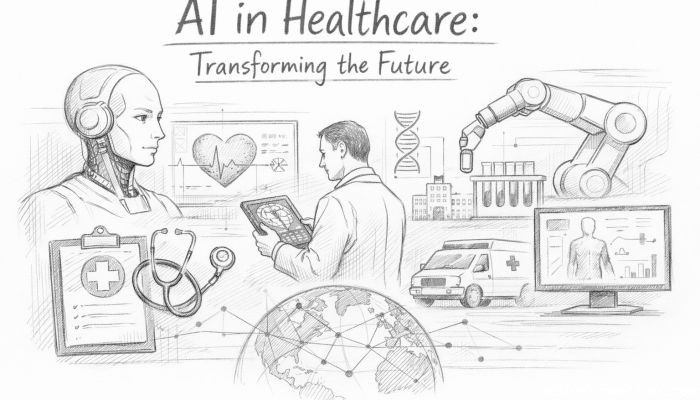
AI in Healthcare: Transforming the Future
Artificial Intelligence (AI) is revolutionizing industries worldwide, and healthcare stands at the forefront of this technological transformation. As healthcare systems face increasing demands, rising costs, and the ever-growing complexity of medical data, AI offers promising solutions to enhance efficiency, improve patient outcomes, and reduce errors. From predictive analytics and personalized medicine to robotic surgeries and virtual health assistants, AI innovations are redefining how we diagnose, treat, and manage diseases. This article delves into the multifaceted role of AI in healthcare, exploring its applications, benefits, challenges, and future prospects. By understanding the integration of AI in medicine, healthcare professionals, policymakers, and patients alike can appreciate how this powerful technology is shaping a healthier tomorrow.
- Understanding AI and Its Relevance in Healthcare
- AI in Medical Imaging and Diagnostics
- Enhancing Precision Medicine through AI
- AI-Powered Predictive Analytics in Healthcare
- Virtual Health Assistants and Chatbots
- Robotic Surgery: Precision and Minimal Invasiveness
- AI in Drug Discovery and Development
- Managing Healthcare Operations with AI
- Ethical Considerations and Challenges of AI in Healthcare
- The Role of AI in Global Health and Accessibility
- AI and the Future of Healthcare Professionals
- Emerging Trends and the Road Ahead for AI in Healthcare
- Conclusion
- More Related Topics
Understanding AI and Its Relevance in Healthcare
Artificial Intelligence refers to computer systems' ability to perform tasks that typically require human intelligence, such as learning, reasoning, problem-solving, and natural language processing. In healthcare, AI harnesses massive datasets—from patient records and medical imaging to genomic data—to uncover insights unavailable to human practitioners alone. Its relevance in healthcare lies in augmenting clinical decisions, optimizing operational workflows, and personalizing therapies. Machine learning algorithms, a subset of AI, analyze patterns and make predictions that can identify disease risks or suggest treatment options. Natural language processing (NLP) helps in interpreting unstructured data like clinical notes, thus making vast amounts of information accessible and actionable.
AI in Medical Imaging and Diagnostics
One of AI’s earliest and most impactful applications in healthcare is in medical imaging. AI-powered tools can detect anomalies in X-rays, MRIs, CT scans, and ultrasounds with remarkable accuracy. Algorithms trained on thousands of images can identify subtle patterns indicative of cancer, fractures, or other conditions, often outperforming human radiologists in speed and sometimes precision. This capability not only aids early diagnosis but also reduces human error. Additionally, AI algorithms assist in automating image segmentation and quantification tasks, freeing radiologists to focus on complex cases and patient care.
Enhancing Precision Medicine through AI
Precision medicine aims to tailor medical treatment to individual characteristics such as genetics, lifestyle, and environment. AI facilitates this personalized approach by integrating and analyzing diverse datasets, including genomic sequences, biomarker profiles, and electronic health records. Machine learning models can predict patient responses to therapies, identify suitable drug candidates, and optimize dosing regimens, improving treatment efficacy while minimizing adverse effects. This has particular significance in oncology, where AI-driven genomic analysis helps oncologists design targeted therapies that improve survival rates and quality of life.
AI-Powered Predictive Analytics in Healthcare
Predictive analytics uses historical and real-time data to forecast future outcomes, enabling proactive healthcare interventions. AI models analyze patterns to predict disease outbreaks, patient readmission risks, and the progression of chronic illnesses like diabetes or cardiovascular disease. Hospitals utilize predictive tools to manage resource allocation, schedule staffing efficiently, and reduce emergency department overcrowding. For patients, AI can predict deteriorations, prompting timely medical attention that may prevent hospitalization. This proactive care model enhances patient safety and reduces healthcare costs.
Virtual Health Assistants and Chatbots
Virtual health assistants and chatbots, powered by AI, are transforming patient engagement and healthcare delivery. These digital tools provide around-the-clock support, answering medical queries, scheduling appointments, reminding patients about medication adherence, and triaging symptoms to determine urgency. By easing administrative burdens on healthcare staff, they improve workflow efficiency while delivering timely information to patients. Moreover, they increase accessibility, particularly for individuals in remote areas or with limited healthcare access, ensuring continuity of care beyond traditional clinical settings.
Robotic Surgery: Precision and Minimal Invasiveness
Robotic surgery integrates AI and robotics to enhance surgical precision, flexibility, and control. Surgeons use AI-assisted robotic systems to perform minimally invasive procedures, reducing trauma, blood loss, and recovery time. AI algorithms in these systems provide real-time analytics and movement optimization, improving surgical outcomes. Moreover, AI aids in preoperative planning by simulating procedures and identifying potential complications. As these technologies advance, they are expanding the scope of complex surgeries feasible through minimally invasive techniques, benefiting patients with faster healing and fewer complications.
AI in Drug Discovery and Development
The drug discovery process is traditionally long, costly, and fraught with high failure rates at various stages. AI is streamlining this journey by rapidly analyzing biological data, predicting molecule interactions, and identifying promising drug candidates. Machine learning models analyze vast chemical libraries to suggest compounds with high efficacy and low toxicity, accelerating preclinical research. AI also optimizes clinical trial design by identifying suitable patient cohorts and monitoring treatment responses in real time. Such advancements hold the promise of bringing new therapies to market faster and at reduced costs.
Managing Healthcare Operations with AI
Beyond clinical applications, AI is transforming healthcare management and operations. AI-powered systems optimize hospital workflows, including patient admissions, bed management, supply chain logistics, and billing. Predictive analytics forecast patient volumes, enabling better staff scheduling and reducing wait times. Natural language processing automates documentation and coding, enhancing revenue cycle management. These efficiencies lower operational costs and free healthcare professionals to dedicate more time to direct patient care, ultimately enhancing healthcare system sustainability.
Ethical Considerations and Challenges of AI in Healthcare
While AI’s potential is vast, ethical challenges accompany its integration into healthcare. Data privacy and security remain paramount, as AI requires access to sensitive patient information. Potential biases in AI algorithms, stemming from unrepresentative training data, may result in disparities in care among different populations. Transparency and explainability of AI decisions are essential to build trust among clinicians and patients. Moreover, regulatory frameworks must evolve to ensure AI tools are safe, effective, and equitable. Addressing these challenges requires collaboration among technologists, healthcare providers, policymakers, and ethicists.
The Role of AI in Global Health and Accessibility
AI has the power to bridge gaps in healthcare access globally, especially in low-resource settings. AI-driven diagnostic tools and telemedicine platforms can provide clinical support in remote regions with few specialists. Language translation, symptom screening, and remote monitoring improve healthcare delivery where infrastructure is limited. Furthermore, AI can analyze public health trends and facilitate responses to infectious disease outbreaks worldwide. By democratizing healthcare knowledge and enabling scalable interventions, AI contributes to reducing health disparities and promoting universal health coverage.
AI and the Future of Healthcare Professionals
The rise of AI in healthcare does not aim to replace clinicians but to augment their capabilities. By handling routine tasks, providing decision support, and uncovering insights from complex data, AI empowers healthcare professionals to focus on empathetic patient care and complex problem-solving. Education and training must adapt to equip professionals with AI literacy, ensuring effective collaboration with AI tools. As a result, the patient-care provider relationship is likely to evolve, with AI serving as a trusted partner in delivering precise and personalized medicine.
Emerging Trends and the Road Ahead for AI in Healthcare
The future of AI in healthcare is vibrant with emerging technologies and innovations. Advances in deep learning, federated learning, and explainable AI are enhancing model accuracy and transparency while addressing privacy concerns. Integration with Internet of Things (IoT) devices and wearable sensors enables continuous monitoring and proactive health management. Additionally, AI’s role in mental health diagnostics, rehabilitation, and aging care is expanding. As partnerships between tech companies, healthcare providers, and governments deepen, we can expect AI to become an indispensable tool in achieving better health outcomes globally.
Conclusion
Artificial Intelligence is reshaping healthcare into a more efficient, precise, and patient-centered enterprise. Its applications—from diagnostics and treatment personalization to operational efficiency and global health—are vast and expanding rapidly. Yet, navigating ethical, regulatory, and integration challenges remains essential to fully realize AI’s benefits. The future of healthcare will be defined by harmonious collaboration between AI technologies and human expertise, enabling better diagnoses, innovative therapies, and accessible care worldwide. Embracing AI’s transformative potential promises a new era in healthcare—one where innovation and compassion unite to improve lives across the globe.
 Big O Notation Explained for Beginners
 AI in Gaming: Smarter NPCs and Environments
 Understanding Bias in AI Algorithms
 Introduction to Chatbots and Conversational AI
 How Voice Assistants Like Alexa Work
 Federated Learning: AI Without Sharing Data