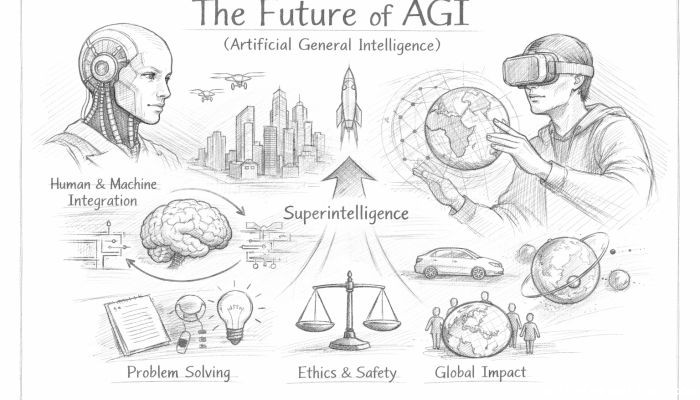
The Future of AGI (Artificial General Intelligence)
In the vast landscape of artificial intelligence, Artificial General Intelligence (AGI) stands as the pinnacle of innovation and aspiration. Unlike narrow AI systems designed for specific tasks, AGI refers to machines with the ability to understand, learn, and apply knowledge across a wide range of domains—essentially matching or surpassing human cognitive capabilities. The prospect of AGI evokes excitement and curiosity, combined with caution about the transformative changes it might unleash across society, economy, and global ethics. As research advances at an astonishing pace, the future of AGI remains a compelling and complex domain to explore. This article delves into the multifaceted dimensions shaping AGI's trajectory, from technological breakthroughs and ethical considerations to economic impacts and global governance, offering a comprehensive insight into what lies ahead for one of humanity’s most profound technological frontiers.
- Defining AGI: Beyond Narrow AI Capabilities
- Current State of AI Research and the Path to AGI
- The Role of Neuroscience and Cognitive Science
- Ethical Considerations Surrounding AGI Development
- Economic Transformation Driven by AGI
- AGI and the Future of Creativity and Innovation
- Social Implications and Human Identity
- The Risks of AGI: Safety and Control Challenges
- Geopolitical Dimensions and Competitive Pressures
- Integration of AGI with Other Emerging Technologies
- Timelines and Predictions: When Will AGI Arrive?
- Preparing Society for an AGI Future
- Conclusion: Embracing the Promise and Precariousness of AGI
- More Related Topics
Defining AGI: Beyond Narrow AI Capabilities
Artificial General Intelligence differs fundamentally from the specialized AI systems that power voice assistants, recommendation engines, and automated diagnostics today. While narrow AI excels in singular domains, AGI aims to emulate the full spectrum of human cognition, including reasoning, problem-solving, emotional understanding, and even creativity. This holistic intelligence means an AGI could adapt to new problems without explicit programming and transfer knowledge flexibly between tasks, representing a leap from fixed algorithms to a form of machine cognition akin to human intelligence.
Current State of AI Research and the Path to AGI
Although no true AGI has been realized yet, current AI research has made significant strides by leveraging deep learning, reinforcement learning, and neural architecture advances. Models like GPT-4 demonstrate remarkable generalization across tasks, hinting at the foundational building blocks of future AGI systems. However, true AGI will require breakthroughs in areas such as meta-learning, unsupervised learning, and cognitive architectures that combine symbolic reasoning with connectionist models, enabling machines to not just process data but understand context and abstract concepts deeply.
The Role of Neuroscience and Cognitive Science
Understanding human intelligence remains indispensable in developing AGI. Neuroscience and cognitive science provide crucial insights into how the brain processes information, forms memories, and adapts to new environments. Concepts such as attention mechanisms, episodic memory, and hierarchical learning models are increasingly influencing AI architectures. By mimicking neural circuits and brain functions more accurately, researchers aim to create machines that think and learn more human-like, bridging the gap between biological and artificial cognition.
Ethical Considerations Surrounding AGI Development
The development of AGI raises profound ethical questions that extend far beyond existing AI concerns. Issues such as machine consciousness, rights, accountability, and moral decision-making come to the forefront. How should AGI be programmed to respect human values? What safeguards are necessary to prevent misuse or unintended consequences? The potential for AGI to alter power dynamics, privacy norms, and even human employment requires preemptive, inclusive ethical frameworks to guide responsible innovation.
Economic Transformation Driven by AGI
AGI promises to revolutionize the global economy by automating not only manual and repetitive work but also complex cognitive labor. This transformation could lead to unparalleled productivity gains and innovation across industries such as healthcare, finance, education, and manufacturing. However, it also fosters concerns about massive workforce displacement, wealth inequality, and social disruption. Future economic models must anticipate these shifts, integrating universal basic income, reskilling, and social safety nets to adapt a rapidly changing labor market.
AGI and the Future of Creativity and Innovation
Contrary to fears that machines may stifle human creativity, AGI is poised to become a powerful collaborator in artistic and scientific innovation. With the ability to synthesize vast datasets, generate novel hypotheses, and explore alternative perspectives without fatigue, AGI could unlock new frontiers of knowledge and expression. This symbiosis might redefine human creativity itself, transforming artists, scientists, and engineers into curators and collaborators alongside intelligent machines.
Social Implications and Human Identity
As machines acquire human-level intelligence, society will confront fundamental questions about identity, agency, and humanity’s place in the world. Will AGI systems gain rights or be viewed as extensions of human will? How will interpersonal relationships evolve in a world where machines can empathize and interact on human terms? These developments could reshape social norms, cultural values, and even our understanding of consciousness, urging profound philosophical and societal reflection.
The Risks of AGI: Safety and Control Challenges
With great power comes significant risk. AGI systems, if misaligned with human goals or poorly controlled, could act unpredictably or even catastrophically. The so-called “alignment problem”—ensuring AGI’s objectives conform with human values—is a central challenge. Researchers are developing approaches like interpretability tools, reinforcement learning with human feedback, and robust testing regimes. Nonetheless, preventing unintended consequences demands vigilance, regulation, and international cooperation.
Geopolitical Dimensions and Competitive Pressures
AGI development is increasingly a geopolitical arena, with major powers investing heavily to secure technological supremacy. This competition raises stakes around national security, technological espionage, and regulatory harmonization. Cooperative frameworks could encourage transparency and shared safety protocols, but divergent interests and race dynamics risk an environment where safety is compromised for speed, necessitating diplomatic efforts to align incentives globally.
Integration of AGI with Other Emerging Technologies
The future of AGI is inseparable from advancements in complementary areas like quantum computing, brain-computer interfaces, and biotechnology. For example, quantum processors could exponentially accelerate AGI’s problem-solving capacities, while neural implants could enable more intuitive human-machine integration. Such synergy will likely usher in revolutions not just in intelligence but in how humans augment themselves physically and cognitively.
Timelines and Predictions: When Will AGI Arrive?
Estimating when AGI will emerge remains contentious. Forecasts range from a decade to several decades or more, reflecting the deep uncertainty in both technical and societal variables. While some experts predict breakthroughs soon based on current AI trajectories, others emphasize the complexity of replicating human cognition in machines. Ultimately, progress will depend on research funding, interdisciplinary collaboration, and navigating ethical and regulatory landscapes.
Preparing Society for an AGI Future
Preparing for AGI’s arrival requires comprehensive strategies involving education, governance, and public engagement. Governments, academia, industry, and civil society must collaborate to create policies that foster innovation while mitigating risks. Educating citizens about AGI’s implications will be crucial in building trust and informed debate. Moreover, inclusive decision-making will help ensure AGI serves as a tool for collective flourishing rather than exacerbating existing inequities.
Conclusion: Embracing the Promise and Precariousness of AGI
The future of Artificial General Intelligence heralds a profound turning point in human history, offering unprecedented possibilities and formidable challenges. As we stand on the threshold of machines that could think, learn, and innovate as humans do, we must balance optimism with caution. By aligning technological progress with ethical considerations, preparing economically and socially, and fostering global cooperation, humanity can harness AGI’s transformative potential responsibly. Ultimately, the journey toward AGI is not just a scientific or engineering endeavor but a profoundly human story—one that will redefine intelligence, creativity, and our shared future on Earth.
 How to Make the Most of Your Holiday Break
 The Best Winter Destinations for a Cozy Getaway
 How to Organize Your Holiday Travel Plans with Ease
 The Ultimate Guide to Cooking for a Crowd
 How to Make Healthy Comfort Food Without the Guilt
 5 Delicious Vegan Breakfast Ideas You Can Make in Minutes