How Machine Learning Works Step-by-Step
Machine learning (ML), once a niche field within computer science, has swiftly transformed industries, powered innovations, and reshaped the way we interact with technology. From personalized recommendations on streaming platforms to autonomous vehicles navigating city streets, machine learning systems are embedded in daily life, silently making decisions and predictions. But what exactly happens under the hood? How does a machine “learn” from data, identify patterns, and improve over time without explicit programming instructions? This article unpacks the intricate but fascinating step-by-step process of how machine learning works. By breaking down each stage—from data gathering and preprocessing to model evaluation and deployment—we will demystify the machinery behind intelligent systems, enabling readers to grasp both the technical fundamentals and practical workflows that drive machine learning solutions.
- Understanding the Problem and Defining Objectives
- Collecting and Gathering Data
- Data Cleaning and Preprocessing
- Splitting Data into Training, Validation, and Test Sets
- Choosing the Right Machine Learning Algorithm
- Training the Model
- Hyperparameter Tuning
- Evaluating Model Performance
- Addressing Overfitting and Underfitting
- Deploying the Model
- Continuous Monitoring and Maintenance
- Ethical Considerations and Bias Mitigation
- Conclusion
- More Related Topics
Understanding the Problem and Defining Objectives
Before diving into algorithms and data, the essential first step in any machine learning project is clearly understanding the problem to solve. Is the goal to classify emails as spam or not? Predict future sales? Detect fraudulent transactions? Defining the problem scope, objectives, and success criteria sets the foundation for the entire process. Machine learning thrives on well-defined questions because the right approach depends largely on whether the task involves classification, regression, clustering, or another learning paradigm. Establishing measurable performance metrics like accuracy, precision, recall, or mean squared error guides later evaluation stages and helps assess how "well" the machine is learning.
Collecting and Gathering Data
Data is the lifeblood of machine learning. Without high-quality, relevant data, no algorithm can learn effectively. Depending on the problem, data can come from diverse sources: customer databases, sensors, websites, or external data repositories. Data collection often requires collaboration across teams and domain experts to ensure that the gathered information is comprehensive and representative. The quantity of data is important, but quality is paramount—data should be accurate, consistent, and as free of bias as possible. Often, raw data is messy and incomplete, demanding careful evaluation before proceeding.

Data Cleaning and Preprocessing
Raw data rarely arrives in a machine-readable, clean format. Data cleaning involves handling missing values, correcting inaccuracies, and removing duplicates to improve dataset quality. Preprocessing transforms data into a format suitable for machine learning algorithms. This can include normalization to rescale numeric values, encoding categorical variables into numerical forms, and feature extraction or engineering to create meaningful input attributes. Well-executed preprocessing significantly boosts model performance and reduces training time, as learning algorithms depend heavily on the quality and representation of input data.
Splitting Data into Training, Validation, and Test Sets
To evaluate a model’s ability to generalize beyond the data it sees during training, the dataset is typically split into three subsets: training, validation, and testing. The training set is used to fit the model, allowing it to learn patterns. The validation set helps tune hyperparameters and make decisions about model complexity. The test set, unseen during training and validation, provides an unbiased estimate of how the model will perform on completely new data. This approach prevents overfitting—where a model memorizes training data instead of learning generalizable patterns—and ensures reliable performance assessment.
Choosing the Right Machine Learning Algorithm
Machine learning offers a rich toolkit of algorithms, each suited to specific tasks and data types. Common categories include supervised learning algorithms like decision trees, support vector machines, and neural networks; unsupervised methods such as k-means clustering; and reinforcement learning approaches. Selecting the right algorithm involves considering the problem type, dataset size, feature characteristics, interpretability requirements, and computational constraints. Sometimes multiple algorithms are tested to determine which yields the best results, making algorithm selection both an art and a science.
Training the Model
Training is the core step where the machine “learns” by adjusting parameters to minimize error in its predictions. During supervised learning, the algorithm processes the training data iteratively and updates its internal weights or rules in response to discrepancies between predicted outputs and actual labels. This optimization typically uses algorithms like gradient descent. Training duration varies based on model complexity and dataset size, and techniques such as mini-batch training or early stopping help balance learning speed with accuracy. Successful training produces a model that captures underlying patterns without overfitting.
Hyperparameter Tuning
While the model learns parameters from data, hyperparameters are settings that control the learning process itself but are not directly learned. Examples include learning rate, number of layers in a neural network, or the number of neighbors in k-nearest neighbors algorithms. Hyperparameter tuning involves systematically varying these values to identify configurations that maximize model performance. Methods include grid search, random search, and more sophisticated approaches like Bayesian optimization. Proper tuning is vital as hyperparameters significantly influence the balance between underfitting and overfitting.
Evaluating Model Performance
Once the model is trained and tuned, its performance is assessed using the validation and test datasets. Key evaluation metrics depend on the task: classification problems often utilize accuracy, precision, recall, F1 score, and ROC-AUC; regression tasks look to mean squared error, mean absolute error, or R-squared values. Confusion matrices provide detailed insights into prediction errors. Rigorous evaluation helps ensure the model’s reliability and guides decisions such as further refinement or deployment readiness, informing whether adjustments or more data are needed.
Addressing Overfitting and Underfitting
Overfitting occurs when a model learns training data too precisely, including noise and outliers, resulting in poor generalization to new data. Underfitting happens when the model is too simplistic to capture underlying patterns. Both conditions degrade performance and demand specific remedies. Techniques to combat overfitting include cross-validation, regularization (like L2 or dropout in neural networks), feature selection, and gathering more data. To fix underfitting, more complex models, additional features, or extended training might be necessary. Balancing model complexity is central to effective machine learning.
Deploying the Model
After achieving satisfactory results, the machine learning model is deployed into a production environment to generate real-time or batch predictions. Deployment strategies depend on application requirements but typically involve integrating the model into software systems via APIs or embedding it within edge devices. Monitoring the model’s performance in production is crucial to detect any degradation caused by data drift or changing conditions. Updates and retraining may be required to sustain accuracy over time, making deployment an ongoing lifecycle stage rather than a one-time event.
Continuous Monitoring and Maintenance
Machine learning models are not “set-and-forget” solutions. Once deployed, continuous monitoring tracks metrics such as prediction accuracy, latency, and system resource usage. Data distribution may shift over time, leading to performance decay—a phenomenon called concept drift. Regular retraining with new data, scheduled audits, and feedback loops ensure the model adapts and maintains relevance. Maintenance also includes addressing security, scalability, and compliance considerations to guarantee a robust and trustworthy ML application.
Ethical Considerations and Bias Mitigation
As ML models become increasingly integral to decision-making in sensitive domains, ethical concerns demand careful attention. Biases present in training data can lead to discriminatory or unfair outcomes affecting individuals or groups. Transparency, fairness, and accountability should be embedded throughout the ML workflow. Techniques like fairness-aware algorithms, explainability tools, and diverse data collection practices help mitigate bias. Ethical stewardship ensures that machine learning applications benefit society while minimizing harm and respecting privacy.
Conclusion
Machine learning weaves together data, algorithms, and iterative optimization into an elegant process that allows computers to "learn" from experience. Each step—from problem definition through data collection, preprocessing, training, evaluation, deployment, and ongoing maintenance—is vital for building models that deliver accurate, reliable, and ethical predictions. Understanding this step-by-step journey reveals the complexity behind seemingly effortless AI capabilities and empowers practitioners and enthusiasts to engage thoughtfully with machine learning technologies. As data volumes grow and algorithms advance, this foundational process will continue evolving, unlocking new potentials and challenging us to apply machine learning with responsibility and insight.
 Big O Notation Explained for Beginners
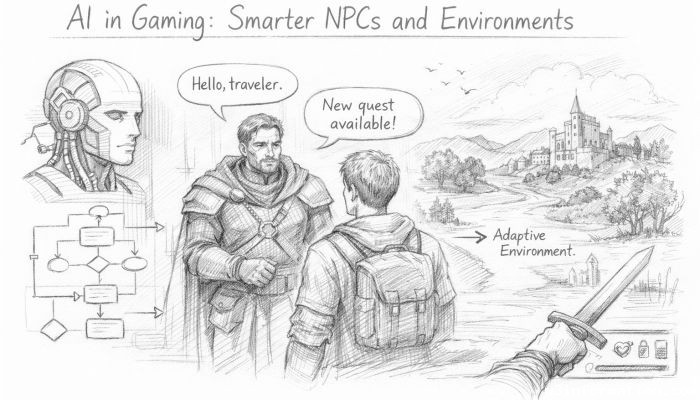 AI in Gaming: Smarter NPCs and Environments
 Understanding Bias in AI Algorithms
 Introduction to Chatbots and Conversational AI
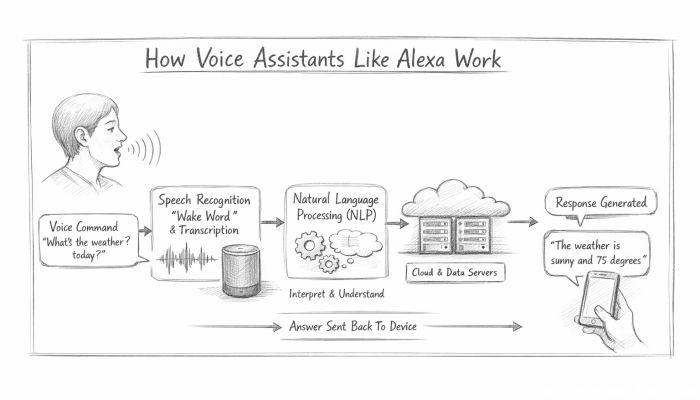 How Voice Assistants Like Alexa Work
 Federated Learning: AI Without Sharing Data