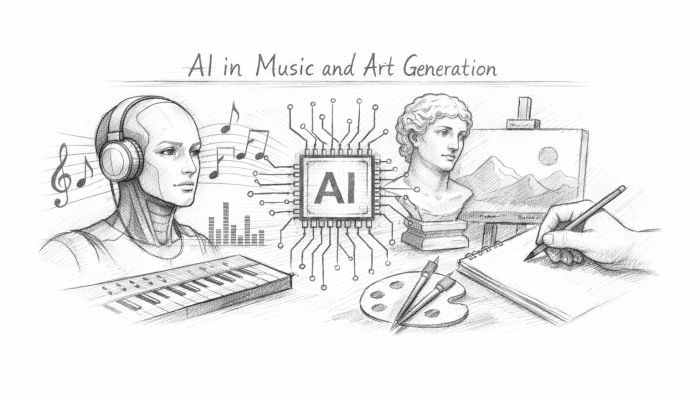
AI in Music and Art Generation
The intertwining of artificial intelligence (AI) with creative disciplines such as music and art is reshaping the way we perceive and produce creative content. From algorithms that compose symphonies to AI-driven tools generating stunning visual masterpieces, this fusion is not only breaking conventional boundaries but also raising profound questions about creativity, authorship, and human expression. With AI’s growing sophistication, machines are not just mimicking creativity—they are becoming collaborators, assistants, and even originators in the creative process. This article delves into the transformative role of AI in music and art generation, exploring its technologies, applications, challenges, and future possibilities. Whether you’re a tech enthusiast, artist, musician, or simply curious about the evolving landscape of creativity, understanding AI’s impact on these fields provides a fascinating lens into the future of artistic expression.
- The Evolution of AI in Creative Fields
- Understanding the Technology Behind AI Creativity
- AI in Music Composition: From Algorithms to Originals
- Visual Art Generation: Algorithms as the New Brush
- Collaborative Creativity: AI as a Creative Partner
- Democratization of Art and Music Production
- Intellectual Property and Ethical Considerations
- The Impact on Traditional Artists and Musicians
- AI’s Role in Music and Art Education
- Future Trends: Beyond Generation to Emotion and Experience
- Challenges and Limitations of AI Creativity
- Conclusion: Embracing the New Creative Frontier
- More Related Topics
The Evolution of AI in Creative Fields
AI’s journey into creativity began several decades ago, initially limited to rule-based systems designed to assist with simple tasks or generate art based on basic algorithms. Early experiments, such as Harold Cohen’s AARON program in the 1970s, laid the groundwork for computational creativity. With advancements in machine learning, particularly deep learning and neural networks in recent years, AI systems have exponentially improved their ability to analyze large datasets, recognize patterns, and create complex outputs that rival human originality. This evolution signals a paradigm shift—from viewing AI as a tool for replication to regarding it as an active creative partner.
Understanding the Technology Behind AI Creativity
At the core of AI music and art generation lie several cutting-edge technologies. Neural networks, especially Generative Adversarial Networks (GANs), have revolutionized image creation by pitting two networks against each other to produce increasingly realistic artworks. In music, Recurrent Neural Networks (RNNs) and Transformer models analyze sequences, enabling AI to compose melodies, harmonies, and rhythms that mimic or innovate upon existing musical styles. Natural Language Processing (NLP) also plays a role, allowing AI to understand and generate lyrics or art descriptions, thereby enriching the creative process.
AI in Music Composition: From Algorithms to Originals
AI music composition tools have developed from simple algorithmic music generators into sophisticated systems capable of producing original scores in various genres. Platforms like OpenAI’s Jukebox and Google’s Magenta explore how AI can autonomously compose music that incorporates complex structures, moods, and even lyrics. Musicians are using these systems as co-composers, leveraging AI to spark new ideas, overcome writer’s block, or rapidly prototype arrangements. The result is a new genre of AI-assisted music that blends human emotion with machine precision.
Visual Art Generation: Algorithms as the New Brush
Visual art has embraced AI through tools that generate paintings, sketches, and digital art with minimal human input. GAN-based projects such as DeepDream and DALL·E have captured public imagination by creating surreal, dream-like images or photorealistic visuals from textual descriptions. These technologies allow users without traditional artistic training to create compelling pieces, democratizing art creation. Additionally, AI can analyze art history to generate works that pay homage to or reimagine the styles of classical masters, expanding artistic possibilities.
Collaborative Creativity: AI as a Creative Partner
Rather than replacing artists and musicians, many view AI as a creative collaborator that augments human imagination. Artists can input parameters, adjust styles, or selectively curate AI-generated content to produce unique works. For musicians, AI can suggest chord progressions or generate improvisations, which artists refine to suit their vision. This synergy redefines the notion of authorship and encourages a dynamic, interactive approach to creativity where human intuition meets computational power.
Democratization of Art and Music Production
AI-powered tools significantly lower the barriers to entry in art and music creation. With accessible platforms, novices can compose music, design graphics, or generate complex visual art without years of formal training or expensive equipment. This democratization fuels diversity, enabling voices and styles from a broad demographic spectrum. Moreover, businesses and marketers leverage AI-generated content to enhance branding, creating personalized and scalable creative assets that would not be feasible manually.
Intellectual Property and Ethical Considerations
AI-driven creativity brings complex legal and ethical issues to the forefront. Questions around who owns AI-generated art or music—whether it be the creator of the algorithm, the user inputting parameters, or the AI itself—remain unresolved in many jurisdictions. Furthermore, ethical concerns arise regarding the use of AI trained on existing artists’ work without permission, potentially infringing on copyright or undermining artist compensation. As AI-generated content proliferates, establishing clear frameworks for intellectual property rights and ethical use is imperative.
The Impact on Traditional Artists and Musicians
While AI expands creative tools, it also disrupts traditional artistic roles and industries. Some fear that rapid AI content generation could devalue human artistry or saturate markets with mass-produced works, challenging livelihoods. Conversely, others argue that AI can free artists from routine tasks, inspire innovative styles, and open new revenue streams through hybrid artworks. The key lies in adapting to the changing landscape by integrating AI thoughtfully, maintaining the irreplaceable value of human creativity and emotional depth.
AI’s Role in Music and Art Education
Education is another sphere transformed by AI creativity. Music and art students can use AI tools to experiment risk-free, receive instant feedback, and explore diverse styles beyond their instructors’ expertise. AI tutors and virtual assistants personalize learning paths, making education more interactive and accessible. Additionally, AI can archive and analyze vast cultural artifacts, offering insights into artistic traditions and fostering cross-cultural appreciation among students.
Future Trends: Beyond Generation to Emotion and Experience
The future of AI in creative arts goes beyond simple generation to crafting emotionally resonant and immersive experiences. Research is underway to develop AI that understands and responds to human emotions, creating music and art that adapt in real time to audience reactions or environments. Virtual and augmented reality platforms coupled with AI promise interactive artistic spaces where creation and consumption merge, transforming passive audiences into participants in the artistic process.
Challenges and Limitations of AI Creativity
Despite impressive achievements, AI-generated art and music face inherent challenges. Current models often lack true understanding or intention; they generate based on pattern recognition rather than genuine emotion or cultural context. Biases in training data can perpetuate stereotypes or limit diversity in outputs. Technical constraints, such as computational costs and the need for large datasets, also restrict accessibility. Addressing these limitations requires ongoing research, transparent design, and collaboration between technologists and creatives.
Conclusion: Embracing the New Creative Frontier
AI’s integration into music and art generation heralds a transformative era, blending human ingenuity with computational innovation. While it challenges traditional notions of creativity and authorship, AI also democratizes creation, offers collaborative possibilities, and enriches cultural expression. The key to harnessing AI’s potential lies in thoughtful application, ethical mindfulness, and valuing the irreplaceable human spirit behind every creative act. As artists and machines co-create, the boundaries of creativity will continue to expand, inviting us to reimagine what it means to create in the 21st century and beyond.
 How to Make the Most of Your Holiday Break
 The Best Winter Destinations for a Cozy Getaway
 How to Organize Your Holiday Travel Plans with Ease
 The Ultimate Guide to Cooking for a Crowd
 How to Make Healthy Comfort Food Without the Guilt
 5 Delicious Vegan Breakfast Ideas You Can Make in Minutes