Data Privacy Laws Around the World
In an increasingly digital world, data has become one of the most valuable commodities. From social media platforms and e-commerce stores to healthcare providers and financial institutions, vast amounts of personal data are collected, stored, and processed every day. This surge in data usage brings significant benefits in convenience, innovation, and connectivity, but also raises critical concerns about privacy and security. Governments worldwide have responded by introducing data privacy laws designed to protect individuals’ personal information while regulating how organizations handle such data. This article explores the global landscape of data privacy laws, examining the diverse approaches different countries and regions take, the principles underpinning these regulations, and the challenges faced in enforcement. Whether you are a business owner, legal professional, or simply a concerned citizen, understanding these laws is essential in today’s interconnected world.
- The Rise of Data Privacy Awareness
- The European Union’s General Data Protection Regulation (GDPR)
- United States: A Sectoral and State-by-State Approach
- China’s Personal Information Protection Law (PIPL)
- Privacy Laws in Latin America: Growing Trends and Challenges
- Africa’s Emerging Data Privacy Frameworks
- Australia’s Privacy Act and Cross-Border Data Issues
- Japan’s Act on the Protection of Personal Information (APPI)
- The Role of International Bodies and Agreements
- Challenges in Enforcing Data Privacy Laws
- Impact of Data Privacy Laws on Businesses
- The Future of Data Privacy Legislation
- Conclusion
- More Related Topics
The Rise of Data Privacy Awareness
The evolution of data privacy laws has been driven largely by growing public awareness of privacy rights. High-profile data breaches and scandals, such as the Cambridge Analytica incident involving Facebook, have exposed how personal data can be misused. With digital footprints growing exponentially, individuals are increasingly conscious of the risks associated with sharing personal information online. This awareness has pressured policymakers to strengthen protections against unauthorized data collection, surveillance, and exploitation. Consequently, data privacy is no longer considered a niche legal issue but a fundamental human right recognized by numerous international frameworks and national statutes.
The European Union’s General Data Protection Regulation (GDPR)
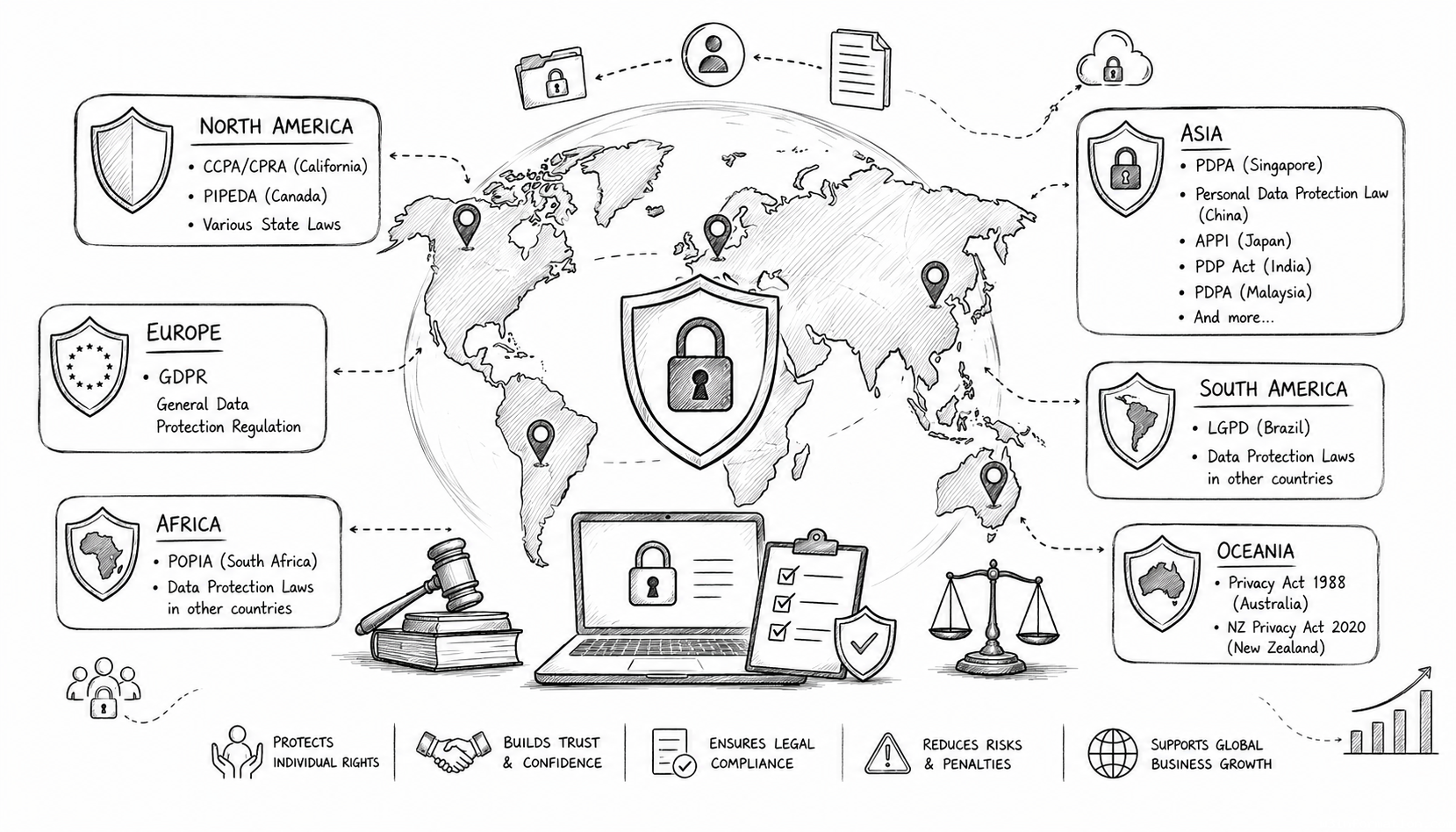
One of the most comprehensive and influential data privacy laws is the European Union’s General Data Protection Regulation (GDPR), which came into effect in 2018. The GDPR set a global benchmark by establishing robust rules for data protection across all EU member states, emphasizing transparency, user consent, and the right to access and delete personal data. It mandates strict penalties for non-compliance, with fines reaching up to 4% of a company’s global annual revenue. The GDPR also introduced concepts such as data portability and the "right to be forgotten," empowering individuals with more control over their personal information. Due to its extraterritorial reach, the GDPR affects organizations worldwide that handle EU citizens’ data, making it a pivotal law in the global data privacy ecosystem.
United States: A Sectoral and State-by-State Approach
Unlike the EU’s unified framework, the United States employs a more fragmented approach to data privacy, with federal laws targeting specific sectors and states implementing their own regulations. Key federal legislation includes the Health Insurance Portability and Accountability Act (HIPAA) for health data, the Children’s Online Privacy Protection Act (COPPA) for minors, and the Gramm-Leach-Bliley Act (GLBA) for financial information. However, there is no single overarching data privacy law, creating a complex compliance environment. In recent years, states like California have stepped up with comprehensive laws such as the California Consumer Privacy Act (CCPA) and the California Privacy Rights Act (CPRA), offering residents enhanced rights and imposing new obligations on businesses. This patchwork system continues to evolve, with other states proposing or enacting similar laws, highlighting the US trend toward greater consumer data protection.
China’s Personal Information Protection Law (PIPL)
China has emerged as a significant player in data privacy regulation with its Personal Information Protection Law (PIPL), enacted in 2021. The PIPL is often compared to the GDPR as it establishes extensive rules on how personal data should be collected, stored, and used within China. It mandates explicit consent, data minimization, and stipulates cross-border data transfer mechanisms. However, the PIPL also reflects China’s specific political and social context, balancing privacy protection with national security considerations. Organizations operating in China or handling data of Chinese residents must pay close attention to these provisions, which mark a notable development in Asia’s data privacy landscape and influence global data governance norms.
Privacy Laws in Latin America: Growing Trends and Challenges
Latin American countries are increasingly adopting comprehensive data privacy laws, inspired by both the GDPR and regional cooperation efforts. Countries like Brazil introduced the General Data Protection Law (LGPD) in 2020, which is comparable to the GDPR in scope and enforcement mechanisms. Argentina, Mexico, and Chile also have data protection frameworks, each with unique features tailored to local needs. Despite progress, the region faces challenges such as uneven enforcement, technological gaps, and balancing privacy with economic development. Nonetheless, the trend toward stronger data privacy legislation reflects growing recognition of citizens’ rights and the necessity to foster trust in digital markets.
Africa’s Emerging Data Privacy Frameworks
Africa’s approach to data privacy is rapidly evolving, with growing legislative activity across the continent. The African Union’s Convention on Cyber Security and Personal Data Protection, known as the Malabo Convention, aims to harmonize data protection norms among member states, though ratification is still limited. Individual countries like South Africa, Kenya, and Nigeria have enacted national laws regulating personal data. South Africa’s Protection of Personal Information Act (POPIA) is particularly noteworthy for its comprehensive provisions and enforcement efforts. However, challenges related to infrastructure, awareness, and enforcement capacity remain. Continued development in this area is critical as Africa becomes an increasingly important digital economy.
Australia’s Privacy Act and Cross-Border Data Issues
Australia’s Privacy Act 1988 regulates the handling of personal information by government agencies and private sector organizations. It incorporates principles on collection, use, disclosure, and data security, and provides mechanisms for individuals to lodge complaints about privacy breaches. In recent years, Australia has revisited the Act to address emerging issues such as data breaches, leading to mandatory notification requirements. Cross-border data transfer is a particular concern in Australia’s context, given the country’s role as a regional digital hub. The law encourages organizations to ensure overseas recipients provide a comparable level of protection, highlighting the importance of international cooperation on data privacy.
Japan’s Act on the Protection of Personal Information (APPI)
Japan’s Act on the Protection of Personal Information (APPI), initially enacted in 2003 and substantially amended in 2017 and 2020, positions Japan as a leader in Asian data privacy regulation. The APPI sets out obligations for personal information use, consent, and breach notification, aligning more closely with international standards such as the GDPR. Japan’s law features a unique approval system for data transfers and strong enforcement by the Personal Information Protection Commission (PPC). Japan’s data privacy regime facilitates cross-border data flow, an essential goal given its economic ties, while ensuring robust protections for individual privacy.
The Role of International Bodies and Agreements
International organizations, such as the United Nations, Organisation for Economic Co-operation and Development (OECD), and the Council of Europe, have played critical roles in shaping data privacy norms by issuing guidelines and conventions that encourage member states to adopt coherent standards. The Council of Europe’s Convention 108, for example, is the first legally binding international treaty focused on data protection and has been widely ratified. These instruments foster cooperation, set baseline standards, and address challenges such as cross-border enforcement and jurisdictional conflicts. As data flows transcend national borders, international collaboration remains vital for effective data governance.
Challenges in Enforcing Data Privacy Laws
While legislative frameworks proliferate worldwide, enforcement remains a significant challenge due to several factors. Resource constraints limit regulatory agencies’ capacity to investigate and sanction violations. The technically complex nature of data processing complicates detection of non-compliance. Moreover, global digital companies operate beyond borders, creating jurisdictional hurdles and enforcement gaps. Privacy laws must continuously adapt to emerging technologies such as artificial intelligence, blockchain, and the Internet of Things, which introduce new risks. Balancing regulation without stifling innovation requires nuanced approaches, including stakeholder engagement, transparent governance, and technological safeguards.
Impact of Data Privacy Laws on Businesses
Data privacy laws impose significant obligations on businesses regarding how they collect, use, and protect personal information. Compliance demands investments in data protection policies, employee training, technology, and monitoring systems. Failure to comply can result in costly fines, reputational damage, and loss of customer trust. However, these laws can also create competitive advantages by fostering transparency and accountability. Companies that prioritize privacy often enjoy stronger brand loyalty and differentiation in markets that value data ethics. Navigating diverse legal landscapes requires comprehensive compliance strategies, often necessitating legal counsel and data protection officers to oversee adherence.
The Future of Data Privacy Legislation
As technology evolves and public expectations shift, data privacy laws will continue to develop dynamically. Emerging concepts such as data sovereignty, decentralized data management, and privacy by design are influencing new legislation. Increasing calls for digital rights, ethical AI use, and greater transparency suggest future laws will broaden beyond traditional personal data to include algorithmic accountability and biometric safeguards. Additionally, efforts toward international harmonization and mutual recognition of privacy standards are likely to gain momentum to facilitate global digital trade. Stakeholders must remain vigilant and proactive in adapting to these trends to uphold privacy protections effectively.
Conclusion
Data privacy laws around the world reflect a complex mosaic of legal frameworks shaped by cultural values, political priorities, technological advances, and economic imperatives. From the comprehensive protections of the GDPR and China’s PIPL to the sector-specific rules in the United States and emerging frameworks in Africa and Latin America, the global landscape is diverse and dynamic. Despite challenges in enforcement and the rapid pace of technological innovation, these laws play a crucial role in safeguarding individual privacy rights and fostering trust in the digital economy. As data becomes ever more integral to modern life, understanding and respecting data privacy laws is essential for governments, businesses, and individuals alike. The future of privacy will likely depend on international cooperation, legislative innovation, and a collective commitment to balancing technological progress with human dignity.
 How to Make the Most of Your Holiday Break
 The Best Winter Destinations for a Cozy Getaway
 How to Organize Your Holiday Travel Plans with Ease
 The Ultimate Guide to Cooking for a Crowd
 How to Make Healthy Comfort Food Without the Guilt
 5 Delicious Vegan Breakfast Ideas You Can Make in Minutes