Role of Firewalls and IDS/IPS
In an increasingly digitized world, cybersecurity has become a cornerstone of organizational resilience and personal data protection. Among the myriad tools and technologies utilized to safeguard digital ecosystems, firewalls and Intrusion Detection/Prevention Systems (IDS/IPS) stand out as fundamental components. These systems play critical roles in monitoring, filtering, and defending networks against a wide array of cyber threats, from unauthorized access attempts to sophisticated attacks that can compromise sensitive information. Understanding the distinct yet complementary functions of firewalls and IDS/IPS is essential not only for IT professionals but also for anyone invested in the security of their data and systems. This article delves into the roles, mechanisms, and evolving significance of firewalls and IDS/IPS in contemporary cybersecurity frameworks, providing a comprehensive overview of how they work together to form a robust defense strategy.
- Understanding Firewalls: The First Line of Defense
- Types of Firewalls and Their Functions
- Intrusion Detection Systems (IDS): Monitoring for Threats
- Intrusion Prevention Systems (IPS): Proactive Threat Mitigation
- How Firewalls and IDS/IPS Complement Each Other
- The Evolution of Cyber Threats and the Necessity for Integrated Systems
- Deployment Considerations for Firewalls and IDS/IPS
- Managing False Positives and Alert Fatigue
- The Importance of Regular Updates and Patching
- Role of Artificial Intelligence and Machine Learning
- Compliance and Regulatory Implications
- Future Trends in Firewalls and IDS/IPS
- Conclusion
- More Related Topics
Understanding Firewalls: The First Line of Defense
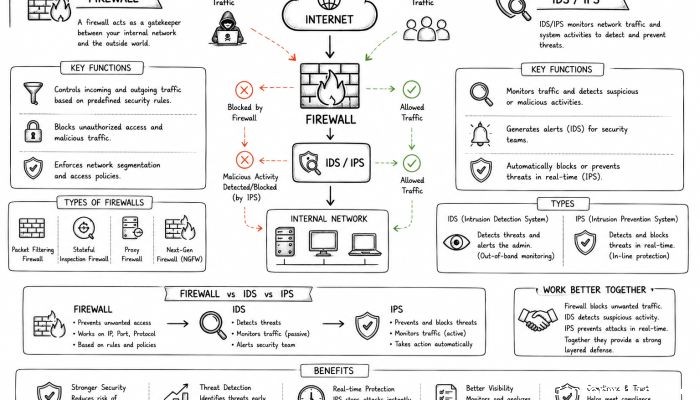
Firewalls serve as the primary barrier between a trusted internal network and untrusted external networks such as the internet. By enforcing a set of predefined rules, firewalls control incoming and outgoing network traffic to prevent unauthorized access. Initially designed as packet filters, modern firewalls have evolved to include stateful inspection, proxying, and deep packet inspection techniques. They analyze traffic based on attributes like IP addresses, port numbers, and protocols to block malicious packets or suspicious connections. Firewalls effectively create a perimeter defense, shielding systems from common threats such as port scans, unauthorized access, and network-based attacks.
Types of Firewalls and Their Functions
Firewalls come in various forms tailored to different network environments and security needs. Packet-filtering firewalls operate at the network layer, examining IP addresses and ports. Stateful firewalls introduce connection tracking, evaluating the state of network sessions to allow or deny packets based on the context of prior traffic. Application-layer firewalls, or proxy firewalls, scrutinize traffic at the application level, enabling more granular control over specific protocols like HTTP or FTP. Next-Generation Firewalls (NGFW) combine traditional functionalities with advanced features such as intrusion prevention, SSL decryption, and application awareness, providing a more comprehensive security solution.
Intrusion Detection Systems (IDS): Monitoring for Threats
While firewalls focus on traffic control, Intrusion Detection Systems (IDS) serve to monitor network or system activities for signs of malicious behavior. IDS are passive security tools designed to detect potentially harmful actions and raise alerts for administrators. They employ various detection methods, including signature-based detection that matches known attack patterns, anomaly detection that identifies deviations from normal behavior, and hybrid approaches. IDS can be network-based (NIDS), monitoring traffic across the network, or host-based (HIDS), watching for suspicious activities on individual devices.
Intrusion Prevention Systems (IPS): Proactive Threat Mitigation
Intrusion Prevention Systems (IPS) build upon IDS capabilities by not only detecting but also actively blocking or mitigating threats in real-time. Unlike IDS, which typically passively notifies administrators, IPS automatically takes actions to stop attacks, such as dropping malicious packets, resetting connections, or quarantining infected hosts. Positioned inline with network traffic, IPS devices analyze packets in real-time, ensuring immediate response to emerging threats. This proactive defense reduces reaction times and limits the potential damage from cyberattacks.
How Firewalls and IDS/IPS Complement Each Other
Firewalls and IDS/IPS serve different but synergistic roles in cybersecurity. Firewalls create a controlled boundary that restricts unauthorized access and filters basic threats, serving as the first checkpoint. However, firewalls alone cannot detect sophisticated or insider attacks that may bypass basic filtering rules. IDS/IPS systems provide deeper scrutiny by monitoring traffic and system activities for subtle indicators of compromise. Together, they form a layered security model where firewalls reduce the attack surface, and IDS/IPS detect or prevent breaches that evade the initial perimeter control.
The Evolution of Cyber Threats and the Necessity for Integrated Systems
Cyber threats have evolved from simple probes and denial-of-service attacks to complex, multi-vector incursions involving malware, ransomware, phishing, and zero-day exploits. This evolution necessitates a more dynamic and integrated defense posture. Modern cybersecurity strategies increasingly deploy firewalls with embedded IDS/IPS functions or integrate them into unified threat management (UTM) systems. This integration allows for more efficient traffic processing, real-time threat correlation, and centralized management, enhancing an organization's ability to respond effectively to emerging threats.
Deployment Considerations for Firewalls and IDS/IPS
Effective implementation of firewalls and IDS/IPS requires careful planning tailored to the organization's network architecture and risk profile. Firewalls are generally deployed at network perimeters, between trusted internal networks and external networks, or within internal segmentation zones to isolate sensitive assets. IDS/IPS can be positioned at strategic points to monitor traffic flows or on critical hosts. Scalability, latency, false positive rates, and resource consumption are important factors influencing the choice and placement of these systems. A well-architected deployment ensures optimal performance and maximum security coverage.
Managing False Positives and Alert Fatigue
A significant challenge with IDS/IPS systems is managing false positives—benign activities incorrectly flagged as threats—which can overwhelm security teams and lead to alert fatigue. To address this, systems employ tuning, filtering, and machine learning techniques to enhance detection accuracy. Continuous monitoring and updating of signatures, behavioral baselines, and rule sets are essential to maintaining the balance between sensitivity and noise. Effective incident response protocols coupled with automated alert triage also help security teams focus on genuine threats.
The Importance of Regular Updates and Patching
The effectiveness of firewalls and IDS/IPS relies heavily on up-to-date signatures, policies, and software versions. Cyber attackers constantly devise new exploits and techniques, making timely updates critical to detecting and blocking the latest threats. Vendors frequently release patches and signature updates to address vulnerabilities and expand detection capabilities. Organizations must prioritize regular maintenance and incorporate automated update mechanisms where possible to sustain robust protection.
Role of Artificial Intelligence and Machine Learning
Advances in artificial intelligence (AI) and machine learning (ML) are shaping the future of firewall and IDS/IPS technologies. These intelligent systems analyze vast amounts of network data, identify complex patterns, and detect anomalies with greater precision than traditional rule-based methods. AI-powered firewalls and IDS/IPS enhance threat detection, reduce false positives, and enable adaptive security policies. Moreover, predictive analytics help anticipate emerging attacks, enabling preemptive defenses. However, integrating AI also demands responsible management to avoid biases and ensure transparency.
Compliance and Regulatory Implications
Many regulatory frameworks, such as GDPR, HIPAA, and PCI-DSS, mandate stringent cybersecurity measures, including implementation of firewalls and intrusion detection/prevention mechanisms. Compliance with these standards not only enforces data protection obligations but also enhances overall security posture. Proper logging, auditing, and reporting capabilities embedded in firewalls and IDS/IPS aid in meeting compliance requirements and supporting forensic investigations in case of cybersecurity incidents.
Future Trends in Firewalls and IDS/IPS
Looking ahead, firewall and IDS/IPS technologies are poised to become more integrated, automated, and context-aware. Cloud adoption and the proliferation of Internet of Things (IoT) devices challenge traditional perimeter-based security, prompting development of cloud-native firewalls and distributed IDS/IPS solutions. Zero Trust security models emphasize continuous verification and micro-segmentation, necessitating advanced detection systems embedded across network layers. Additionally, collaboration between human analysts and AI-driven tools will become increasingly critical in preempting sophisticated cyber threats.
Conclusion
Firewalls and IDS/IPS constitute indispensable pillars of contemporary cybersecurity architectures, each fulfilling vital yet distinct roles in defending digital assets. Firewalls establish the first line of defense by filtering traffic and restricting unauthorized access, while IDS/IPS provide enhanced visibility and proactive response capabilities to detect and mitigate sophisticated threats. Their combined deployment fosters a layered security strategy that is essential in the face of evolving cyber risks. As technologies advance and threats become more complex, continuous integration, intelligent automation, and adaptive security mechanisms will be key to maintaining resilient defenses. By understanding and strategically employing firewalls and IDS/IPS, organizations can create robust security frameworks that safeguard their information assets and ensure operational continuity in an increasingly perilous digital landscape.
 How to Make the Most of Your Holiday Break
 The Best Winter Destinations for a Cozy Getaway
 How to Organize Your Holiday Travel Plans with Ease
 The Ultimate Guide to Cooking for a Crowd
 How to Make Healthy Comfort Food Without the Guilt
 5 Delicious Vegan Breakfast Ideas You Can Make in Minutes