Hashing vs Encryption
In today’s digital age, securing information is more critical than ever. Whether it’s safeguarding personal data, protecting financial transactions, or ensuring privacy in communications, understanding how data can be protected is fundamental. Two foundational techniques—hashing and encryption—often come up in discussions about data security. While they may appear similar because both involve making data unreadable to unauthorized parties, they serve fundamentally different purposes and operate in different ways. This article dives deep into hashing and encryption, comparing their mechanisms, use cases, strengths, and limitations. By the end, you’ll have a clear grasp of when and why each should be used in securing digital information.
- What is Hashing?
- What is Encryption?
- Comparing the Core Purpose
- How Hashing Functions Work
- How Encryption Algorithms Work
- Key Use Cases for Hashing
- Key Use Cases for Encryption
- Security Strengths and Vulnerabilities of Hashing
- Security Strengths and Vulnerabilities of Encryption
- Performance Considerations
- The Role of Hashing and Encryption in Modern Systems
- Future Trends and Developments
- Conclusion
- More Related Topics
What is Hashing?
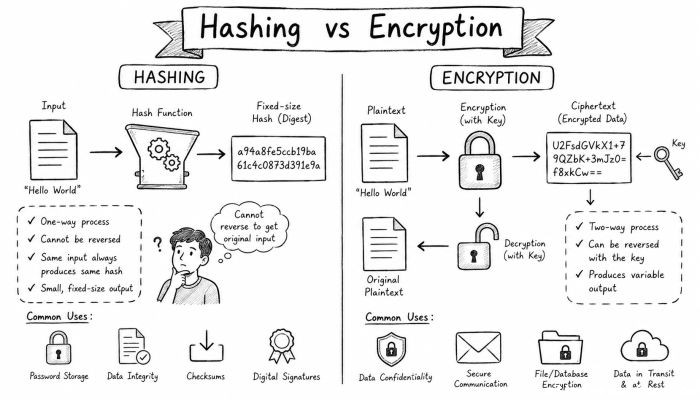
Hashing is a process of transforming input data—of any length—into a fixed-size string of characters, which typically appears as a seemingly random sequence. This output is called a hash or digest. Hash functions are designed so that even a tiny change in the input produces a drastically different hash, making it a useful digital fingerprint of the original data. Importantly, hashing is a one-way process, meaning it cannot be reversed to reveal the original input. This property makes hashing ideal for integrity verification, password storage, and other applications requiring data validation without needing to recover the original data.
What is Encryption?
Encryption is the process of encoding data so that only authorized parties can decode and access it. Unlike hashing, encryption is a two-way function: data is “scrambled” using an algorithm and a key, and it can be “unscrambled” or decrypted using the appropriate key. Encryption aims to maintain confidentiality by preventing unauthorized access to the data, whether it’s in transit over a network or stored on a device. There are several encryption schemes—symmetric encryption uses the same key for encryption and decryption, while asymmetric encryption uses a pair of keys (public and private) for these purposes.
Comparing the Core Purpose
The fundamental difference lies in their objectives: hashing is primarily used for integrity verification and ensuring data authenticity, while encryption is centered on confidentiality. Hashing creates a unique fixed output to efficiently compare data and detect tampering. Encryption protects the actual content from prying eyes by rendering it unreadable unless decrypted. Although both make the information less accessible, only encryption preserves the original data in a reversible form.
How Hashing Functions Work
Hash functions take input data, process it through a series of mathematical operations, and output a fixed-length string regardless of input size. Popular hash functions include MD5, SHA-1, and the more secure SHA-256. A good hash function exhibits several key properties: determinism (same input always produces the same hash), quick computation, pre-image resistance (impossible to retrieve the input from the hash), small changes in input produce unpredictable changes in output (avalanche effect), and collision resistance (hard to find two different inputs producing the same hash). These characteristics make hashing well-suited for detecting unauthorized data alterations.
How Encryption Algorithms Work
Encryption algorithms transform plaintext data into ciphertext through complex mathematical operations and a secret key. Symmetric encryption algorithms, such as AES (Advanced Encryption Standard), use a single key for both encryption and decryption, making them fast and efficient for large volumes of data. Asymmetric algorithms, like RSA, use a public key for encryption and a private key for decryption, facilitating secure key exchange and digital signatures. The security of encryption depends not only on the algorithm but also on proper key management and the strength of the key itself.
Key Use Cases for Hashing
Hashing finds widespread use in various aspects of cybersecurity. Passwords stored in databases are hashed to prevent exposure if the database is compromised: even if attackers obtain the hashes, retrieving the original passwords is infeasible. Hash functions verify data integrity in files and messages, ensuring no tampering occurred during transmission. Digital signatures also utilize hashing: data is hashed and the hash is encrypted with a private key to authenticate the source and guarantee the message’s integrity.
Key Use Cases for Encryption
Encryption is essential whenever sensitive data must remain confidential. This includes protecting communications through protocols like HTTPS, encrypting files on disk, securing emails, and encrypting data stored in cloud environments. Encryption ensures that even if data is intercepted or accessed without authorization, it remains unintelligible without the key. Furthermore, encryption underpins technologies such as VPNs and secure messaging apps, where privacy is integral.
Security Strengths and Vulnerabilities of Hashing
While hashing provides robust means for data verification, certain older hashes like MD5 and SHA-1 have known vulnerabilities, including collision attacks where two distinct inputs produce the same hash. Modern cryptographic standards recommend using secure hashes like SHA-256 or SHA-3. Additionally, hashing alone does not provide confidentiality, so sensitive data like passwords should be combined with techniques like salting (adding random data before hashing) to thwart rainbow table attacks.
Security Strengths and Vulnerabilities of Encryption
Encryption’s security hinges on algorithm robustness, key secrecy, and key length. Modern algorithms like AES are widely trusted and resistant to brute-force attacks when implemented correctly. However, improper key management—such as using weak keys, reusing keys, or exposing keys—can compromise security. Also, encryption can be computationally intensive, and some algorithms may be vulnerable to advances in cryptanalysis or quantum computing, prompting continuous evolution in cryptographic practices.
Performance Considerations
Hashing is generally faster than encryption due to its one-way, stateless nature, making it ideal for fast integrity checks and password verification. Encryption, especially asymmetric encryption, tends to require more processing power and time because of the complex mathematical operations and key management involved. For large-scale data, symmetric encryption is preferred for its speed, often combined with asymmetric encryption to securely exchange keys.
The Role of Hashing and Encryption in Modern Systems
Modern cybersecurity frameworks integrate both hashing and encryption as complementary technologies. For example, secure messaging apps encrypt messages to preserve confidentiality and use hashing to verify message integrity. Digital certificates combine asymmetric encryption and hashing to provide trust in online communications. This layered approach ensures multifaceted protection—confidentiality, integrity, and authenticity.
Future Trends and Developments
Emerging technologies and threats continue to shape hashing and encryption methods. Post-quantum cryptography aims to develop new encryption algorithms resistant to quantum computer attacks, while advancements in hash functions focus on higher security and efficiency. Additionally, growing privacy regulations and data protection laws emphasize the proper use of both techniques as part of comprehensive data governance strategies. Organizations increasingly adopt hybrid cryptographic solutions optimized for evolving cyber threats.
Conclusion
Hashing and encryption are indispensable tools in the arsenal of data security, each playing distinct yet complementary roles. Hashing offers a powerful way to verify data integrity and authenticate information without revealing the original content, while encryption safeguards privacy by transforming readable data into protected ciphertext. Understanding their differences in purpose, process, and application not only helps in selecting the right tool for a given security challenge but also strengthens the overall defense against cyber threats. In a constantly evolving digital landscape, the synergy of hashing and encryption will remain fundamental to ensuring trust, confidentiality, and data integrity across systems worldwide. Embracing these technologies with adequate knowledge empowers individuals and organizations alike to build more resilient, secure digital environments.
 How to Make the Most of Your Holiday Break
 The Best Winter Destinations for a Cozy Getaway
 How to Organize Your Holiday Travel Plans with Ease
 The Ultimate Guide to Cooking for a Crowd
 How to Make Healthy Comfort Food Without the Guilt
 5 Delicious Vegan Breakfast Ideas You Can Make in Minutes