Introduction to Cryptography
In an increasingly digital world, securing information has become more critical than ever. Cryptography, often referred to as the art and science of secret communication, plays a foundational role in protecting data from unauthorized access, ensuring privacy, and establishing trust in electronic transactions. From sending emails and online banking to safeguarding government secrets and military communications, cryptography permeates nearly every aspect of modern life. This article introduces cryptography by exploring its essential concepts, historical roots, types, techniques, and real-world applications, offering readers a comprehensive overview of how cryptography works to keep our digital interactions safe and secure.
- What is Cryptography?
- Historical Evolution of Cryptography
- Symmetric Key Cryptography
- Asymmetric Key Cryptography
- Cryptographic Hash Functions
- Digital Signatures and Authentication
- Key Management and Distribution
- Modern Cryptographic Protocols
- Quantum Cryptography and Future Challenges
- Practical Applications of Cryptography
- Ethical and Legal Considerations
- Learning Cryptography: Tools and Resources
- Conclusion
- More Related Topics
What is Cryptography?
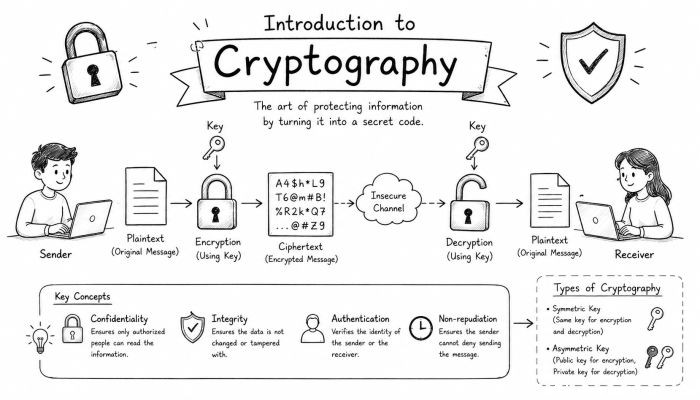
Cryptography is the practice and study of techniques for secure communication in the presence of adversaries. At its core, cryptography involves transforming readable data (plaintext) into an unintelligible format (ciphertext) through encryption, ensuring that only authorized parties can reverse the process using decryption. Beyond secrecy, cryptography also encompasses methods for authentication, data integrity, and non-repudiation, which are essential for verifying identities, ensuring information hasn’t been altered, and preventing denial of actions or transactions.
Historical Evolution of Cryptography
Cryptography has a rich history dating back thousands of years. The earliest known usage traces to ancient Egypt around 1900 BCE with hieroglyphic symbols altered to conceal messages. The Greeks developed the Scytale—a device used for transposition ciphers—and Julius Caesar famously employed substitution ciphers to protect military communications, giving rise to the term "Caesar cipher." Over centuries, techniques evolved with the development of mechanical encryption devices such as the Enigma machine in World War II, which played a pivotal role in wartime intelligence, and ultimately paved the way for modern electronic cryptography.
Symmetric Key Cryptography
Symmetric key cryptography, also called secret key cryptography, uses the same key for both encryption and decryption. This method depends on shared secret keys that must be distributed securely among parties. Popular symmetric algorithms include the Data Encryption Standard (DES) and the Advanced Encryption Standard (AES). Symmetric cryptography is generally fast and efficient for handling large amounts of data, although key management and distribution remain challenging, especially over insecure channels.
Asymmetric Key Cryptography
Unlike symmetric cryptography, asymmetric key cryptography uses a pair of mathematically related keys: a public key and a private key. The public key is openly shared and used for encryption, while only the private key holder can decrypt the message. This method overcomes the key distribution problem inherent in symmetric systems. The RSA algorithm is one of the earliest and most widely used asymmetric cryptographic schemes, foundational to secure internet communications, including SSL/TLS protocols.
Cryptographic Hash Functions
Cryptographic hash functions play an important role in ensuring data integrity. A hash function takes an input of any size and produces a fixed-size string of characters, which appears random. Any modification to the original data, even by a single bit, results in a drastically different hash value, making hashes useful for checking file integrity or storing passwords securely. Popular hashing algorithms include SHA-256 and MD5, though the latter is now considered insecure for cryptographic applications.
Digital Signatures and Authentication
Digital signatures combine cryptographic hash functions and asymmetric cryptography to provide authentication, data integrity, and non-repudiation. A sender generates a hash of a message and encrypts it using their private key to create a signature. Recipients decrypt the signature with the sender’s public key and compare the hash to the message they received. If they match, it confirms that the message originated from the sender and wasn’t altered during transmission. Digital signatures underpin technologies such as secure email and software code signing.
Key Management and Distribution
Secure key management is crucial in cryptography. Generating, storing, distributing, and revoking keys must be handled meticulously to prevent unauthorized access. Traditional manual key exchange methods are vulnerable; hence, protocols like Diffie-Hellman key exchange enable two parties to establish a shared secret over an insecure channel. Modern systems use Public Key Infrastructure (PKI), which leverages digital certificates and trusted certificate authorities (CAs) to manage key trust relationships.
Modern Cryptographic Protocols
Modern cryptographic protocols combine various cryptographic techniques to secure communications over the internet. Transport Layer Security (TLS), the protocol behind HTTPS, uses asymmetric cryptography to exchange symmetric keys securely and subsequently encrypt communication using symmetric algorithms for efficiency. Other examples include IPsec, used for secure internet protocol communications, and blockchain technologies, which use cryptographic techniques to ensure the integrity and authenticity of decentralized ledgers.
Quantum Cryptography and Future Challenges
Quantum computing poses potential threats to current cryptographic standards because quantum algorithms like Shor’s algorithm can efficiently break widely used public-key cryptography systems such as RSA and ECC. As a response, researchers are developing post-quantum cryptography algorithms designed to be secure against quantum attacks. Additionally, quantum cryptography exploits quantum mechanical principles to enable theoretically unbreakable cryptographic communication, such as Quantum Key Distribution (QKD), heralding a new era of security.
Practical Applications of Cryptography
Cryptography's impact extends well beyond theory into practical applications that affect everyday life. Secure messaging apps like Signal and WhatsApp use end-to-end encryption, ensuring that only participants in the conversation can read the messages. Banking and e-commerce rely on cryptography for secure payment processing and protecting sensitive customer data. Governments deploy cryptography for classified communication, while organizations utilize it for protecting intellectual property, digital rights management, and compliance with data protection regulations.
Ethical and Legal Considerations
While cryptography empowers privacy and security, it also raises ethical and legal questions. The balance between individual privacy rights and the needs of law enforcement remains a contentious issue, with debates over “backdoors” that allow government access to encrypted data. Cryptography can be used maliciously by criminals and adversaries to conceal activities. Hence, responsible use, regulatory frameworks, and international cooperation are necessary to harness cryptography for societal benefit while mitigating misuse.
Learning Cryptography: Tools and Resources
For those interested in exploring cryptography, numerous educational resources are available. Online courses, textbooks, and interactive platforms offer foundational knowledge and practical exercises. Programming languages such as Python provide libraries like PyCryptodome that allow learners to experiment with implementing encryption algorithms. Staying current on cryptographic research through journals and attending conferences is also crucial for advanced learners aiming to contribute to this dynamic field.
Conclusion
Cryptography is an indispensable pillar of modern digital security, safeguarding privacy, ensuring data integrity, and facilitating trust in a connected world. Rooted in rich historical traditions and continuously evolving through innovations, cryptography encompasses diverse methods such as symmetric and asymmetric encryption, hashing, and digital signatures. Alongside technical advancements, addressing challenges posed by emerging technologies like quantum computing and ethical concerns remains crucial. As digital reliance deepens, understanding cryptography is not only essential for cybersecurity professionals but also valuable for anyone seeking to navigate and protect their information securely in the digital age.
 How to Make the Most of Your Holiday Break
 The Best Winter Destinations for a Cozy Getaway
 How to Organize Your Holiday Travel Plans with Ease
 The Ultimate Guide to Cooking for a Crowd
 How to Make Healthy Comfort Food Without the Guilt
 5 Delicious Vegan Breakfast Ideas You Can Make in Minutes