Introduction to Graph Algorithms
In the vast realm of computer science and discrete mathematics, graph algorithms stand as fundamental tools that model and solve a myriad of real-world problems. From social networks and transportation systems to web page ranking and biological data analysis, graphs provide a versatile structure for representing relationships between entities. A graph, consisting of nodes (vertices) connected by edges, can capture intricate patterns and dependencies that linear data structures cannot. Graph algorithms delve into these structures, enabling efficient navigation, optimization, and analysis. This article offers a comprehensive introduction to graph algorithms, exploring their core concepts, classifications, and applications. Whether you are a beginner trying to grasp the basics or an intermediate learner looking to deepen your understanding, this guide unfolds the essential techniques and principles behind graph algorithms, illuminating their power and versatility.
- Understanding Graphs: Nodes, Edges, and Types
- Representing Graphs: Adjacency Matrices and Lists
- Graph Traversal Techniques: Depth-First Search (DFS)
- Breadth-First Search (BFS): Exploring Level by Level
- Detecting Cycles and Connectivity
- Shortest Path Algorithms: Dijkstra's Algorithm
- Shortest Paths with Negative Edges: Bellman-Ford Algorithm
- Finding Minimum Spanning Trees: Kruskal’s and Prim’s Algorithms
- Topological Sorting: Ordering Tasks With Dependencies
- Detecting Strongly Connected Components
- Network Flow Algorithms: The Max-Flow Problem
- Real-World Applications of Graph Algorithms
- Conclusion
- More Related Topics
Understanding Graphs: Nodes, Edges, and Types
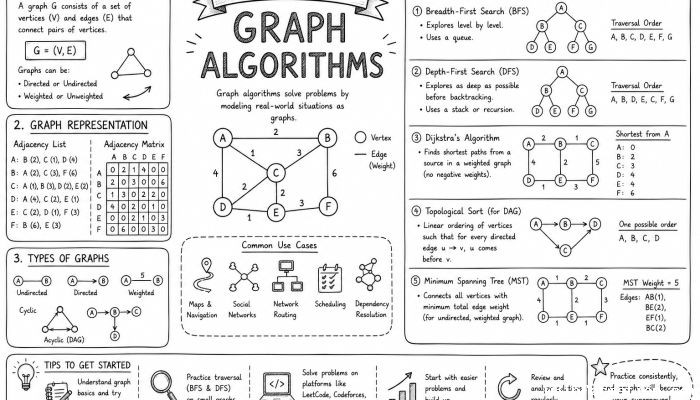
At the heart of graph algorithms lies the structure of the graph itself. A graph consists of vertices (or nodes) and edges that connect pairs of vertices. Graphs can be directed or undirected; in directed graphs, edges have a direction indicating one-way relationships, whereas undirected graphs imply mutual connections. Moreover, edges can carry weights representing distance, cost, or capacity, leading to weighted graphs. Additionally, graphs may be classified as simple (no multiple edges or loops), multigraphs (multiple edges allowed between vertices), or bipartite graphs (vertices split into two disjoint sets with edges only between sets). Understanding these fundamental properties is crucial because different types of graphs require different algorithmic approaches and yield unique insights when analyzed.
Representing Graphs: Adjacency Matrices and Lists
Efficient graph algorithms heavily depend on how the graph is represented in memory. Two common representations are the adjacency matrix and the adjacency list. An adjacency matrix is a 2D array where each element indicates the presence (and possibly weight) of an edge between two vertices. This form is preferred for dense graphs since it allows O(1) edge lookup but uses O(V²) space. Conversely, the adjacency list keeps a list of neighboring vertices for each node, resulting in more space-efficient storage for sparse graphs (graphs with fewer edges). This structure supports efficient iteration over neighbors, which is critical for many traversal and search algorithms. When selecting a representation, one must consider trade-offs between memory consumption and speed of access to edges.
Graph Traversal Techniques: Depth-First Search (DFS)
One of the foundational graph algorithms is Depth-First Search (DFS), a traversal method that explores as far as possible along each branch before backtracking. DFS uses a stack—either explicitly or via recursion—to keep track of pathways. It is particularly effective for exploring connectivity in graphs, detecting cycles, and decomposing graphs into components such as strongly connected components in directed graphs. DFS can also serve as a building block for more complex algorithms like topological sorting and finding articulation points. Its elegance lies in simplicity combined with the power to uncover diverse structural properties within graphs.
Breadth-First Search (BFS): Exploring Level by Level
Breadth-First Search (BFS) complements DFS by exploring graph vertices in layers, starting from a source node and visiting its immediate neighbors before moving to nodes further away. BFS uses a queue data structure to maintain the frontier of exploration. This method excels in finding the shortest path in unweighted graphs, determining connected components, and solving problems related to minimum distance or spreading phenomena like network broadcasting. Understanding the nuances between BFS and DFS equips one with versatile tools for analyzing graphs in varied contexts.
Detecting Cycles and Connectivity
Identifying cycles and measuring connectivity are common graph problems with practical implications. DFS is a robust tool for cycle detection; for instance, in undirected graphs, a back edge during traversal indicates a cycle. In directed graphs, cycle detection is essential to determine if a topological order is possible. Connectivity analysis determines whether a graph is connected as a whole or divided into isolated components. Algorithms like Union-Find (Disjoint Set Union) efficiently track connectivity during dynamic graph operations. These concepts are foundational for applications such as deadlock detection in operating systems and validating prerequisites in course scheduling.
Shortest Path Algorithms: Dijkstra's Algorithm
When edges have weights, finding the shortest path between vertices becomes more complex. Dijkstra's algorithm is a quintessential approach that computes the minimum distance from a single source to all other vertices in graphs with non-negative edge weights. It operates by iteratively selecting the closest unvisited vertex and relaxing its adjacent edges to update their tentative distances. The algorithm's efficiency can be enhanced using priority queues (heaps). Dijkstra’s method is widely used in navigation systems, network routing, and resource optimization problems, showcasing the power of graph algorithms in solving real-world challenges.
Shortest Paths with Negative Edges: Bellman-Ford Algorithm
Unlike Dijkstra’s algorithm, which requires non-negative edges, the Bellman-Ford algorithm addresses shortest path problems where edges can have negative weights. This capability is essential in scenarios where costs or gains can offset each other. Bellman-Ford iteratively relaxes edges up to |V| - 1 times, where V is the number of vertices, making it slower but more versatile. A key feature is its ability to detect negative weight cycles, which invalidate shortest path definitions. This detection plays a critical role in financial modeling and detecting arbitrage opportunities in currency exchange graphs.
Finding Minimum Spanning Trees: Kruskal’s and Prim’s Algorithms
In weighted undirected graphs, a common task is to connect all vertices with the minimum total edge weight—this is the minimum spanning tree (MST) problem. Kruskal’s algorithm builds the MST by sorting edges by weight and adding the smallest edges that do not form cycles, employing a Union-Find data structure to efficiently prevent cycles. Prim’s algorithm starts from a chosen vertex and grows the MST by adding the lightest edge connecting the tree to a new vertex. Both algorithms are foundational in network design, minimizing wiring costs, and cluster analysis.
Topological Sorting: Ordering Tasks With Dependencies
For directed acyclic graphs (DAGs), topological sorting creates a linear ordering of vertices such that for every directed edge u → v, u appears before v in the ordering. This technique is vital in scheduling problems, such as arranging tasks with dependencies, compiling source codes, and organizing class prerequisites. Algorithms for topological sorting typically rely on DFS or BFS (Kahn’s algorithm), leveraging the absence of cycles in DAGs to guarantee that a valid order exists.
Detecting Strongly Connected Components
In directed graphs, strongly connected components (SCCs) are maximal subgraphs where every vertex is reachable from every other vertex. Identifying SCCs is crucial in understanding the structure of graphs, optimizing circuits, and analyzing social network clusters. Kosaraju’s and Tarjan’s algorithms are popular methods for finding SCCs, both based on DFS with linear time complexity. Recognizing SCCs allows decomposition of complex graphs into simpler parts, facilitating modular analysis and processing.
Network Flow Algorithms: The Max-Flow Problem
The analysis of network flow extends graph algorithms into domains like transportation, communication, and supply chain management. The Maximum Flow problem seeks the greatest amount of flow that can be sent from a source to a sink through a network with capacity constraints on edges. The Ford-Fulkerson method and its optimized implementation, the Edmonds-Karp algorithm, use augmenting paths found by BFS or DFS to iteratively increase flow until no more improvements are possible. Maximum flow algorithms underpin resource allocation, traffic management, and bipartite matching.
Real-World Applications of Graph Algorithms
Beyond theoretical interest, graph algorithms permeate countless real-world applications. Social media platforms analyze user interactions with graph traversal and community detection. Search engines rank pages via algorithms like PageRank, which model web links as weighted graphs. Logistics companies optimize routes with shortest path and MST algorithms. Biological networks, such as protein interactions, use graph structures to identify functional modules and disease pathways. Understanding graph algorithms thus equips professionals to tackle diverse challenges, turning complex relationships into actionable solutions.
Conclusion
Graph algorithms form a cornerstone of computer science, offering elegant solutions to complex problems by leveraging relationships and structures inherent in data. From the basics of graph representations to sophisticated techniques like network flows and strongly connected components, these algorithms demonstrate versatility and depth. Grasping fundamental traversal methods like DFS and BFS paves the way toward understanding optimization strategies such as shortest paths and minimum spanning trees. As real-world networks become increasingly interconnected, the relevance of graph algorithms continues to expand across technology, science, and industry. By mastering these concepts, learners and practitioners gain powerful tools to model, analyze, and optimize systems that shape our digital and physical worlds.
 How to Make the Most of Your Holiday Break
 The Best Winter Destinations for a Cozy Getaway
 How to Organize Your Holiday Travel Plans with Ease
 The Ultimate Guide to Cooking for a Crowd
 How to Make Healthy Comfort Food Without the Guilt
 5 Delicious Vegan Breakfast Ideas You Can Make in Minutes