Sorting Algorithms Comparison
In the vast realm of computer science, sorting algorithms stand as fundamental pillars that facilitate efficient data organization and retrieval. From the simplest tasks of arranging a list of numbers to complex applications in database management, search optimization, and machine learning, sorting algorithms play a critical role. The efficiency of these algorithms impacts overall system performance, influencing both time complexity and resource consumption. As developers and computer scientists, understanding how various sorting algorithms function, their strengths and weaknesses, and their use-case scenarios is essential for selecting the right tool for a given problem. This article delves into a comprehensive comparison of popular sorting algorithms, exploring their mechanisms, performance metrics, and practical applications, allowing readers to gain a well-rounded insight into this cornerstone topic.
- What Are Sorting Algorithms?
- Why Sorting Algorithms Matter
- Classification of Sorting Algorithms
- Bubble Sort: Simplicity at a Cost
- Selection Sort: Minimal Swaps but Slow
- Insertion Sort: Efficient for Small or Nearly Sorted Data
- Merge Sort: The Divide and Conquer Champion
- Quick Sort: Fastest for Average Cases
- Heap Sort: Reliable and Memory-Efficient
- Counting Sort: Non-Comparison for Integer Data
- Radix Sort: Sorting by Digits
- Comparing Stability and Space Complexity
- Choosing the Right Sorting Algorithm
- Conclusion
- More Related Topics
What Are Sorting Algorithms?
Sorting algorithms are systematic methods used to rearrange elements in a list or array into a particular order—commonly in numerical, lexicographical, or custom sequences. The primary goal is to reorder data so that operations such as searching, merging, or analyzing become more efficient and meaningful. These algorithms differ in implementation, computational complexity, and usage context but share the common objective of organizing data. Sorting is often considered a precursor step in many computational processes, making algorithm choice critical for optimizing overall system workflows.
Why Sorting Algorithms Matter
Efficient sorting is vital for improving the performance of various computer operations, including searching algorithms like binary search which require sorted data. Additionally, sorting enhances the readability and accessibility of data, particularly in large datasets. From databases to user interfaces, sorted data allows easier data manipulation and quicker decision-making. Moreover, sorting algorithms form the basis for more complex algorithms and systems such as priority queues and graph algorithms, thus driving the need for precise comparisons and selection criteria to suit diverse needs.
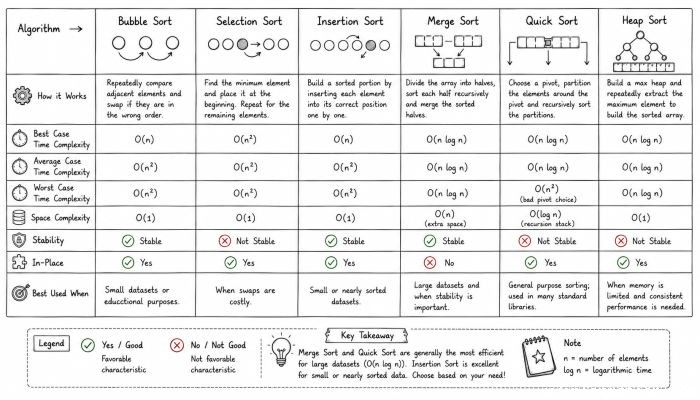
Classification of Sorting Algorithms
Sorting algorithms can broadly be classified into two types: comparison-based and non-comparison-based. Comparison-based sorting relies on comparing elements to determine their order. Examples include Quick Sort, Merge Sort, and Bubble Sort. Non-comparison sorts, such as Counting Sort and Radix Sort, leverage the properties of data (e.g., integer keys) to sort without direct comparisons, often achieving faster runtimes on specialized datasets. Further classifications include in-place vs. out-of-place, stable vs. unstable sorting, and recursive vs. iterative implementations, which influence performance and applicability.
Bubble Sort: Simplicity at a Cost
Bubble Sort is one of the simplest sorting algorithms, operating by repeatedly swapping adjacent elements if they are in the wrong order. Despite its intuitive approach, Bubble Sort suffers from a time complexity of O(n²), making it inefficient for large datasets. It’s rarely used in practical applications but serves as an educational tool to illustrate basic sorting mechanics and algorithmic complexity. Its stable sorting attribute, however, ensures equal elements retain their original order, which can be valuable in certain contexts.
Selection Sort: Minimal Swaps but Slow
Selection Sort improves upon Bubble Sort by minimizing the number of swaps. It divides the input list into a sorted and unsorted region, then selects the smallest (or largest) element from the unsorted region and swaps it into its correct position. While this reduces the number of writes—a useful property when write operations are costly—it still maintains an O(n²) time complexity. Selection Sort is easy to implement but not suitable for large or time-critical applications.
Insertion Sort: Efficient for Small or Nearly Sorted Data
Insertion Sort builds the sorted array one element at a time by repeatedly inserting the next element into a sorted sublist. This algorithm performs exceptionally well when dealing with small datasets or those that are already nearly sorted, boasting an average and worst-case time complexity of O(n²) but a best-case of O(n). Its simplicity and efficiency in particular use cases make it a common choice for hybrid algorithms and small benchmark scenarios.
Merge Sort: The Divide and Conquer Champion
Merge Sort uses a divide and conquer strategy to sort an array by recursively dividing it into halves, sorting each half, and then merging the sorted halves into a balanced, sorted whole. It guarantees a time complexity of O(n log n), regardless of input distribution, and is stable by nature. Merge Sort’s main drawback is its additional space requirement (O(n)) due to its divide and merge processes. Nevertheless, it is ideal for large datasets and external sorting where stability and guaranteed performance are important.
Quick Sort: Fastest for Average Cases
Quick Sort is often the preferred sorting algorithm due to its average-case O(n log n) time complexity and in-place sorting capability, requiring minimal extra memory. It selects a “pivot” element and partitions the array into two subarrays—elements less than the pivot and those greater—then recursively sorts the subarrays. While Quick Sort is generally faster than Merge Sort, its worst-case time complexity degrades to O(n²) in cases of poor pivot choices. However, with proper pivot selection strategies such as randomization or median-of-three, these pitfalls can be largely mitigated.
Heap Sort: Reliable and Memory-Efficient
Heap Sort builds a binary heap data structure to efficiently sort an array. By constructing a max heap, it repeatedly removes the largest element and places it at the end of the array, sorting the dataset in-place. Heap Sort has a time complexity of O(n log n) for all cases and requires O(1) additional space, making it memory efficient. However, it is not stable because the heap structure rearranges elements arbitrarily. Its predictability and efficiency in bounded memory conditions make it a valuable alternative when quicksort’s instability or merge sort’s space requirements are a concern.
Counting Sort: Non-Comparison for Integer Data
Counting Sort diverges from comparison-based methods by assuming the input consists of integers within a fixed range. It counts the occurrences of each distinct integer and calculates positions based on these counts, allowing sorting in O(n + k) time, where *k* is the range of the input values. This makes Counting Sort extremely efficient for datasets with limited value ranges. It is stable and used often as a subroutine in radix sort but is impractical for large ranges or non-integer data.
Radix Sort: Sorting by Digits
Radix Sort extends the idea of Counting Sort by processing integer or string keys digit by digit, starting from the least significant digit to the most significant. By applying stable counting sorts to each digit, Radix Sort handles large datasets efficiently in O(d(n + k)) time, where *d* is the number of digits. It performs exceptionally on fixed-length integer keys or strings but requires stable intermediate sorts and extra memory. Radix Sort illustrates how problem-specific characteristics can optimize sorting beyond comparison limits.
Comparing Stability and Space Complexity
Besides time efficiency, two critical factors impacting algorithm choice are stability—whether equal elements retain their input order after sorting—and space complexity—how much extra memory is required. Stability matters in multi-level sorting scenarios, such as sorting database records by multiple fields. Algorithms like Merge Sort and Insertion Sort are stable, while Quick Sort and Heap Sort typically are not. Space considerations distinguish in-place algorithms (Quick Sort, Heap Sort) from those requiring extra memory (Merge Sort, Counting Sort), influencing decisions in memory-constrained environments.
Choosing the Right Sorting Algorithm
Selecting the most suitable sorting algorithm depends on input size, data distribution, stability needs, memory constraints, and performance requirements. For small or nearly sorted arrays, Insertion Sort is preferable. Quick Sort is a robust general-purpose option, though care must be taken to avoid worst-case scenarios. Merge Sort excels when stability is required or for external sorting. Non-comparison sorts are advantageous for specific data types under constrained ranges. Ultimately, understanding the trade-offs allows developers to make informed, context-sensitive algorithm choices.
Conclusion
Sorting algorithms form the backbone of efficient data handling in computing, impacting everything from simple data displays to complex data processing pipelines. Each algorithm offers distinct advantages tailored to various problem scenarios, whether through simplicity, speed, stability, or memory efficiency. By comparing these algorithms in terms of their methodology, time and space complexity, stability, and practical applications, one gains valuable insights into optimizing data organization tasks. In a world increasingly dependent on rapid data processing, mastery of sorting algorithms remains a timeless and essential skill, guiding the way toward smarter, faster, and more reliable software solutions.
 How to Make the Most of Your Holiday Break
 The Best Winter Destinations for a Cozy Getaway
 How to Organize Your Holiday Travel Plans with Ease
 The Ultimate Guide to Cooking for a Crowd
 How to Make Healthy Comfort Food Without the Guilt
 5 Delicious Vegan Breakfast Ideas You Can Make in Minutes