How to Implement Binary Search in Python
In the world of computer science and programming, the ability to efficiently search through data is paramount. As datasets grow larger and more complex, simple methods like linear search become impractical, prompting the need for faster algorithms. Binary search stands out as one of the most efficient searching techniques for sorted arrays or lists, boasting a logarithmic time complexity of O(log n). This efficiency makes it indispensable for many applications, from database querying to system functions. Implementing binary search in Python not only solidifies your grasp of algorithmic thinking but also enhances your problem-solving toolkit. This article walks you through the fundamentals of binary search, from conceptual understanding to practical implementation, optimizing your approach with Python’s robust features and offering insights into common pitfalls to avoid.
- What is Binary Search?
- Why Use Binary Search?
- Prerequisites: Sorted Input
- Binary Search Algorithm Explained
- Implementing Iterative Binary Search in Python
- Recursive Binary Search in Python
- Handling Edge Cases
- Implementing Binary Search to Find First or Last Occurrence
- Binary Search with Python’s `bisect` Module
- Time Complexity and Space Complexity Analysis
- Practical Applications of Binary Search
- Common Mistakes and How to Avoid Them
- Enhancing Binary Search: Searching in Rotated Sorted Arrays
- Conclusion
- More Related Topics
What is Binary Search?
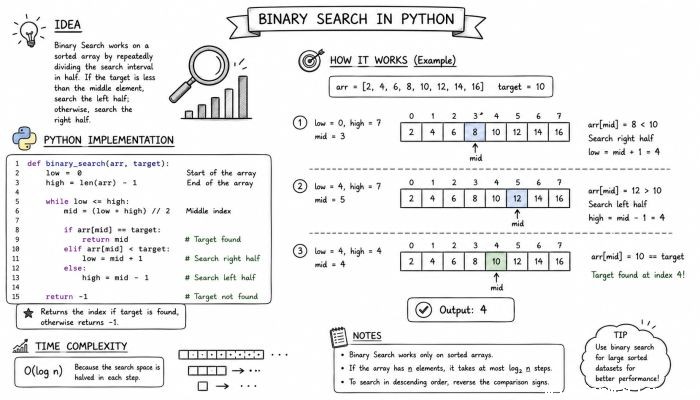
Binary search is a divide-and-conquer algorithm used to find the position of a target value within a sorted array or list. Unlike linear search, which inspects each element sequentially, binary search dramatically reduces the number of comparisons by repeatedly halving the search interval. Starting from the middle of the sorted array, the algorithm compares the target with the midpoint element. If the target matches this element, the search ends; if it's smaller, the search continues in the left half; if larger, in the right half. This process repeats until the target is found or the subarray reduces to zero size. Due to its efficiency and simplicity, binary search is a cornerstone technique in both academic and industry settings.
Why Use Binary Search?
The primary reason to use binary search over simpler methods is performance. Binary search operates in O(log n) time, meaning even very large sorted datasets can be searched rapidly. For example, finding an element in a list of one million items requires at most about 20 comparisons with binary search, compared to up to one million with linear search. Moreover, binary search is not only faster but also more predictable in terms of worst-case performance. This makes it ideal for systems requiring consistent and fast response times, such as real-time applications. Understanding binary search also provides a foundation for more advanced algorithms that build upon its principles.
Prerequisites: Sorted Input
A critical requirement for binary search to function correctly is that the input data must be sorted. Binary search exploits the sorted order to eliminate half of the search space at each step. If the input list is unsorted, the algorithm will produce incorrect results. Hence, ensuring your data is sorted before applying binary search is mandatory. In Python, sorting can be done using the built-in `sorted()` function or the `list.sort()` method. For example, `sorted_list = sorted(my_list)` returns a new sorted list, allowing safe binary search operations without altering the original data.
Binary Search Algorithm Explained
The binary search algorithm involves the following steps:
1. Initialize two pointers: `low` set to the start index (0), and `high` set to the end index (length of array minus one).
2. While `low` is less than or equal to `high`:
- Calculate the middle index: `mid = (low + high) // 2`.
- Compare the middle element with the target.
- If the middle element equals the target, return its index.
- If the middle element is greater than the target, adjust `high` to `mid - 1`.
- Otherwise, adjust `low` to `mid + 1`.
3. If the target is not found, return an indicator such as `-1`.
This repeated halving ensures rapid narrowing of the search space until the element is found or deemed missing.
Implementing Iterative Binary Search in Python
The iterative approach uses a loop to implement the repeated halving process. It is efficient, easy to understand, and typically preferred in Python for its straightforwardness and minimal overhead compared to recursion.
```python
def binary_search_iterative(arr, target):
low, high = 0, len(arr) - 1
while low <= high:
mid = (low + high) // 2
if arr[mid] == target:
return mid
elif arr[mid] < target:
low = mid + 1
else:
high = mid - 1
return -1
```
In this function, `arr` is the sorted list, and `target` is the value to find. The function returns the index of the target if found; otherwise, it returns -1.
---
Recursive Binary Search in Python
A recursive implementation of binary search uses function calls to navigate the search space instead of a loop. This version is elegant and mirrors the algorithm's conceptual description but may be slightly less efficient in some cases due to function call overhead.
```python
def binary_search_recursive(arr, target, low, high):
if low > high:
return -1
mid = (low + high) // 2
if arr[mid] == target:
return mid
elif arr[mid] < target:
return binary_search_recursive(arr, target, mid + 1, high)
else:
return binary_search_recursive(arr, target, low, mid - 1)
```
To call this function initially, you must specify the bounds:
```python
index = binary_search_recursive(arr, target, 0, len(arr) - 1)
```
This approach recursively reduces the search range until the base case is met.
---
Handling Edge Cases
Correct binary search implementations must handle several edge cases:
- Empty list: Search should immediately return -1.
- Single-element list: Correctly return 0 if found, otherwise -1.
- Duplicate elements: Binary search returns an index of any matching element. To find the first or last occurrence, modifications are needed.
- Target not in the list: Return a sentinel value (e.g., -1).
Accounting for these ensures robustness and reliability in varying scenarios.
---
Implementing Binary Search to Find First or Last Occurrence
When searching for duplicates, binary search can be modified to find the first or last occurrence of the target. This is useful in frequency counting or range searching.
For example, to find the first occurrence:
```python
def binary_search_first(arr, target):
low, high = 0, len(arr) - 1
result = -1
while low <= high:
mid = (low + high) // 2
if arr[mid] == target:
result = mid
high = mid - 1 # Continue to search in left half
elif arr[mid] < target:
low = mid + 1
else:
high = mid - 1
return result
```
The idea is to continue searching the left half even after finding the target to locate the earliest index.
---
Binary Search with Python’s `bisect` Module
Python offers the `bisect` module, which provides built-in support for binary search on lists, including insertion points. It abstracts the complexity of manual implementation.
Example:
```python
import bisect
def search_with_bisect(arr, target):
index = bisect.bisect_left(arr, target)
if index != len(arr) and arr[index] == target:
return index
return -1
```
The `bisect_left` function returns the insertion point to maintain sorted order, which can be used to verify the presence of the target.
---
Time Complexity and Space Complexity Analysis
Binary search shines due to its O(log n) time complexity, achieved by halving the search space at each step. Whether implemented iteratively or recursively, the number of comparisons scales logarithmically with input size. Regarding space:
- Iterative approaches use O(1) space.
- Recursive implementations may use O(log n) space due to call stack usage.
For very deep recursions on massive datasets, iterative methods are more memory efficient.
---
Practical Applications of Binary Search
Beyond simple search tasks, binary search is foundational in algorithms like:
- Searching in sorted databases or files.
- Finding boundaries in search problems, like the smallest/largest value meeting a condition.
- Implementing efficient solutions in coding challenges involving ordered data.
- Systems requiring fast membership tests or lookups.
Mastering binary search enhances the ability to craft optimized algorithms for diverse domains.
---
Common Mistakes and How to Avoid Them
Binary search can be deceptively tricky. Some common pitfalls include:
- Incorrect midpoint calculation leading to overflow (e.g., in languages with fixed integer sizes): In Python, this isn't an issue due to arbitrary-size integers, but calculating mid as `low + (high - low) // 2` is a good habit.
- Infinite loops because of incorrect update of pointers: Ensure `low` and `high` pointers update correctly to shrink the search space.
- Forgetting to check the boundary conditions, especially for edge cases like empty lists.
- Using binary search on unsorted data, producing incorrect results.
Thorough testing and debugging help circumvent these issues.
---
Enhancing Binary Search: Searching in Rotated Sorted Arrays
A common interview question is to perform binary search on a rotated sorted array, where the sorted array has been shifted at a pivot point. This requires modified logic to decide which side to search.
Example outline:
- Identify which half (left or right) is sorted.
- Decide if the target lies within the sorted part.
- Recursively or iteratively search the correct half.
Implementing this variation strengthens your understanding of binary search’s flexibility.
---
Conclusion
Binary search is a powerful and efficient searching method essential for any programmer's toolkit. This article has illuminated its fundamental principles, the importance of sorted inputs, iterative and recursive implementations in Python, and adaptations for special cases. Mastering binary search enhances your ability to handle large datasets effectively while fostering algorithmic thinking. Whether using custom coded solutions or Python’s built-in `bisect` module, the key lies in understanding how to meticulously halve the search space without losing track of boundaries. In practice, binary search extends beyond mere element lookup—it serves as the foundation for complex problem-solving and optimization tasks, making its mastery a worthwhile endeavor in growing as a proficient developer. By practicing and applying these concepts, you can harness the full potential of binary search in your coding journey.
 How to Make the Most of Your Holiday Break
 The Best Winter Destinations for a Cozy Getaway
 How to Organize Your Holiday Travel Plans with Ease
 The Ultimate Guide to Cooking for a Crowd
 How to Make Healthy Comfort Food Without the Guilt
 5 Delicious Vegan Breakfast Ideas You Can Make in Minutes