Common Algorithms You Should Know
In today’s digital age, algorithms form the backbone of nearly every application and system we interact with. From searching for information on the internet to navigating complex data structures, algorithms dictate how efficiently and effectively these tasks are performed. Whether you are a budding programmer, a computer science student, or a professional in the tech industry, understanding common algorithms is essential for both problem-solving and algorithmic thinking. This article aims to demystify some of the most fundamental algorithms that form the core of computer science. We will explore their principles, use cases, and significance in various scenarios, providing you with a solid grasp on these timeless tools that continue to shape technology and innovation.
- What is an Algorithm?
- Sorting Algorithms: Organizing Data Efficiently
- Search Algorithms: Finding Data Rapidly
- Recursive Algorithms: Solving Problems by Breaking Them Down
- Dynamic Programming: Optimizing by Storing Subproblems
- Greedy Algorithms: Making Locally Optimal Choices
- Graph Algorithms: Navigating Networks
- Divide and Conquer: Problem Decomposition
- Backtracking: Exploring all Possibilities
- Hashing Algorithms: Fast Data Access
- String Algorithms: Manipulating Text Efficiently
- Understanding Algorithm Complexity: Big O Notation
- Conclusion
- More Related Topics
What is an Algorithm?
An algorithm is a well-defined sequence of instructions designed to perform a specific task or solve a particular problem. In computer science, algorithms provide the logical frameworks needed to process data, make decisions, and automate repetitive operations. They are central to programming, ensuring that computers execute operations efficiently and accurately. Whether it's sorting a list, searching for an element, or managing resources, algorithms are the conceptual foundation that translates problem requirements into actionable steps. Their effectiveness can often be judged by metrics like time complexity and space complexity, which measure how fast and how resource-efficient they are, respectively.
Sorting Algorithms: Organizing Data Efficiently
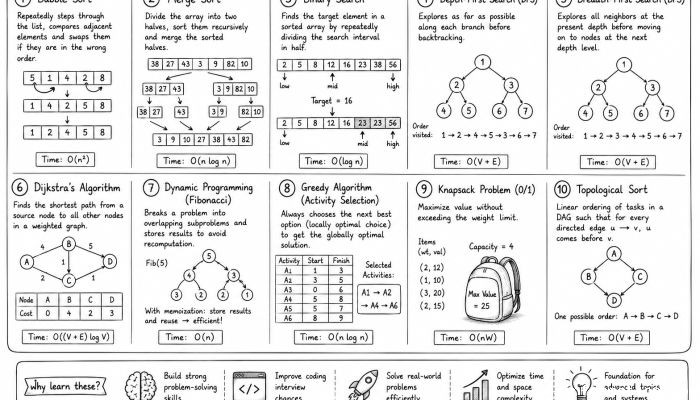
Sorting is one of the most common algorithmic problems and is crucial since many other algorithms depend on sorted data to function correctly. Popular sorting algorithms include Bubble Sort, Insertion Sort, Merge Sort, Quick Sort, and Heap Sort. Bubble Sort and Insertion Sort are simple but inefficient for large datasets, operating on average in O(n²) time, which limits their scalability. More advanced algorithms like Merge Sort and Quick Sort leverage divide-and-conquer strategies to achieve O(n log n) average-case performance, making them suitable for larger inputs. Understanding how these algorithms operate helps in choosing the right sort to suit the task at hand, balancing simplicity, speed, and resource usage.
Search Algorithms: Finding Data Rapidly
Searching algorithms help locate specific elements within a data structure. The basic linear search scans elements sequentially, suitable for unsorted data but inefficient for large datasets with O(n) time complexity. Binary Search, however, is a powerful algorithm designed for sorted arrays. It repeatedly divides the search interval, discarding half of the search space at each step, operating in O(log n) time. This efficiency gain is vital for large-scale data retrieval systems. Beyond these, specialized search algorithms such as depth-first search (DFS) and breadth-first search (BFS) are widely used for traversing graph and tree data structures, expanding the horizon of search paradigms beyond linear collections.
Recursive Algorithms: Solving Problems by Breaking Them Down
Recursion is a technique where an algorithm solves a problem by solving smaller instances of the same problem. Recursive algorithms are particularly elegant and powerful for problems that have natural hierarchical or repetitive structures. Classic examples include calculating factorials, Fibonacci sequences, and navigating tree structures. However, recursion requires a base case to terminate the call stack; otherwise, it risks infinite loops and stack overflow. While recursion can make code more intuitive and easier to understand, it may also incur higher memory costs compared to iterative solutions. Mastering when and how to utilize recursion is key for algorithmic versatility.
Dynamic Programming: Optimizing by Storing Subproblems
Dynamic programming (DP) is an advanced technique used to solve complex problems by breaking them down into simpler overlapping subproblems, storing results to avoid redundant computations. This approach is extremely useful for optimization problems such as the knapsack problem, calculating Fibonacci numbers efficiently, and finding shortest paths in weighted graphs. By employing memoization or tabulation, DP transforms exponential time complexity problems, which are impractical for large input sizes, into polynomial-time solutions. Understanding how to recognize problems suitable for dynamic programming and structure their solutions can greatly enhance one’s problem-solving toolkit.
Greedy Algorithms: Making Locally Optimal Choices
Greedy algorithms make decisions based on the best immediate or local choice, hoping that these local optimizations lead to a globally optimal solution. They are straightforward and efficient, often resulting in fast, simple algorithms. A classic example is the coin change problem, where one tries to make change with the fewest coins. Other canonical problems solvable by greedy algorithms include Huffman coding for data compression and Prim’s or Kruskal’s algorithms for finding minimum spanning trees. Although greedy strategies don’t guarantee optimal solutions for every problem, their simplicity and effectiveness in many contexts make them indispensable.
Graph Algorithms: Navigating Networks
Graphs are data structures used to represent pairwise relationships among objects. Graph algorithms are essential in many fields, including social networks, transportation systems, and web page ranking. Key algorithms include Dijkstra’s algorithm for shortest path, Bellman-Ford algorithm for graphs with negative weights, and Floyd-Warshall algorithm for all pairs shortest paths. Additionally, DFS and BFS play foundational roles in connectivity and traversal problems. Understanding graph algorithms requires grasping concepts like vertices, edges, directed and undirected graphs, weighted and unweighted connections, and cycles. Mastering these can unlock solutions to complex network problems.
Divide and Conquer: Problem Decomposition
Divide and conquer is a strategic algorithmic paradigm that divides a problem into smaller subproblems, conquers these independently, and then combines their solutions to solve the original problem. This approach underpins many efficient algorithms such as Merge Sort and Quick Sort. It is also used in binary search and various numerical algorithms. Divide and conquer algorithms often have logarithmic or logarithmic-linear time complexities, making them highly performant for large datasets. This method exemplifies how breaking a problem into manageable parts can drastically simplify complexity and computation time.
Backtracking: Exploring all Possibilities
Backtracking is a systematic method for generating all possible configurations or solutions for a problem, abandoning each path as soon as it is determined to lead to an invalid or incomplete state. It is widely used in solving puzzles, combinatorial problems, and constraint satisfaction tasks, such as the N-Queens problem, Sudoku, and maze navigation. Backtracking explores the solution space depth-first, rolling back ("backtracking") when a dead-end is reached. Although backtracking can be computationally expensive in the worst cases, pruning techniques and heuristics often make it practical and efficient for many applications.
Hashing Algorithms: Fast Data Access
Hashing is a technique to map data of arbitrary size to fixed-size values called hash codes, which are then used to index data for efficient retrieval. Hash functions are fundamental to implementing hash tables, a crucial data structure for fast access, insertion, and deletion operations, typically achieving average O(1) time complexity. Common real-world applications include database indexing, caching, password storage (through cryptographic hashing), and data deduplication. Understanding hashing involves knowledge of collision resolution strategies like chaining and open addressing, which maintain performance even when hash collisions occur.
String Algorithms: Manipulating Text Efficiently
String algorithms are specialized procedures designed to handle tasks involving text, such as searching, pattern matching, and parsing. Popular algorithms include the Knuth-Morris-Pratt (KMP) algorithm for efficient substring searching, Rabin-Karp for detecting plagiarism or duplicate strings, and the Z algorithm for quick pattern identification. These algorithms reduce the time complexity from naïve methods and find direct application in text editors, search engines, and bioinformatics. Their proficiency can drastically enhance the speed and accuracy of text processing in computational systems.
Understanding Algorithm Complexity: Big O Notation
No discussion of algorithms is complete without understanding their complexity, often represented using Big O notation. This notation classifies algorithms based on their performance relative to input size, emphasizing worst-case behavior. For example, an algorithm with time complexity O(n) grows linearly with input size, while O(n²) grows quadratically, becoming impractical for large datasets. Space complexity refers to memory consumption. Evaluating and comparing algorithms by their Big O characteristics allow developers to choose the most efficient solution, especially in environments with limited resources or real-time requirements.
Conclusion
Algorithms are the invisible engines driving modern computing, translating complex problems into clear, executable instructions. From basic searching and sorting to sophisticated dynamic programming and graph traversal techniques, each algorithm offers powerful strategies to tackle a variety of challenges. Familiarity with these common algorithms equips programmers and computer scientists with essential tools to design efficient, reliable software and systems. As technology evolves and datasets grow, understanding and mastering these foundational algorithms not only improves technical competence but also fosters innovative thinking and problem-solving prowess. By continually exploring algorithmic approaches, one can unlock new possibilities and optimize solutions in an ever-changing digital world.
 How to Make the Most of Your Holiday Break
 The Best Winter Destinations for a Cozy Getaway
 How to Organize Your Holiday Travel Plans with Ease
 The Ultimate Guide to Cooking for a Crowd
 How to Make Healthy Comfort Food Without the Guilt
 5 Delicious Vegan Breakfast Ideas You Can Make in Minutes