Dynamic Programming Simplified
In the realm of computer science and algorithm design, dynamic programming (DP) stands out as a potent technique that transforms seemingly intractable problems into manageable ones. It’s a method that thrives on breaking down complex problems into simpler subproblems and solving each just once, thereby saving immense amounts of computational effort. Despite its power, dynamic programming can often appear daunting to beginners due to its abstract nature and the subtleties involved in problem decomposition and state management. This article aims to demystify dynamic programming by simplifying its core concepts, steps, and applications. Whether you’re a student grappling with your first DP problem or a programmer eager to deepen your understanding, this guide will offer clear explanations, illustrative examples, and practical strategies to master dynamic programming efficiently.
- What is Dynamic Programming?
- Key Concepts: Optimal Substructure and Overlapping Subproblems
- Memoization: The Top-Down Approach
- Tabulation: The Bottom-Up Approach
- Identifying Subproblems and States
- Writing Recurrence Relations
- Space Optimization Techniques
- Common Dynamic Programming Problems and Their Solutions
- Dynamic Programming in Real-World Applications
- Tips and Strategies for Learning Dynamic Programming
- Common Pitfalls to Avoid
- Advancements and Variants of Dynamic Programming
- Tools and Resources to Master Dynamic Programming
- Conclusion: Embracing the Power of Dynamic Programming
- More Related Topics
What is Dynamic Programming?
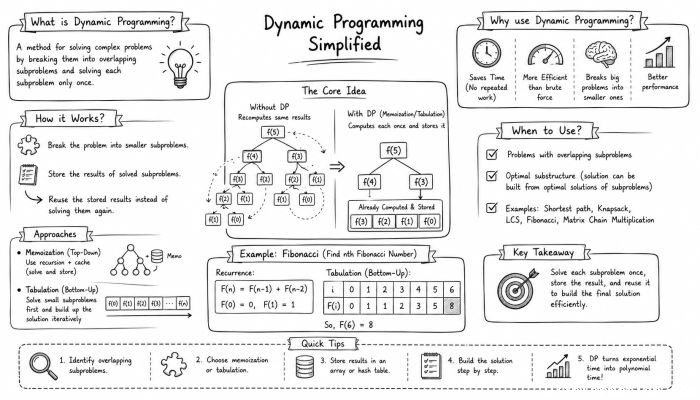
Dynamic programming is a method for solving complex problems by breaking them down into simpler subproblems and storing their solutions to avoid redundant computations. At its heart, DP leverages the principles of optimal substructure and overlapping subproblems. Unlike divide-and-conquer algorithms that solve independent subproblems recursively, DP tackles problems where subproblems share sub-subproblems, making caching results critical. The term "programming" here doesn’t relate to computer code but comes from mathematical optimization, where it refers to step-by-step decision processes. Through memoization or tabulation, dynamic programming provides a systematic way to solve optimization problems, sequence analysis, and resource allocation with significantly reduced time complexity.
Key Concepts: Optimal Substructure and Overlapping Subproblems
Understanding dynamic programming hinges upon two integral concepts: optimal substructure and overlapping subproblems. Optimal substructure means that the solution to a problem can be constructed efficiently from solutions to its subproblems—if an optimal solution to a problem includes optimal solutions to its subproblems, the problem displays this property. Overlapping subproblems imply that the problem can be broken down into subproblems which recur multiple times throughout the computation. Unlike problems suited for divide and conquer, where subproblems are independent, DP problems repeatedly solve identical subproblems. Recognizing these characteristics in a problem is the first step in deciding whether dynamic programming is a suitable approach.
Memoization: The Top-Down Approach
Memoization is a top-down technique in dynamic programming where the problem is solved in a recursive manner, but solutions to subproblems are saved in a cache (usually a hash table or array) so that repeated calculations are avoided. When a function is called with the same arguments, the stored result is returned directly instead of recomputing. Memoization effectively trades space for time, often converting exponential time recursive solutions into polynomial time. This approach is particularly intuitive when solving problems that naturally lend themselves to recursive definitions, such as calculating Fibonacci numbers, combinatorial counts, or pathfinding problems in graphs.
Tabulation: The Bottom-Up Approach
Contrasting memoization is tabulation, a bottom-up dynamic programming approach. Instead of recursion, tabulation involves explicitly building up a table (usually an array or matrix) that represents what subproblems have been solved and their answers. Start from the simplest subproblems (usually the smallest inputs) and incrementally solve larger subproblems using previously computed results. This approach eliminates the overhead of recursive calls and is typically iterative. Tabulation is preferred when the number of subproblems is known and can be processed in a logical sequence, like in classic problems such as the knapsack, longest common subsequence, or edit distance.
Identifying Subproblems and States
The art of dynamic programming involves correctly identifying the subproblems and defining the states used to represent them. A state is a set of parameters that uniquely describes a subproblem’s context. For instance, in a knapsack problem, a state might be defined by the current index of the item being considered and the remaining weight capacity. This abstraction allows us to think in terms of transitions between states, which dynamic programming algorithms solve systematically. Choosing the right abstraction simplifies the formulation of recurrence relations, ensures manageable memory usage, and enhances program clarity.
Writing Recurrence Relations
Recurrence relations are mathematical equations or formulas that describe the value of a function in terms of its values on smaller inputs. They form the backbone of dynamic programming by expressing how to compute a solution from previously computed results. For example, the Fibonacci sequence follows the relation F(n) = F(n-1) + F(n-2). In DP problems, the relation often captures choices or decisions: like whether to include an item in the knapsack or not, or aligning characters in two sequences to find the longest common subsequence. Correctly defining the recurrence is critical because it directly enables the programmatic construction of DP solutions.
Space Optimization Techniques
One challenge in dynamic programming can be the potentially high space complexity, especially in problems involving large state spaces or multidimensional tables. Space optimization seeks to reduce the memory footprint without sacrificing correctness. Common techniques involve using only a subset of the previously computed DP table (for example, using two arrays rather than a full matrix in sequence comparison problems) or rolling arrays, where old data not needed anymore is overwritten. Identifying which states depend only on recent computations is key to such optimizations. This balance between space and time complexity often makes DP-based solutions more practical for real-world applications.
Common Dynamic Programming Problems and Their Solutions
Dynamic programming shines across various classic problems, each demonstrating key DP ideas:
- Fibonacci Sequence: The simplest example, illustrating memoization and tabulation.
- Knapsack Problem: Demonstrates decision-making in resource allocation with state defined by item index and remaining capacity.
- Longest Common Subsequence (LCS): Shows how to handle relationships between two sequences.
- Coin Change Problem: Highlights counting combinations or minimum elements to reach a sum.
- Edit Distance: Illustrates string transformation and minimization of operations.
Studying these foundational examples provides templates for solving a wide array of other problems by recognizing their underlying DP structure.
Dynamic Programming in Real-World Applications
Beyond academia, dynamic programming plays a significant role in real-world applications. In bioinformatics, DP algorithms find sequence alignments crucial for comparing DNA and proteins. In operations research, DP optimizes resource management and scheduling. Financial modeling uses DP for portfolio optimization and risk assessment. Even video games rely on DP to efficiently compute pathfinding (as in A* or Dijkstra algorithms, which have DP characteristics). Understanding DP empowers practitioners to design efficient algorithms that solve complex problems with feasible resource use.
Tips and Strategies for Learning Dynamic Programming
Mastering dynamic programming is challenging but rewarding. Effective strategies include:
- Start with simple problems like Fibonacci or climbing stairs, focusing on identifying states and recurrences.
- Practice both memoization and tabulation to understand differences.
- Draw state transition diagrams or use tabular forms on paper before coding.
- Break problems into smaller parts and write out base cases clearly.
- Review multiple problem variants to recognize common patterns.
- Analyze time and space complexity to appreciate optimization.
- Engage with communities and coding platforms (LeetCode, HackerRank) for diverse practice.
Consistent, incremental practice and analysis cultivate a natural intuition for DP problem-solving.
Common Pitfalls to Avoid
Even experienced programmers stumble with some common dynamic programming pitfalls:
- Incorrectly defining states can lead to redundant computations or missed cases.
- Overlooking base cases can cause incorrect or incomplete solutions.
- Confusing memoization and tabulation mechanics might result in inefficient code.
- Neglecting optimization leads to excessive space or time consumption.
- Misunderstanding problem constraints, leading to improper state design.
- Ignoring problem-specific nuances such as ordering or permissible transitions.
By being mindful of these traps and learning from errors, one can steadily improve DP skills.
Advancements and Variants of Dynamic Programming
Dynamic programming, while conceptually stable, continues to evolve with advancements such as:
- Bitmask DP: Used for problems involving subsets, allowing compact representation.
- Digit DP: Helpful in counting or optimizing over digits of numbers.
- Tree DP: Adapts DP techniques for tree-structured data.
- Probabilistic and Approximate DP: Used when exact computation is infeasible.
- Parallel DP: Research explores dividing DP computations for faster processing.
These variants expand dynamic programming’s applicability and efficiency across new domains.
Tools and Resources to Master Dynamic Programming
Several resources can aid learning and implementation:
- Interactive platforms: LeetCode, Codeforces, and AtCoder feature DP challenges ranked by difficulty.
- Books: “Introduction to Algorithms” by Cormen et al., “Elements of Programming Interviews,” and “Competitive Programming” by Steven Halim provide thorough coverage.
- Visualizers: Online DP table visualization tools help understand iterative computations.
- Programming languages: Languages with efficient memoization support (Python’s decorators or C++ STL maps) streamline implementation.
- Tutorials and videos: Blogs, YouTube channels, and university courses offer step-by-step walkthroughs.
Using a combination of these can accelerate the learning curve.
Conclusion: Embracing the Power of Dynamic Programming
Dynamic programming is a powerful, versatile algorithmic paradigm that unlocks efficient solutions to complex problems by utilizing structure and foresight. By mastering concepts like optimal substructure, overlapping subproblems, memoization, and tabulation, programmers gain a toolkit to tackle challenges that naïve recursion or brute force approaches cannot handle. Although it requires a shift in thinking and careful formulation, dynamic programming offers clarity, elegance, and efficiency. Whether applied in competitive coding, academic research, or real-world problem-solving, DP remains an essential skill. With patience, practice, and the right strategies, anyone can simplify dynamic programming and harness its full potential to transform problem-solving capabilities.
 How to Make the Most of Your Holiday Break
 The Best Winter Destinations for a Cozy Getaway
 How to Organize Your Holiday Travel Plans with Ease
 The Ultimate Guide to Cooking for a Crowd
 How to Make Healthy Comfort Food Without the Guilt
 5 Delicious Vegan Breakfast Ideas You Can Make in Minutes