Difference Between Front-End and Back-End Development
In today’s digital-driven world, websites and web applications have become essential tools for businesses, communication, and entertainment. But behind every seamless online experience lies a complex web of technology divided primarily into two crucial domains: front-end and back-end development. These complementary fields work hand-in-hand to create the functional, interactive, and visually appealing web presence users engage with daily. Understanding the difference between front-end and back-end development is key not only for aspiring developers but also for anyone looking to appreciate how modern web systems function. This article will delve into both fields, exploring their distinct roles, required skills, technologies, and how they collaborate to build the web ecosystem. Whether you are a curious learner, a business owner, or a budding programmer, this comprehensive guide aims to illuminate the nuanced yet interconnected worlds of front-end and back-end development.
- Defining Front-End Development
- Understanding Back-End Development
- Core Technologies Used in Front-End Development
- Key Technologies in Back-End Development
- User Interface vs. Server Logic
- Roles and Responsibilities in Front-End Development
- Roles and Responsibilities in Back-End Development
- Front-End and Back-End Collaboration
- Career Opportunities and Skillsets
- Challenges Faced by Front-End Developers
- Challenges Faced by Back-End Developers
- Emerging Trends Bridging Front-End and Back-End
- Conclusion
- More Related Topics
Defining Front-End Development
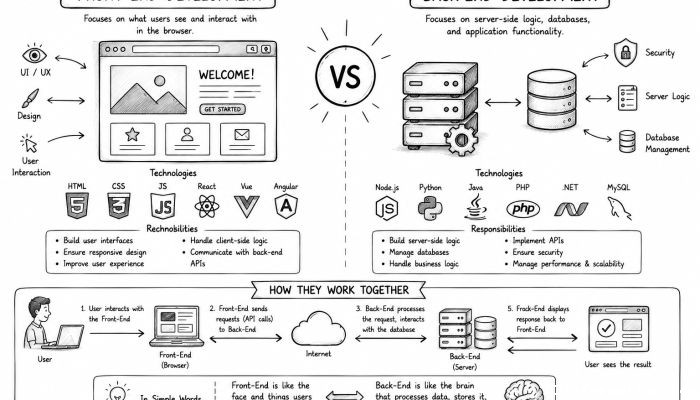
Front-end development, also known as client-side development, focuses on the visual aspects of a website or web application that users directly interact with. It encompasses everything the user sees and experiences, from fonts, colors, and buttons to layouts and animations. A front-end developer’s main responsibility is to translate design mockups into functional interfaces using technologies like HTML, CSS, and JavaScript. Beyond aesthetics, front-end development ensures that websites are responsive, accessible, and user-friendly across various devices and screen sizes. This discipline requires a blend of technical coding skills and an eye for design, coupled with an understanding of user experience principles.
Understanding Back-End Development
Back-end development, or server-side development, refers to the behind-the-scenes processes that power the website or application’s core functionality. It involves managing databases, servers, and application logic that handle data processing, user authentication, and server communication. Unlike front-end developers, back-end developers rarely work directly with visual elements; instead, they focus on writing code that enables data retrieval, storage, and manipulation, usually through server-side languages like Python, Java, Ruby, or PHP. Back-end development also ensures security, efficiency, and scalability of web applications, making it indispensable for dynamic content-driven websites and complex software systems.
Core Technologies Used in Front-End Development
At the heart of front-end development lie three cornerstone technologies: HTML, CSS, and JavaScript. HTML (HyperText Markup Language) structures web content, defining elements like headings, paragraphs, and images. CSS (Cascading Style Sheets) styles these elements, specifying colors, layout arrangements, fonts, and animations. JavaScript adds interactive capabilities such as form validation, dynamic content updates, and user-triggered events. Modern front-end development frequently utilizes frameworks and libraries like React, Angular, and Vue.js, which streamline coding tasks and offer reusable components, thereby enhancing development speed and consistency.
Key Technologies in Back-End Development
Back-end development employs server-side scripting languages and frameworks that handle logic, data transactions, and integration with external services. Common programming languages include Python (with frameworks like Django and Flask), Java (Spring), PHP (Laravel), Ruby (Rails), and JavaScript with Node.js. Back-end developers also work with databases like MySQL, PostgreSQL, and MongoDB to store and retrieve information efficiently. Additionally, knowledge of web servers (such as Apache and Nginx), APIs (Application Programming Interfaces), and cloud services plays a vital role in managing the infrastructure and services that power web applications behind the scenes.
User Interface vs. Server Logic
The fundamental distinction between front-end and back-end development lies in their focus: front-end deals with user interfaces, while back-end handles server logic. Front-end developers construct the visual components users interact with, ensuring an engaging and intuitive experience. Back-end developers build the logic and algorithms that manipulate data, enforce business rules, and respond to user requests. This dynamic is akin to an automobile — the front-end is the dashboard and controls visible to the driver, whereas the back-end is the engine under the hood powering the vehicle.
Roles and Responsibilities in Front-End Development
Front-end developers wear multiple hats that include transforming UI/UX design prototypes into code, optimizing website responsiveness for various devices, enhancing load times, and maintaining cross-browser compatibility. They collaborate closely with designers to implement visual elements while ensuring usability standards are met. Their work also involves debugging user interface bugs, improving performance with efficient coding practices, and incorporating animations and transitions that enrich the overall user experience.
Roles and Responsibilities in Back-End Development
Back-end developers are responsible for architecting and implementing server-side logic, managing databases and data structures, and ensuring secure user authentication and authorization. They design APIs for communication between the server and client, handle server configuration and optimization, and integrate third-party services such as payment gateways or messaging platforms. Moreover, back-end professionals monitor system health and scalability, often employing automated tests and deployment pipelines to maintain robust and reliable applications.
Front-End and Back-End Collaboration
Despite their distinct roles, front-end and back-end development are deeply interconnected, requiring constant collaboration to create functional and cohesive web platforms. Front-end developers depend on APIs crafted by back-end teams to retrieve and display data dynamically, while back-end developers rely on front-end components to send user input and trigger server processes. This collaborative workflow often uses JSON or XML for data formatting and tools like RESTful APIs or GraphQL to streamline communication. Effective teamwork between these two disciplines is essential for delivering seamless user experiences and smooth application functionality.
Career Opportunities and Skillsets
Both front-end and back-end development offer rich career opportunities but demand different skill sets. Front-end developers need proficiency in design principles, responsive frameworks (Bootstrap, Tailwind CSS), and reactive programming. They often require creative problem-solving skills alongside proficiency in JavaScript ecosystems. Back-end developers prioritize strong programming fundamentals, mastery of server-side languages, database management skills, and a deep understanding of security practices and system architecture. Full-stack developers combine both skill sets, bridging the gap to handle all layers of development.
Challenges Faced by Front-End Developers
Front-end developers face challenges such as ensuring consistent behavior across different browsers and devices, optimizing loading times for performance-critical applications, and keeping up with rapidly evolving frameworks and tools. Accessibility compliance for users with disabilities adds another layer of complexity, requiring developers to adhere to standards like WCAG. Moreover, integrating intricate animations or responsive features often demands careful balancing of aesthetics and functionality.
Challenges Faced by Back-End Developers
Back-end development challenges include ensuring data security against cyber threats, maintaining scalable architectures capable of handling large user bases, and optimizing server response times. Debugging complex server-side logic, managing database migrations, and integrating third-party services without compromising system integrity are other critical hurdles. Additionally, back-end developers must stay updated on best practices for security patches and evolving protocols.
Emerging Trends Bridging Front-End and Back-End
In recent years, new trends like serverless computing, JAMstack architecture, and API-driven development have blurred the traditional lines between front-end and back-end. Technologies such as GraphQL offer more flexible data querying, while tools like Next.js enable developers to write both client and server code seamlessly. The rise of progressive web apps (PWAs) also demands expertise across both domains, promoting faster load times and offline functionality. These trends create exciting opportunities for developers to work more fluidly across the entire stack.
Conclusion
Front-end and back-end development represent two indispensable facets of modern web creation, each characterized by unique technologies, responsibilities, and challenges. The front-end crafts the visible interface and user experience, relying heavily on design sensibility and interactivity, while the back-end powers the core logic, data management, and server operations that breathe life into applications. Understanding their differences and how they integrate enriches our appreciation of the digital experiences we often take for granted. As the web continues to evolve, collaboration between these domains will grow ever more crucial, offering exciting prospects for innovation and career growth across the full spectrum of development. Whether you aim to design stunning user interfaces or build powerful server infrastructure, mastering either side of the divide opens doors to shaping the future of technology.
 How to Make the Most of Your Holiday Break
 The Best Winter Destinations for a Cozy Getaway
 How to Organize Your Holiday Travel Plans with Ease
 The Ultimate Guide to Cooking for a Crowd
 How to Make Healthy Comfort Food Without the Guilt
 5 Delicious Vegan Breakfast Ideas You Can Make in Minutes