Best Online Resources to Learn Coding for Free
In today's increasingly digital world, coding has become an essential skill that opens doors to countless career opportunities and creative endeavors. Whether you’re a complete beginner eager to explore the basics or an experienced programmer looking to sharpen your skills, the wealth of online learning resources available today is nothing short of remarkable. The best part? Many of these platforms offer comprehensive, high-quality coding courses completely free of charge. From interactive coding challenges and video tutorials to community-driven forums and project-based learning, free online resources provide a flexible and accessible way to dive deep into programming without financial burden. This article explores the top free coding resources available online, helping you choose the best tools to kickstart or accelerate your programming journey.
- Codecademy: Interactive Learning at Its Best
- freeCodeCamp: Learn by Building Projects
- The Odin Project: Full-Stack Web Development for Free
- Khan Academy: Coding Fundamentals and More
- Coursera: University-Level Coding Courses for Free
- edX: High-Quality Programming Education
- W3Schools: The Go-To Reference for Web Developers
- SoloLearn: Coding on the Go
- HackerRank: Practice with Coding Challenges
- GitHub Learning Lab: Learn Through Open Source Projects
- CS50 by Harvard: Introduction to Computer Science
- Python.org: Official Python Tutorials and Resources
- Conclusion
- More Related Topics
Codecademy: Interactive Learning at Its Best
Codecademy is one of the most popular platforms for anyone beginning their coding journey. Known for its user-friendly interface and hands-on approach, Codecademy offers interactive courses on a wide array of programming languages including Python, JavaScript, HTML, and CSS. The platform’s “Learn by Doing” philosophy allows learners to write code directly in the browser, receiving instant feedback that helps solidify concepts quickly. While the Pro version includes advanced lessons and projects, the free tier still covers all the fundamental topics and coding basics, making it an excellent starting point for novices.
freeCodeCamp: Learn by Building Projects
freeCodeCamp stands out as a community-driven platform that offers a comprehensive curriculum in web development, data structures, and algorithms. What makes freeCodeCamp special is its project-based learning approach. Instead of passive watching, learners build real-world applications such as portfolio websites, interactive games, and data visualization tools. Their certification programs reflect mastery in different domains like Responsive Web Design and JavaScript Algorithms. Best of all, the entire curriculum is completely free and supported by an active forum community where learners can seek help and collaborate.
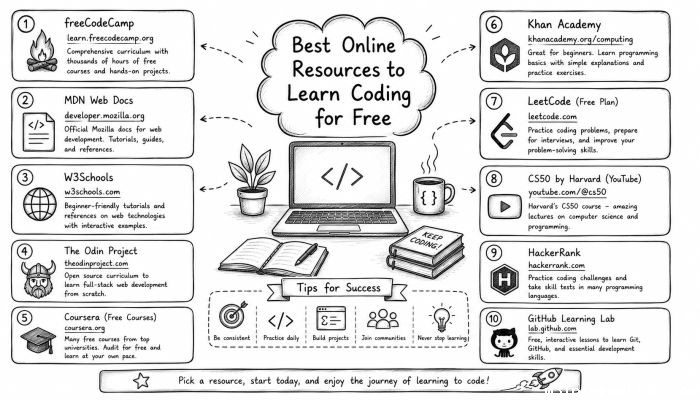
The Odin Project: Full-Stack Web Development for Free
For those specifically interested in full-stack web development, The Odin Project is a treasure trove. It offers an opinionated path that guides beginners through HTML, CSS, JavaScript, Git, Node.js, and databases, among others. Unlike platforms that focus on isolated coding exercises, The Odin Project provides a holistic curriculum structured around projects and real-world applications. Learners gain hands-on experience by building complete websites and applications from scratch while also learning how to work with tools like Github. The community forums and Discord channels further enrich the experience by facilitating peer-to-peer support.
Khan Academy: Coding Fundamentals and More
Though Khan Academy is primarily renowned for its comprehensive educational content across various subjects, it also offers a rich selection of programming tutorials. Its coding lessons focus on drawing and animation using JavaScript and ProcessingJS, which appeals especially to learners interested in creative coding. The step-by-step tutorials and interactive coding environment provide a gentle introduction to programming logic and concepts, making it suitable for younger students or complete beginners. Moreover, Khan Academy's free, open-access model aligns well with learners seeking foundational coding knowledge without distractions.
Coursera: University-Level Coding Courses for Free
Coursera collaborates with leading universities and tech companies to offer free coding courses that often mirror university curricula. Platforms like Stanford, University of London, or Google provide programming courses that cover languages such as Python, Java, and C++. While full course access is free under the “audit” option, some features like graded assignments or certifications require payment. Learners can benefit from video lectures, peer-reviewed assignments, and forums that simulate a classroom experience. Coursera suits those who want structured, academic-quality content at no cost.
edX: High-Quality Programming Education
Similar to Coursera, edX hosts a plethora of computer science and programming courses created by top institutions like MIT and Harvard. Users can audit most courses for free, accessing video lectures, exercises, and discussion boards. The platform teaches foundational concepts, language-specific skills, and even specialized topics like cybersecurity or machine learning. The professional and academic rigor of edX's offerings is ideal for learners who seek a deep theoretical understanding along with practical coding practice. Additionally, micro-degrees allow motivated students to stack free courses towards career-ready credentials, although the full certificate may carry a fee.
W3Schools: The Go-To Reference for Web Developers
For quick and straightforward coding reference, W3Schools is an indispensable resource for beginners and intermediate web developers. The website covers web languages such as HTML, CSS, JavaScript, PHP, SQL, and more. Each topic includes concise explanations, code samples, and “Try it Yourself” editors where users can modify example code and see live results instantly. Its simplicity and ease of use make W3Schools a perfect supplement to more comprehensive platforms, ideal for those who want to quickly look up specific concepts or perform quick hand-on drills.
SoloLearn: Coding on the Go
If you prefer learning on your smartphone or tablet, SoloLearn is an excellent choice. Available as an app and through a web interface, SoloLearn offers bite-sized lessons with gamified learning elements designed to keep users motivated. Covering diverse languages like Python, Java, C++, and Ruby, it encourages interactive quizzes, peer interaction, and code challenges that promote retention and understanding. SoloLearn’s community feature allows users to share code snippets, ask questions, and engage with fellow learners, making it appealing for beginners seeking a portable, social learning environment.
HackerRank: Practice with Coding Challenges
Coding theory alone isn’t enough; practical problem-solving practice is crucial for mastery. HackerRank provides a free, extensive collection of coding challenges spanning algorithms, data structures, artificial intelligence, and databases. Users can attempt problems in various languages and receive instant feedback. Its leaderboard system fosters friendly competition and continuous improvement. While HackerRank is popular with job seekers preparing for technical interviews, it is also an effective training ground for coders of all levels who want to hone their coding skills through deliberate practice.
GitHub Learning Lab: Learn Through Open Source Projects
GitHub Learning Lab offers a unique way to learn coding by walking learners through real-world projects and workflows on the GitHub platform. Emerging developers get hands-on experience with version control, collaborating on repositories, and understanding community standards for open source development. GitHub’s bot-driven lessons automate feedback and guidance, helping users learn essential developer skills like branching, pull requests, and issues management while coding. This resource is particularly valuable for learners wanting to integrate coding with industry-standard collaboration tools.
CS50 by Harvard: Introduction to Computer Science
CS50 is Harvard University's renowned introductory computer science course, freely available online through edX. This course covers foundational topics such as algorithms, data structures, memory, software engineering, and web development in an engaging and accessible manner. It includes theoretical lectures combined with practical problem sets and projects, often encouraging students to think critically and creatively beyond code. CS50’s community and multiple language tracks make it ideal not only for beginners but also for intermediate learners seeking a rigorous and well-rounded introduction to computer science.
Python.org: Official Python Tutorials and Resources
For those specifically drawn to Python, the official website python.org provides an excellent starting point with its comprehensive tutorials and documentation. It covers everything from installation, beginner tutorials, to advanced materials like the standard library and best practices. Since Python is among the most beginner-friendly yet powerful languages, having access to official and up-to-date resources ensures accurate learning. The website also links to various free external resources, forums, and coding challenges tailored to Python learners at all levels.
Conclusion
The digital era offers an abundance of free resources to learn coding, democratizing access to one of the most valuable skills of our time. Whether you prefer interactive lessons through Codecademy and SoloLearn, project-based learning with freeCodeCamp and The Odin Project, or more structured academic courses via Coursera and edX, there is a platform suited to nearly every learning style and goal. Supplement your knowledge with reference websites like W3Schools and engage in practice challenges on HackerRank to sharpen your problem-solving abilities. Moreover, dive into real-world collaboration tools using GitHub Learning Lab or access official language resources such as Python.org to deepen your expertise. By leveraging these best-in-class resources, learners worldwide can develop coding proficiency and unlock countless opportunities, regardless of background or budget. The journey may require persistence and curiosity, but the wealth of free, quality materials available today ensures that anyone with the passion for programming can succeed and thrive in the digital age.
 How to Make the Most of Your Holiday Break
 The Best Winter Destinations for a Cozy Getaway
 How to Organize Your Holiday Travel Plans with Ease
 The Ultimate Guide to Cooking for a Crowd
 How to Make Healthy Comfort Food Without the Guilt
 5 Delicious Vegan Breakfast Ideas You Can Make in Minutes