How to Choose the Right Framework for Your Project
In today’s fast-paced digital landscape, selecting the right framework for your project is pivotal to its success. Whether you’re building a web application, mobile app, or any software solution, the framework you choose will significantly influence your development speed, scalability, maintainability, and overall project outcomes. With a myriad of frameworks available—each touting unique features, ecosystems, and community support—choosing wisely can feel overwhelming. This article aims to demystify that process by guiding developers, project managers, and decision-makers through the critical factors involved in selecting the right framework. By understanding the strengths, challenges, and best use cases of popular frameworks, you can make an informed choice that aligns with your project’s goals, team skill set, and long-term vision.
- Understand Your Project Requirements
- Evaluate the Learning Curve and Developer Expertise
- Consider the Framework’s Ecosystem and Community Support
- Analyze Performance and Scalability Needs
- Assess Flexibility and Customization Options
- Review Security Features and Compliance
- Investigate Licensing and Cost Implications
- Check Compatibility with Existing Technologies
- Evaluate Support for Testing and Deployment
- Examine Documentation Quality and Learning Resources
- Consider Long-Term Maintenance and Future-Proofing
- Weigh Trade-offs: Build vs. Buy
- Conclusion
- More Related Topics
Understand Your Project Requirements
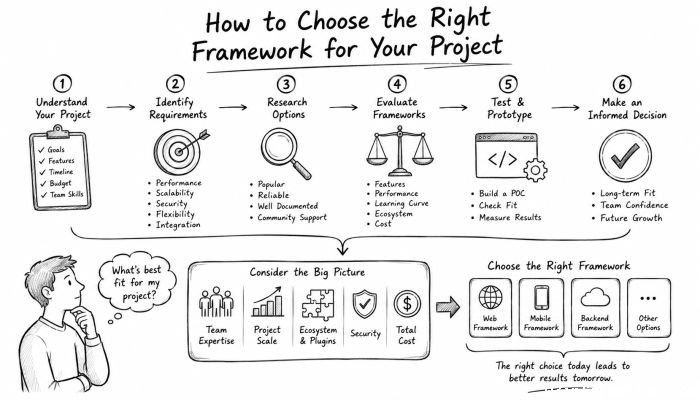
Before diving into frameworks, start by clearly defining what your project entails. Consider the project’s scope, complexity, target platform (web, mobile, desktop), performance needs, user base, and integration requirements. For example, a single-page web app may benefit from JavaScript-based frameworks like React or Vue, while a complex enterprise application may need robust, backend-focused frameworks such as Django or Spring. Identifying your functional and non-functional requirements first helps create a foundation for selecting a framework that addresses these needs effectively.
Evaluate the Learning Curve and Developer Expertise
The expertise of your development team plays a crucial role in framework selection. A framework with a steep learning curve can slow project progress if your team is unfamiliar with its paradigms or language. For instance, Angular offers a comprehensive set of features but requires a good grasp of TypeScript and reactive programming, which may intimidate beginners. Conversely, lightweight frameworks like Flask or Express.js offer easier entry points but may require more manual setup. Assessing your team’s skill set ensures you pick a framework that empowers your developers rather than hampers them.
Consider the Framework’s Ecosystem and Community Support
A vibrant ecosystem and strong community can make or break your development experience. Frameworks like React and Laravel flourish with extensive libraries, plugins, and third-party tools, allowing you to extend functionality without building everything from scratch. Additionally, active communities mean more tutorials, forums, and timely updates that help solve problems faster. Conversely, lesser-known or niche frameworks might lack this support, potentially increasing development risks and maintenance overhead.
Analyze Performance and Scalability Needs
Performance expectations vary significantly between projects. High-traffic applications or real-time platforms demand frameworks that efficiently handle concurrency and resource management. For example, Node.js frameworks excel in asynchronous processing, suitable for chat apps, while Django excels in rapid development but might require optimization for high concurrency. Furthermore, scalability must be factored in—can the framework accommodate growing user bases without complete rewrites? Understanding your current needs and anticipating future growth ensures longevity for your project.
Assess Flexibility and Customization Options
Some frameworks are opinionated, offering predefined structures and conventions that accelerate development but can limit customization. Ruby on Rails is a classic example—great for standard web app structures but restrictive if your project demands unconventional design patterns. Alternatively, frameworks like Express.js provide minimalistic cores, offering maximum flexibility but requiring more configuration. Decide how much control versus structure your project demands, and choose accordingly.
Review Security Features and Compliance
Security is non-negotiable in software development. Frameworks come with varying degrees of built-in security measures, such as protection against cross-site scripting (XSS), SQL injection, and Cross-Site Request Forgery (CSRF). For instance, Django and Laravel offer strong, integrated security features right out of the box. Additionally, if your project requires compliance with regulations like GDPR, HIPAA, or PCI, verify whether the framework’s features and documentation support these requirements. Prioritizing security helps safeguard user data and upholds your project’s credibility.
Investigate Licensing and Cost Implications
While many popular frameworks are open-source and free, some come with licenses that impose restrictions or require fees for commercial use or support. Licensing terms can impact your project’s legal and financial obligations, especially in enterprise or commercial settings. Additionally, consider the total cost of ownership, including developer training, third-party integrations, and long-term maintenance. Understanding these factors early avoids unexpected expenses and legal hurdles.
Check Compatibility with Existing Technologies
Often, new projects need to integrate or coexist with existing systems, databases, or services. Ensure the framework you select supports seamless integration with your current tech stack—be it databases like PostgreSQL, caching tools such as Redis, or third-party APIs. Compatibility reduces development friction, expedites implementation, and minimizes risk. For example, if your organization relies heavily on Microsoft products, using the .NET framework might be a strategic choice due to smooth interoperability.
Evaluate Support for Testing and Deployment
Robust testing capabilities and deployment support accelerate development cycles and increase software reliability. Popular frameworks typically offer integrated testing tools or easy compatibility with third-party testing suites. For example, Angular comes with built-in testing utilities supporting Jasmine and Karma, while Ruby on Rails integrates well with RSpec. Similarly, frameworks with clear documentation on deployment best practices and automation tools help streamline continuous integration and delivery pipelines.
Examine Documentation Quality and Learning Resources
Comprehensive, up-to-date documentation is invaluable, particularly for newer or less experienced developers. Well-documented frameworks not only reduce onboarding time but also help troubleshoot issues and adopt best practices. Look for frameworks with official guides, API references, tutorial portals, and active blogs or video channels. Additionally, platforms such as GitHub, Stack Overflow, and dedicated forums can provide community contributions that enrich your learning experience.
Consider Long-Term Maintenance and Future-Proofing
Software projects evolve, sometimes outliving their initial scope. Choosing a framework that is actively maintained and evolves with industry trends ensures your project remains secure, compatible, and performant over time. Avoid frameworks that show signs of declining community interest or delayed releases. Furthermore, frameworks aligned with emerging technologies and standards reduce the risk of obsolescence as development paradigms shift.
Weigh Trade-offs: Build vs. Buy
In some cases, the framework decision extends beyond picking existing tools to considering whether to build a custom framework tailored specifically to your project’s needs. While creating your own framework offers maximum control and optimization, it requires significant time, expertise, and ongoing support. Conversely, using open-source frameworks accelerates time-to-market but may involve compromises in flexibility or fit. Carefully weigh these trade-offs based on your project’s timeline, budget, and uniqueness to decide the best path forward.
Conclusion
Choosing the right framework is a strategic decision that affects every phase of your project from development to maintenance. By thoroughly understanding your project requirements, team expertise, and long-term goals, you can filter through the vast array of options and identify a framework that not only fits today’s needs but also supports future growth and innovation. Consider factors such as performance, security, community support, flexibility, and integration capabilities to make a balanced decision. Most importantly, remember that no single framework is perfect for every project—successful selection comes down to aligning technology with vision and context. Armed with these insights, you’re now better equipped to select a framework that transforms your project idea into a robust, scalable, and maintainable reality.
 How to Make the Most of Your Holiday Break
 The Best Winter Destinations for a Cozy Getaway
 How to Organize Your Holiday Travel Plans with Ease
 The Ultimate Guide to Cooking for a Crowd
 How to Make Healthy Comfort Food Without the Guilt
 5 Delicious Vegan Breakfast Ideas You Can Make in Minutes