Common Coding Mistakes Beginners Make
In the ever-evolving world of technology, coding has become an essential skill, opening doors to countless opportunities. Yet, for beginners stepping into this vast realm, the coding journey can feel like navigating a complex maze. While programming languages and tools vary, the challenges faced by newcomers often share common threads. Understanding these typical mistakes not only helps in avoiding frustration but also accelerates the learning curve. This article explores the most frequent coding errors beginners make, illuminating how these pitfalls arise and offering insights on how to overcome them. By unpacking these patterns, new coders can build stronger foundations, cultivate best practices, and ultimately transform their early struggles into stepping stones for mastery.
- Ignoring the Importance of Planning and Pseudocode
- Overlooking Proper Syntax and Language Rules
- Poor Variable Naming and Lack of Comments
- Misunderstanding Data Types and Type Conversion
- Forgetting to Initialize Variables
- Overusing or Misusing Loops
- Neglecting Error Handling and Edge Cases
- Copy-Pasting Code Without Understanding
- Not Testing Code Incrementally
- Underestimating the Power of Debugging Tools
- Failing to Use Version Control Systems
- Getting Discouraged by Failure and Giving Up Too Soon
- Conclusion
- More Related Topics
Ignoring the Importance of Planning and Pseudocode
One of the earliest mistakes beginners make is skipping the planning stage before coding. Many dive straight into writing code without taking the time to outline their logic or structure. Planning, often facilitated through pseudocode or flowcharts, helps clarify the problem, break it into manageable parts, and spot potential pitfalls before they arise. By neglecting this step, beginners risk creating poorly organized or inefficient code, which is harder to debug and maintain. Emphasizing upfront design nurtures clearer thinking and a better grasp of programming logic.
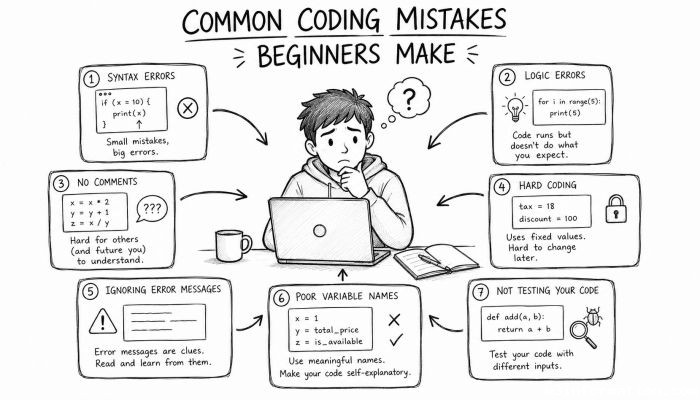
Overlooking Proper Syntax and Language Rules
Programming languages have strict syntax rules; even a missing semicolon or misplaced bracket can halt execution. Beginners frequently underestimate the importance of syntax, leading to frustrating errors that seem incomprehensible at first. Without careful attention to language-specific conventions—such as indentation in Python or braces in Java—new coders often spend excessive time chasing errors that stem from simple typos or formatting issues. Familiarity with the language grammar and consistent code formatting practices can dramatically reduce these avoidable mistakes.
Poor Variable Naming and Lack of Comments
Clear code is readable code. Novice programmers often resort to vague or single-letter variable names like 'x' or 'temp' without context. While this may seem trivial in small snippets, poor naming creates confusion as projects grow. Additionally, many beginners neglect the habit of writing comments, making it difficult for themselves or others to understand the purpose behind code blocks. Adopting descriptive variable names and embedding meaningful comments fosters better collaboration and eases future code reviews or debugging sessions.
Misunderstanding Data Types and Type Conversion
Data types underpin programming logic by defining how data is stored and manipulated. Beginners frequently struggle with understanding distinctions among integers, strings, floats, booleans, and other types. This confusion leads to type errors or unexpected behavior—such as trying to concatenate numbers with strings without conversion. Moreover, implicit type coercion can cause subtle bugs if the coder is unaware of their language's type conversion rules. Developing a solid grasp of data types and practicing explicit conversions can greatly improve code reliability.
Forgetting to Initialize Variables
Another classic beginner slip-up is using variables before initializing them with values. Uninitialized variables can hold unpredictable or default data, causing programs to misbehave silently or throw errors. This is especially problematic in languages that do not automatically assign default values. Ensuring variables are properly declared and assigned initial states protects against erratic behavior and makes the program more robust. Habitually initializing variables is a crucial step often overlooked at the start.
Overusing or Misusing Loops
Loops are fundamental tools in programming to repeat code efficiently. Yet, beginners often misuse them by creating infinite loops or loops that do not meet intended conditions. This results from misunderstanding loop control variables or termination criteria. Similarly, some novices use loops where simple vectorized or built-in functions would suffice, leading to unnecessarily complex and slow code. Mastering loop constructs and recognizing alternatives empower beginners to write more efficient, maintainable programs.
Neglecting Error Handling and Edge Cases
While constructing their first programs, many beginners assume ideal scenarios and neglect to consider errors or unusual inputs. This lack of defensive coding causes programs to crash or behave unpredictably when faced with unexpected data. Handling exceptions, validating inputs, and designing for edge cases is critical to building resilient software. By incorporating error handling early, learners not only improve user experience but also deepen their understanding of program robustness and reliability.
Copy-Pasting Code Without Understanding
In the age of abundant online resources, copy-pasting code snippets is tempting and common. However, many beginners insert blocks of code without fully comprehending their function or integration points, which may introduce bugs or security vulnerabilities. Blindly relying on external code stunts problem-solving skills and leads to fragile programs hard to debug. Investing time to dissect and adapt sourced code nurtures critical thinking and makes learning more meaningful.
Not Testing Code Incrementally
Beginner coders sometimes attempt to write large chunks of code before running any tests, resulting in a multitude of errors that are difficult to isolate. A better approach is incremental testing—writing small pieces of code and verifying their correctness before proceeding. This strategy simplifies debugging and builds confidence as learners can catch and correct mistakes promptly. Emphasizing incremental testing as a fundamental habit enhances efficiency and reduces frustration.
Underestimating the Power of Debugging Tools
Debugging is a vital part of programming, yet beginners often shy away from using debugging tools, relying solely on print statements or guesswork. Modern integrated development environments (IDEs) and debuggers provide powerful features like breakpoints, step execution, and variable inspection, making it easier to trace problems systematically. Learning to use these tools not only saves time but also offers deep insight into program flow and variable states, accelerating the path to proficiency.
Failing to Use Version Control Systems
Version control systems, like Git, are essential for managing changes in code and collaborating on projects. Many beginners overlook this, opting to save multiple copies with different filenames or relying on manual backups. This approach quickly becomes unmanageable and risky as projects grow. Early adoption of version control instills good habits, facilitating organized workflows, easy rollback of mistakes, and collaborative development, all of which are critical in both personal and professional coding environments.
Getting Discouraged by Failure and Giving Up Too Soon
Beyond technical errors, the psychological barrier is a major hurdle for many new programmers. Beginners often expect immediate results, and frequent mistakes can lead to frustration, self-doubt, and premature abandonment of coding pursuits. Accepting that errors and setbacks are natural parts of the learning process is vital. Cultivating patience, resilience, and a growth mindset transforms failures into valuable lessons and motivates continued improvement and passion for programming.
Conclusion
Coding is a challenging yet immensely rewarding skill, and the journey for beginners is filled with valuable learning opportunities hidden within common mistakes. By recognizing and understanding pitfalls such as neglecting planning, mismanaging syntax, failing to handle errors, or becoming discouraged by setbacks, novice programmers can avoid recurring frustrations and accelerate their growth. Embracing structured thinking, clear coding practices, incremental testing, and the use of appropriate tools not only improves code quality but also builds confidence. Ultimately, persistence combined with a willingness to learn from errors empowers beginners to evolve into proficient, thoughtful developers who contribute meaningfully to the digital world. The key lies not in avoiding mistakes altogether but in learning intentionally from them to forge a solid foundation for success in programming.
 How to Make the Most of Your Holiday Break
 The Best Winter Destinations for a Cozy Getaway
 How to Organize Your Holiday Travel Plans with Ease
 The Ultimate Guide to Cooking for a Crowd
 How to Make Healthy Comfort Food Without the Guilt
 5 Delicious Vegan Breakfast Ideas You Can Make in Minutes