The Concept of Recursion in Programming
In the vast and ever-evolving world of programming, certain concepts stand out as elegant tools that simplify complex problems and foster deeper understanding of computational logic. Among these, recursion holds a special place. Recursion is a technique where a function calls itself directly or indirectly to solve smaller instances of the same problem until reaching a base case. This approach mirrors a divide-and-conquer strategy, breaking down intricate tasks into manageable subtasks. Despite its power, recursion often appears daunting to beginners due to its abstract nature and the subtle intricacies involved in its correct implementation. This article delves into the concept of recursion, unpacking its fundamentals, applications, advantages, and pitfalls, while providing practical examples and insights to help both novices and experienced programmers harness this versatile programming paradigm effectively.
- What is Recursion in Programming?
- Historical Background and Theoretical Foundations
- How Recursion Works: Key Components
- Recursion vs. Iteration: A Comparative Perspective
- Common Applications of Recursion
- Writing Effective Recursive Functions
- Understanding the Call Stack in Recursion
- Tail Recursion and Its Optimization
- Recursive Data Structures: Enabling Recursion
- Potential Pitfalls and How to Avoid Them
- Recursion in Functional Programming
- Real-World Examples of Recursion
- How to Transition from Recursive to Iterative Solutions
- Conclusion: The Enduring Relevance of Recursion
- More Related Topics
What is Recursion in Programming?
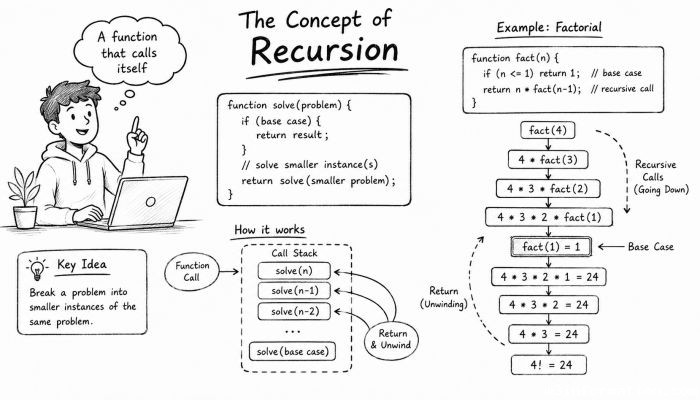
Recursion in programming refers to a method where a function solves a problem by calling itself one or more times with modified parameters until a terminating condition, known as the base case, is met. Unlike iterative solutions that use loops, recursive approaches utilize self-referential calls, enabling a compact expression of complicated processes. The essence of recursion lies in decomposing a problem into similar subproblems that are easier to solve. For example, calculating the factorial of a number n (denoted n!) is naturally recursive: the factorial of n equals n times the factorial of (n-1), and the recursion concludes when n reaches 1. Understanding recursion requires grasping both the recursive case, where the function calls itself, and the base case, which stops further calls to avoid infinite loops.
Historical Background and Theoretical Foundations
Recursion's roots extend beyond computer science into mathematics, logic, and linguistics. Mathematically, it emerges from recursive definitions such as the Fibonacci sequence and factorial function. In theoretical computer science, recursion is closely linked to formal systems and the concept of Turing completeness, where recursive functions represent computations executable by machines. Alan Turing and Alonzo Church’s work on computability theory in the 1930s formalized foundational principles of recursion. This theoretical underpinning paved the way for recursion being a fundamental tool in algorithm design and programming language theory. Today, recursion's influence permeates functional programming languages like Haskell and Lisp, where it is a core mechanism for iteration and state management.
How Recursion Works: Key Components
Every recursive function consists of two essential parts: the recursive case and the base case. The recursive case breaks a large problem into smaller, similar problems, where the function calls itself with updated arguments that progressively approach a stopping point. The base case serves as the termination condition, returning a simple, non-recursive answer to prevent infinite descent. Without a base case, recursion leads to stack overflow errors as the function repeatedly calls itself without end. For example, in computing the sum of numbers from 1 to n, the recursive case might add n to the sum of numbers from 1 to n-1, while the base case returns 0 when n reaches 0. Properly defining these conditions is critical for recursion to function correctly and efficiently.
Recursion vs. Iteration: A Comparative Perspective
Recursion and iteration are two primary techniques used to implement repetitive processes. Iteration employs looping constructs like `for` or `while`, performing repetitive tasks by cycling through code blocks until a condition fails. Recursion, however, uses self-referential calls to achieve repetition implicitly. Though both can solve similar problems, the choice depends on context. Iterative solutions are typically more memory-efficient and straightforward, making them suitable for simple, linear problems. Conversely, recursion excels in problems with inherently nested or hierarchical structures, such as tree traversals or divide-and-conquer algorithms, offering cleaner and more intuitive code. Understanding when to use recursion over iteration is a hallmark of skilled programming.
Common Applications of Recursion
Recursion finds extensive use in algorithm design and problem-solving strategies. One classic example is tree traversal in data structures like binary trees, where recursion navigates nodes effortlessly. Another important application is in sorting algorithms such as quicksort and mergesort, which recursively split arrays into smaller parts, sort them, and merge results. Recursive algorithms also naturally fit problems involving combinatorics, such as generating permutations and combinations, where the problem's structure is self-similar. Additionally, recursion is instrumental in graph algorithms, used for depth-first search (DFS) and exploring connected components. Understanding these practical uses helps programmers harness recursion's potential effectively.
Writing Effective Recursive Functions
Crafting effective recursive functions requires attention to several best practices. First and foremost, define clear and reachable base cases to prevent infinite recursion and stack overflows. Next, ensure that each recursive call processes a smaller or simpler subproblem, guaranteeing progress towards termination. Avoid unnecessary computation or repeated work by optimizing recursive calls where possible, sometimes employing memoization to cache results. Additionally, maintain clarity by limiting the complexity within each recursive call and properly documenting the function’s behavior. Thoroughly test recursive functions with varying input sizes, including edge cases, to verify correctness and efficiency.
Understanding the Call Stack in Recursion
Recursion leverages the call stack, a region of memory that tracks active function calls. Each time a recursive function calls itself, a new stack frame is pushed onto the stack containing information such as parameters, local variables, and return address. Once a base case is reached, the function begins returning values, popping frames off the stack in reverse order. This last-in-first-out (LIFO) mechanism allows recursive functions to “remember” where to resume execution after each recursive call completes. However, excessive recursion depth can exhaust stack space, leading to stack overflow errors. Visualizing the call stack helps programmers understand recursion flow and debug issues related to infinite recursion or inefficient implementations.
Tail Recursion and Its Optimization
Tail recursion is a special form of recursion where the recursive call is the last operation performed in a function. In tail-recursive functions, there is no additional work to be done after the recursive call returns, enabling certain compilers or interpreters to optimize memory usage by reusing the current stack frame instead of adding a new one. This optimization, known as tail call optimization (TCO), allows recursive algorithms to execute efficiently, akin to iterative loops without growing the call stack. While many modern functional programming languages support TCO, some imperative languages offer limited or no such optimization. Understanding tail recursion enables developers to write more efficient recursive code and avoid risks of stack overflow.
Recursive Data Structures: Enabling Recursion
Recursion is closely tied to recursive data structures, which define objects in terms of smaller instances of themselves, such as trees, linked lists, and graphs. These structures naturally invite recursive algorithms for traversal, insertion, deletion, and manipulation. For example, a binary tree consists of nodes where each node may have left and right child nodes, enabling a recursive approach to visit each node systematically. Linked lists allow recursive processing of nodes and their “next” references. Recognizing recursive data structures helps programmers design elegant solutions that leverage recursion for clarity and efficiency in data manipulation tasks.
Potential Pitfalls and How to Avoid Them
Despite its advantages, recursion also poses challenges and risks if not managed carefully. The most common pitfall is missing or improperly defined base cases, which cause infinite recursion and eventual stack overflow. Another issue is excessive computational overhead and redundant calculations in naive recursive implementations, as seen in naive Fibonacci computations. To avoid inefficiency, techniques such as memoization or iterative refactoring may be necessary. Additionally, deep recursion can lead to stack limitations on some platforms, requiring careful use or alternative algorithms. Finally, debugging recursive code can be more difficult due to function call chains, demanding solid understanding and use of debugging tools. Being mindful of these challenges leads to better recursive code design.
Recursion in Functional Programming
Functional programming languages embrace recursion as a fundamental control structure, often eschewing explicit loops entirely. In languages such as Haskell, Lisp, and Scala, recursion elegantly replaces iteration to process lists, construct data, and manage state immutably. Functional languages also emphasize pure functions and avoid side effects, making recursion a natural fit to express computations transparently. Features like pattern matching and immutable data structures further facilitate clean and readable recursive definitions. The widespread use of recursion in functional programming illustrates its power and expressiveness, encouraging programmers to adopt recursive paradigms for cleaner, more maintainable code.
Real-World Examples of Recursion
To appreciate recursion’s practical utility, it helps to examine real-world examples. A classic is the directory traversal in file systems, where directories contain files and subdirectories, themselves directories. A recursive function can navigate through this hierarchical structure, processing files and folders efficiently. Another real-world problem is solving puzzles like the Tower of Hanoi, where recursion models the step-by-step moving of disks between pegs. Algorithmically, calculating factorial, generating permutations, and implementing recursive descent parsers for compilers are everyday examples that showcase recursion’s versatility, bridging theory and practice in software development.
How to Transition from Recursive to Iterative Solutions
While recursion offers clarity and elegance, sometimes iterative solutions are preferred for performance, readability, or system-level constraints. Converting recursive algorithms into iterative ones often involves using explicit data structures like stacks or queues to simulate the call stack behavior. For instance, a recursive tree traversal can be rewritten iteratively utilizing a stack data structure to hold nodes for visitation. Understanding this transition enhances a programmer’s flexibility and problem-solving toolkit, allowing trade-offs between clarity and efficiency. Mastery of both recursive and iterative methods enriches algorithmic thinking and adaptability to diverse programming challenges.
Conclusion: The Enduring Relevance of Recursion
Recursion remains a cornerstone concept in programming, blending mathematical elegance with practical problem-solving power. From foundational theory and data structures to advanced algorithms and functional programming paradigms, recursion offers a natural way to approach complex, self-similar problems. By mastering recursion’s principles—base and recursive cases, call stack mechanics, and optimization techniques—programmers unlock a potent tool to simplify code and enhance expressiveness. While recursion entails careful design to avoid pitfalls like infinite loops and inefficiencies, its enduring presence across languages and applications attests to its versatility and depth. Embracing recursion enriches one’s programming craft, opening doors to refined logic, novel solutions, and deeper computational understanding.
 How to Make the Most of Your Holiday Break
 The Best Winter Destinations for a Cozy Getaway
 How to Organize Your Holiday Travel Plans with Ease
 The Ultimate Guide to Cooking for a Crowd
 How to Make Healthy Comfort Food Without the Guilt
 5 Delicious Vegan Breakfast Ideas You Can Make in Minutes