How to start building side projects
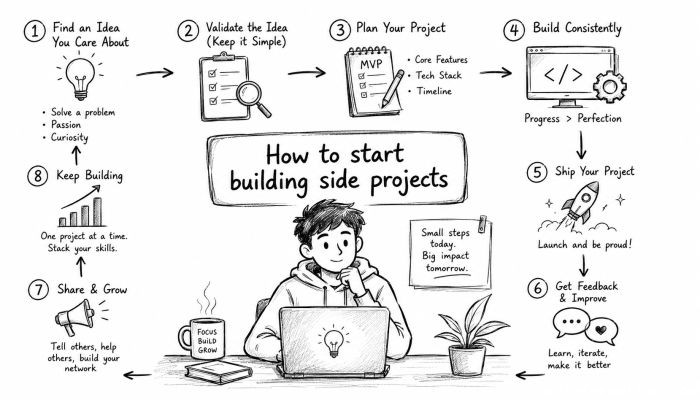
Side projects have increasingly become a productive way to learn new skills, explore new interests, build passion projects, or even create supplemental income. It doesn’t matter if you’re an entrepreneur looking to spark your next big idea, freelancer hoping to grow your skillset, or full-time employee dreaming of creative outlets during your spare time—you can benefit from building side projects. But how do you actually start? How do you go from wanting to work on a side project to creating something impactful on your own time? In this guide, we’ll walk you through some steps to consider when taking on a personal project. We’ll share our best tips on how to start building side projects, from coming up with ideas, to validating them, to building momentum and actually creating. Let’s dive in!
Determine your why
The first step to starting any project? Figuring out why you want to do it. Whether your goal is to learn a new skill, build up your portfolio, express your creativity, or generate income selling your creations on the side—you should know your intentions moving forward. Your motivations can help you determine the scope of your project, what tech you want to use, and how much time you want to dedicate. When you know your why, you can use that as a reason to push through when things don’t go as planned.
Ideation
Ideation can be the hardest step. How do you know what to build? Ask yourself what you’re interested in, what problems you’ve been faced with that you’d like to solve, or what services or products you don’t see offered. Jot down ideas that come to mind and brainstorm freely. You can start to narrow down ideas once you’ve built a decent list. Think about which ideas you’re excited by and which you can actually achieve. Consider your skill level and the time you have available to work on side projects when you’re prioritizing your ideas. It also helps to build something you’re passionate about—after all, you’ll probably be working on your side project in your free time!
Idea Validation
Once you’ve got your idea, see if it’s actually something worth building. Validating your idea can be as simple as looking online to see if there’s an existing demand or creating a survey to send out. You could also ask friends, family, and coworkers if they’ve experienced this problem. Validating your idea can save you months of building something nobody wants. It can also be an early step to get feedback on your idea to help you improve it before you get too far down the road.
Set goals.
Once you’ve settled on an idea you’re excited to work on, start setting goals. What does your definition of “done” look like? Maybe it’s building a minimum viable product. Perhaps you just want to build one piece for your portfolio. It doesn’t even have to be software related—if you want to build a blog, maybe you want to finish with five posts published. Building out goals will help you feel less overwhelmed and allow you to celebrate your wins as you accomplish each goal.
Pick your stack.
Now it’s time to start thinking about what you want to build your project with. This is where many beginners can get tripped up. Should you use .NET or Ruby? No-code or low-code? React or Angular? MySQL or MongoDB? With so many options out there, it’s hard to know where to start. When choosing your tech stack, consider what you already know, what you want to learn, and what technology surrounding that stack. For instance, if you know you want to build a web application but don’t know how to code, you may want to consider a low-code platform. That being said, if you’re interested in learning how to code, you might decide to challenge yourself with a more complicated stack.
Time blocking.
Speaking of challenges, how will you find time to work on your side project? When working on side projects, it’s important to schedule time to work just like you would with any other commitment. Time blocking can help you find time you didn’t know you had. Whether you can only squeeze in 10 minutes a day or you can dedicate a few hours a week, every little bit counts. You’d be surprised at how far you can get by working just a half hour a day.
Build community.
Feeling motivated to build your project but nowhere to show it off? Seek out others interested in building side projects. You can find friendly communities on popular forums like Reddit or Facebook. If you’re looking for something more active, consider finding a local meet-up in your area. Building relationships with like-minded people can help you stay motivated and hold you accountable when it comes to working on your side gig.
Learn to fail.
As with any project, you’re going to run into problems. You’ll need to learn to embrace learn and start to look at side projects as experiments. Like with anything you want to get better at, practice makes perfect. The more side projects you start (and finish! ), the better you’ll get at pinpointing what you want to build and knowing how to go about building it.
Test, test, test!
You’ve built your minimum viable product. Now it’s time to test it. You should test your project yourself, but if you can throw it out to friends, family, and colleagues to get their feedback. The more you test your MVP, the more you’ll learn about your users and you can start to make changes to improve your project. Don’t be afraid to fail and release multiple iterations of your project.
Share your work.
Don’t be shy. You worked hard on your project and you should proud to show it off. Share your project on social media, link it on your personal website, upload your code to GitHub, or submit your project to websites like Product Hunt. If you built something related to your field of work, consider sharing it in communities that might benefit from your project. This is a great way to get more visibility for your project and you can gain some helpful feedback too.
Make money? (optional)
If you built your project with the intention of making money, now’s the time to make it happen. There are tons of different ways to monetize your skills. I won’t dive too deep into how to make money as a side project, but here are a few ideas to get you started. Sell your creations on Etsy. Offer your services as a freelancer. Start a blog and use affiliate marketing. Create an app or sell your own digital product. Build a membership website. The list goes on!
When to call it quits.
Your project isn’t going to be your baby the second you share it with the world. Learn to recognize when it’s time to stop putting time into your project. Just like how you should know your why before starting a project, you should know when to give up on one. Sometimes things don’t work out—but that’s okay! The more projects you start, the better you’ll get at recognizing which side projects are worth your time.
Wrap Up
Building side projects is a great way to learn new skills, pick up new hobbies, and dedicate time to your passions. When it comes to knowing how to start building side projects, it all comes down to figuring out what you want to build. Once you’ve come up with an idea you can validate and are excited by, you’re well on your way to creating your own incredible side project. Remember to build out goals for your project, find a community that can support you, and don’t be afraid to fail. Good luck!
 How to Make the Most of Your Holiday Break
 The Best Winter Destinations for a Cozy Getaway
 How to Organize Your Holiday Travel Plans with Ease
 The Ultimate Guide to Cooking for a Crowd
 How to Make Healthy Comfort Food Without the Guilt
 5 Delicious Vegan Breakfast Ideas You Can Make in Minutes