The Lifecycle of a Data Science Project
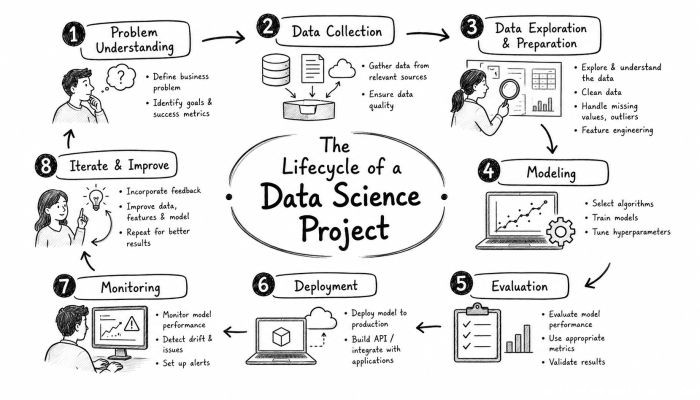
Data science has become a buzzword in recent years and rightfully so. Companies around the world are recognizing its importance and how it can be used to extract useful insights from data, drive growth, and innovate faster. To do so, data science projects are employed to convert data into results. These projects typically follow a set of stages known as the data science lifecycle. This article will walk through each stage of a data science project so that you know what to expect when working on your own.
- Stage 1: Problem Definition, Business Context
- Stage 2: Data Collection/Acquisition
- Stage 3: Data Exploration
- Stage 4: Data Cleaning
- Stage 5: Feature Engineering
- Stage 6: Modeling
- Stage 7: Training
- Stage 8: Evaluating
- Stage 9: Hyperparameter Tuning
- Stage 10: Interpreting Results
- Stage 11: Communicating Results
- Stage 12: Deploying
- Stage 13: Monitoring
- Stage 14: Maintenance
- Stage 15: Documentation
- Conclusion
- More Related Topics
Stage 1: Problem Definition, Business Context
As with any project, it all starts by defining the problem. If a data science project does not have a problem to solve, then it won’t go anywhere. Data Scientists should always take the time to understand their stakeholders, the business, and come up with a question that they can answer with data. On top of defining the problem, data scientists should also define the scope, any constraints, KPIs, or other key details so that everyone is on the same page. There should be a clear understanding of the value that will be provided by the end of the project.
Stage 2: Data Collection/Acquisition
Now that the problem has been defined, it’s time to collect the data. There are many different ways to collect data such as databases, APIs, web scraping, surveys, third-party vendors, etc. The goal of this stage is to make sure that the data you need for your project is available and that you have access to it. You should also determine if there are any holes in how you can acquire data. If so, you may need to create a way to collect this data for the project. Depending on your decisions here, your project can be successful or fail before you even start.
Stage 3: Data Exploration
Exploratory Data Analysis, also known as EDA, is where data scientists start to learn about their data. During this stage, data scientists will generate summaries of the datasets such as data types, distributions, missing values, and more. Visualizations are typically created to gain more intuition around the data. This step will also help validate or invalidate assumptions that were made during the business understanding phase.
Stage 4: Data Cleaning
Data Scientists will often refer to data as “messy”. That is because raw data rarely comes in a way that can be easily used for modeling. Data Cleaning focuses on removing or fixing any incorrect, duplicated, or missing values within your dataset. Data Preprocessing may also happen during this stage to transform variables, encode categorical variables, normalize distributions, remove outliers, etc.
Stage 5: Feature Engineering
In data science, features are individual input variables that are used to train a model. Feature Engineering is the process of creating new features from your raw data or existing features. This includes creating new aggregated features by date, group, etc. Additionally, Feature Engineering can include pulling out important attributes from your data that can be used for the modeling process.
Stage 6: Modeling
Once you have your processed data and features you are ready to choose a modeling technique that is best suited for your problem. There are many different types of models ranging from simple linear regression models to deep learning. The type of model you choose will depend on what problem you are trying to solve (classification, regression, clustering), size of your data, if you need explainability, hardware/constraints, and much more.
Stage 7: Training
With your selected model and training data in hand, it is time to train your model. Training will allow your model to “learn” from the input data. Once training is complete you will typically want to evaluate your model to ensure it worked.
Stage 8: Evaluating
After training your model, you should test your model on data it has never seen. This is important to ensure that your model will generalize to new data. There are different evaluation metrics that you can use depending on what type of problem you are trying to solve. Once you have evaluated your model, you should have a good idea if your model worked.
Stage 9: Hyperparameter Tuning
All Machine Learning models have hyperparameters. Hyperparameters are parameters that are not learned from the data but are set prior to training and control the learning process. Tuning of these hyperparameters can help improve the overall performance of your model. This step can take a while since it requires training many models, each with different hyperparameters. There are also methods such as grid search, random search, and Bayesian optimization that can help you automate this process.
Stage 10: Interpreting Results
Now that you have a trained and tuned model, it’s time to see how it works. Part of the model interpretation process includes understanding how the features impact predictions. For classification models, we also want to determine which features were the most important for making predictions. Model interpretation is important for explainability, especially if you are working in a regulated industry.
Stage 11: Communicating Results
Now that you have results, it’s time to share them with your stakeholders. Data Scientists should never assume that stakeholders will understand all the technical details. You should figure out what metrics are important to share and tell the story of what you found. Data Visualization is a key part of communicating your results.
Stage 12: Deploying
The final step in the data science lifecycle is to deploy your model. Depending on your use case, this could mean exposing an API for real-time scoring, creating a batch processing workflow, adding it into a software application, etc.
Stage 13: Monitoring
Once you have deployed your model, you should monitor it to ensure it continues to perform well. The data that your model was trained on will change over time, this is called concept drift. By monitoring your model, you can retrain it with new data once it starts to perform suboptimally.
Stage 14: Maintenance
Project maintenance includes monitoring but should also include taking action once an issue is identified. Taking action could include retraining your model with fresh data.
Stage 15: Documentation
Documentation should be taken very seriously and happen throughout the entire data science lifecycle. This includes documenting project goals, data sources, data preprocessing steps, model parameters, evaluations results, deployment information, etc.
Conclusion
A data science lifecycle allows data scientists to organize their thought process when working on projects. Each step is important and skips steps could mean an unsuccessful project. There are many other names for each of these steps and not all projects will go through each stage in order. The amount of effort you want to put into each stage is totally up to you and your team. Understanding each of these stages will help you become a better data scientist and allow you to complete more successful projects.
 How to Make the Most of Your Holiday Break
 The Best Winter Destinations for a Cozy Getaway
 How to Organize Your Holiday Travel Plans with Ease
 The Ultimate Guide to Cooking for a Crowd
 How to Make Healthy Comfort Food Without the Guilt
 5 Delicious Vegan Breakfast Ideas You Can Make in Minutes