Importance of Data Normalization
Data normalization is a process that helps organize data in a database or dataset. Raw data often suffers from redundancy, duplication, and inconsistencies that make it difficult to understand, manage, and analyze. Normalization techniques can transform disparate data elements into standard and structured formats, resulting in cleaner databases that increase performance, consistency, and integrity.
In this article, we’ll explore why normalization is important. We’ll discuss fundamental concepts of data normalization while addressing different types, uses, and application areas of normalization. If you work with data daily or want to learn more about normalization techniques, read on!
- What is Data Normalization?
- Origin of Normalization
- Why is Data Normalization Needed in Databases?
- Data Normalization Benefits for Analytics and Machine Learning
- Types of Normalization
- Why Data Should Be Normalized?
- Normalization Problems
- Conclusion
- When to Not Normalize Data?
- Data Normalization for Data Integration
- Tools for Data Normalization
- The Future of Data Normalization
- More Related Topics
What is Data Normalization?
Put simply, data normalization is the process of structuring data elements according to standard guidelines. Applied to databases or tables, normalization aims to remove redundant data across the database. Each data element should be stored only once by partitioning large tables into smaller ones with relationships to other tables.
Originally a term from relational database theory, normalization dictates that all data must satisfy a list of requirements called “normal forms.” These conditions describe how data should be stored to avoid duplication and support databases’ efficient integration. There are several normal forms, and each has specific rulesets to follow for adequate normalization.
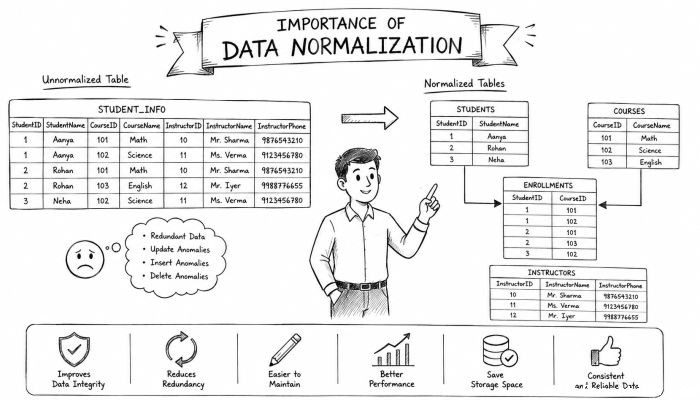
Why does data normalization matter? Data needs to be normalized so that there is a level of consistency with how it is gathered and stored. Normalization also scales well when your data grows because there will be fewer opportunities to duplicate data. Plus, normalized data is often easier to analyze as each data element is stored only once.
Origin of Normalization
Normalization was first conceived as part of a relational database theory introduced by Edgar F. Codd. Database tables are said to be in a normal form if they satisfy a list of rules meant to reduce redundancy and dependency. First Normal Form, Second Normal Form, and Third Normal Form are several normal forms Codd described to help users build better databases.
Why does data normalization matter? It became essential as computers began to hold more data with increasing variance in data quality. Codd created normalization rules to help developers reduce data duplication in relational databases.
Normal forms have since been adopted outside strict relational databases to describe data stored in big data, data warehouses, and even for certain machine learning tasks.
Why is Data Normalization Needed in Databases?
Databases need normalized data to prevent doubling efforts. If you store the same information in two different tables, what happens if someone updates one record and not the other? Data normalization eliminates this issue by optimizing how data is stored so that everything has a logical place. Instead of searching through multiple tables for data elements, you need to look in a single spot.
Benefit #1: Improved Data Quality
Quality information is critical for business intelligence. You need to trust your data. Normalized data has no duplicates by definition, which improves the overall quality of your information. Consider a contact form on your website that stores information in a database. User names and city names may be concatenated into one field. If you update the user’s name, you also inadvertently change part of their city. Normalized data maintains high quality even when subjected to multiple updates.
Benefit #2: Improve Efficiency
Normalization can help improve the efficiency of your storage space. By reducing data duplication, you will inherently decrease the size of your database. Smaller databases have less data to index, making it faster to search for the data you need. Data normalization spares you from storing duplicate data across tables.
Data Normalization Benefits for Analytics and Machine Learning
Aside from traditional database uses, normalization has a different meaning in analytics and machine learning. Many people use the term to describe techniques that convert numerical features to a set range, such as 0-to-1, or scaled to a standard distribution. These procedures force all data to live within specified boundaries forcing models to treat each feature equally.
If you don’t normalize your data, then features with higher numeric ranges will always weigh more heavily in the training process. Normalization allows models to converge quicker and produces more coherent results. This allows for easier pattern recognition and reduces model bias.
Types of Normalization
When discussing normalization, it’s important to know that there are two broad categories being described depending on the context.
Database normalization is the process of organizing tables and reducing duplication and data dependency. It applies to relational database design and utilizes normal forms.
Numerical data normalization, on the other hand, refers to techniques used to scale individual numeric columns to standardized ranges. This process is very common for data mining and machine learning applications.
These two types of normalization help to prepare data for their respective environments. Database normalization applies logic rules to database design. Numerical data normalization applies mathematical formulas to individual fields.
Why does data normalization matter? Regardless of the context, data normalization can help ensure quality data and improve performance.
Why Data Should Be Normalized?
Data duplication and redundancy not only take up space but can also lead to anomalies. Update anomalies are the most common issue with duplicated data.
Imagine you have a customer table that contains name and address information. If you insert the same customer into two different rows, you’ll need to update both records when the customer moves. However, if you only update one and not the other, your data now has two different addresses for the same person.
Duplicated data can also lead to bad data relationships. For example, if you are unsure whether or not a record exists in one table and not another, it can create foreign key issues.
Normalization Problems
Highly normalized databases can produce excessive joins that may cause performance issues. Sometimes denormalization is beneficial to reduce the number of joins your queries will perform.
Normalization also takes time and effort to complete. In big data contexts, where data can come in all types of formats, normalization can become expensive.
Conclusion
Now that we’ve covered what data normalization is, where it came from, and why it’s important. It’s time to discuss some situations where you might not want to normalize your data.
When to Not Normalize Data?
Denormalization is the process of adding redundancy to your data. In data warehouse scenarios, denormalization is common because the data is usually not updated often and read performance is critical.
By duplicating data and reducing table joins, denormalized databases are typically faster to query. However, this comes at the cost of additional storage and potentially more complicated updates.
Knowing when to normalize versus when to denormalize depends on understanding your use case and data flow. Large scale data warehousing is a perfect example of why you would not want to normalize data.
Data Normalization for Data Integration
Data normalization can be beneficial when integrating multiple datasets together. Since data can come from numerous siloed systems with different formats, it’s important to standardize your data before combining it with anything else.
Normalizing your data will help clean, transform, and integrate your data during your ETL process.
Tools for Data Normalization
Due to the labor-intensive process of data normalization, many tools can help automate parts of the process. Database management systems allow for checks against normal forms and can enforce database constraints.
Python and R have libraries that can easily normalize numerical data. You can also find ETL tools with transformations to clean your raw data. Even machine learning platforms have automated ways of normalizing features within their pipelines.
The Future of Data Normalization
Just because data has been around for decades doesn’t mean it will remain stagnant. Data volumes and varieties are only increasing, and new tools will be introduced to help manage everything.
There will likely be smarter ways of normalization through machine learning algorithms that can recognize data inconsistencies and suggest transformations. NoSQL databases and graph databases will provide new use cases and problems related to normalization.
Streaming data is also on the rise, which will force normalization techniques to be more dynamic.
With the explosion of big data, normalization is more important than ever. Continuing to learn about data, its structures, and usage can help you implement better normalization practices.
Thank you for reading our deep dive into Data Normalization!
 The Importance of Fostering Creativity in Education
 How to Plan a Family Movie Night Everyone Will Enjoy
 How to Navigate Parenting in the Digital Age
 How to Stay Sane During Family Holiday Gatherings
 How to Create a Family Calendar for Better Time Management
 How to Encourage Your Child to Be Independent and Responsible