How to Handle Missing Data
In the realm of data analysis, missing data is a pervasive and challenging issue that can significantly affect the quality and validity of research outcomes. Whether you are working with survey results, clinical trials, financial records, or machine learning datasets, encountering absent values is inevitable. Missing data not only reduces statistical power but can also introduce bias, leading to misleading conclusions if not properly addressed. Understanding how to effectively handle missing data is crucial for data scientists, statisticians, and researchers across disciplines. This article delves deep into the nature of missing data, explores various strategies for handling it, and highlights best practices to ensure robust and reliable analysis, preserving the integrity and insights within your datasets.
- Understanding the Nature of Missing Data
- The Impact of Missing Data on Analysis
- Initial Assessment: Quantifying and Diagnosing Missing Data
- Deleting Missing Data: Listwise and Pairwise Deletion
- Mean and Median Imputation: Filling the Gaps Simply
- Advanced Imputation Methods: Regression and k-Nearest Neighbors
- Multiple Imputation: A Robust Solution
- Model-Based Approaches: Maximum Likelihood and Bayesian Methods
- Handling Missing Data in Machine Learning Pipelines
- Using Missing Data Indicators: Leveraging Missingness as Information
- Ethical Considerations and Documentation
- Best Practices for Handling Missing Data
- Conclusion
- More Related Topics
Understanding the Nature of Missing Data
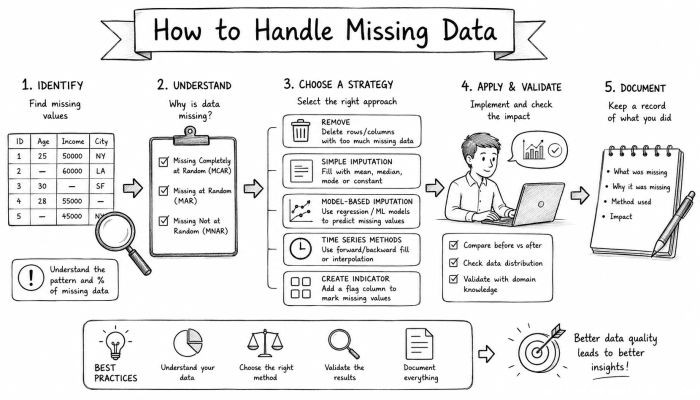
Before tackling missing data, it’s essential to comprehend why data points may be absent. Missing data typically falls into three categories: Missing Completely at Random (MCAR), Missing at Random (MAR), and Missing Not at Random (MNAR). MCAR means the missingness is independent of observed and unobserved data; MAR implies that missingness relates only to observed data, and MNAR indicates missingness depends on unobserved data. Understanding these distinctions informs which handling methods are appropriate and helps prevent misinterpretation.
The Impact of Missing Data on Analysis
Missing data can impair statistical power, reduce sample size, and introduce systematic bias. Simply discarding incomplete cases might lead to skewed results if the missingness is not random. For example, if lower-income respondents are less likely to answer income questions, excluding these cases biases economic analyses. Recognizing these pitfalls underscores the need for thoughtful strategies to manage missingness.
Initial Assessment: Quantifying and Diagnosing Missing Data
An effective approach starts with a comprehensive assessment of missing data patterns. Visual tools such as heatmaps, missingness matrices, and bar plots can highlight the extent and structure of absent values. Additionally, examining correlations between variables and missingness helps identify whether data are MCAR, MAR, or MNAR, shaping subsequent handling choices.
Deleting Missing Data: Listwise and Pairwise Deletion
Listwise deletion removes any observations with missing values, producing complete datasets straightforwardly. While simple, it can drastically reduce data size and cause bias if data are not MCAR. Pairwise deletion, on the other hand, analyzes all available data pairs, preserving more information but complicating interpretation. Both approaches are easy to implement but are generally discouraged in cases of systematic missingness.
Mean and Median Imputation: Filling the Gaps Simply
One common technique is imputing missing values using the mean or median of observed data. This approach is straightforward and computationally light but can underestimate variability and distort distributions. It may also reduce correlations between variables, undermining analytic rigor. Thus, while useful for exploratory analysis, mean/median imputation is usually inadequate for advanced modeling.
Advanced Imputation Methods: Regression and k-Nearest Neighbors
More sophisticated approaches use predictive models to estimate missing values. Regression imputation models the missing variable as a function of other variables, while k-Nearest Neighbors (k-NN) imputes missing entries based on similarity to neighboring data points. These methods better preserve data integrity and reveal underlying patterns, yet require careful consideration to avoid overfitting and inflated confidence.
Multiple Imputation: A Robust Solution
Multiple imputation (MI) involves creating several complete datasets by replacing missing values with multiple plausible estimates, analyzing each dataset independently, and combining results. MI accounts for uncertainty in imputations, reducing bias and increasing validity. Though computationally intensive, it is considered a gold standard technique, especially in clinical and social science research.
Model-Based Approaches: Maximum Likelihood and Bayesian Methods
Maximum likelihood (ML) and Bayesian methods integrate missing data handling directly into analytic models. ML estimates parameters that best explain observed data, while Bayesian techniques incorporate prior knowledge with observed data distributions. Both approaches can efficiently handle MAR data without explicit imputation, but require expertise and computational power.
Handling Missing Data in Machine Learning Pipelines
In machine learning, missing data challenges differ due to algorithmic constraints. Some models like decision trees can handle missing values natively, while others (e.g., SVM, neural networks) require complete data or imputation. Automated pipelines often incorporate imputation transformers or flags for missingness. Feature engineering and careful evaluation of imputation impact on model accuracy are critical.
Using Missing Data Indicators: Leveraging Missingness as Information
Sometimes, the fact that data is missing carries meaningful information. Creating missing data indicator variables flags where data is absent, allowing models to exploit missingness patterns. This technique can be particularly relevant in contexts where missing values signify specific conditions or behaviors, enhancing predictive accuracy.
Ethical Considerations and Documentation
Handling missing data responsibly entails transparency and ethical considerations. Researchers should document missing data extent, patterns, and handling methods in publications and analyses. Awareness of potential bias introduced by imputation or exclusion ensures credibility and enables reproducibility, fostering trust in results.
Best Practices for Handling Missing Data
Best practices involve a combination of careful data inspection, appropriate method selection based on missingness type, and validation of results. Iterative approaches that compare multiple treatments of missing data enhance robustness. Collaborating with domain experts helps interpret missingness causes, guiding methodological choices toward accurate conclusions.
Conclusion
Handling missing data is a critical aspect of data analysis that directly impacts the reliability and validity of research findings. Understanding the mechanisms behind missingness and carefully selecting appropriate strategies—ranging from deletion and simple imputation to advanced multiple imputation and model-based approaches—allow researchers to mitigate bias and preserve statistical power. In addition, integrating missing data handling techniques thoughtfully within machine learning pipelines and maintaining clear documentation enhances transparency and replicability. As data continues to grow in volume and complexity across fields, mastering the art and science of dealing with missing data is indispensable for uncovering truthful insights and making sound decisions. Embracing robust, informed approaches to missing data not only strengthens analytical outcomes but also upholds the integrity of data-driven knowledge creation.
 How to Make the Most of Your Holiday Break
 The Best Winter Destinations for a Cozy Getaway
 How to Organize Your Holiday Travel Plans with Ease
 The Ultimate Guide to Cooking for a Crowd
 How to Make Healthy Comfort Food Without the Guilt
 5 Delicious Vegan Breakfast Ideas You Can Make in Minutes