Hadoop and Spark: The Big Data Tools
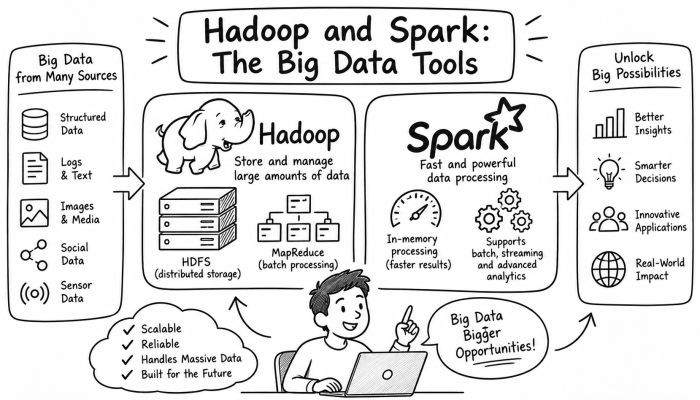
Apache Hadoop and Apache Spark are two of the most widely adopted big data technologies today. Both projects were born out of a need to process large datasets that exceed the capacity of a single server. Hadoop first appeared in 2006 and introduced a new way of storing and processing big data across clusters of commodity hardware. Apache Spark arrived in 2014 and quickly gained popularity for its lightning-fast data processing capabilities, ease of use, and support for real-time streaming and machine learning use cases. In this blog post, we’ll take an in-depth look at how Hadoop and Spark work, compare their architectures and features, and discuss common use cases where each technology excels.
- What is Big Data?
- Introducing Apache Hadoop
- Hadoop Distributed File System (HDFS)
- MapReduce Programming Model
- Benefits of Hadoop
- Components of the Hadoop Ecosystem
- Apache Hive
- Apache Pig
- Apache HBase
- Apache ZooKeeper
- Apache Spark
- Core Concept of Apache Spark: Resilient Distributed Dataset (RDD)
- Apache Spark Ecosystem
- Spark Streaming
- Conclusion
- More Related Topics
What is Big Data?
Big data is a term used to describe datasets that are too large or complex to be processed using traditional software tools. Big data is characterized by the 3 Vs:
Volume
Velocity
Variety
Companies today are sitting on massive amounts of data collected from social media, websites, sensors, logs, transactions, IoT devices, and more. Analysts and scientists use big data tools to surface insights and optimize decision-making processes. To do this, they require technology that allows them to store, process, and analyze this information in ways that were not possible before.
Introducing Apache Hadoop
Apache Hadoop is an open-source framework for distributed storage and batch processing of big data. Hadoop enables applications to scale by distributing datasets and computation across clusters of computers using simple programming models.
Hadoop splits files into blocks and distributes them across nodes in a cluster. It then uses a programming model called MapReduce to process data in parallel on each node. MapReduce abstracts away the complexity of distributed computing so developers don’t have to worry about low-level details like data partitioning, cluster management, or fault tolerance.
Hadoop Distributed File System (HDFS)
Apache Hadoop comes with its own distributed file system called HDFS. HDFS stores data on multiple datanodes throughout a cluster. It splits files into blocks and replicates each block on different nodes. This provides fault tolerance and allows Hadoop to continue processing tasks even if a node goes down.
MapReduce Programming Model
MapReduce is a programming model for processing and generating large datasets with a parallel, distributed algorithm on a Hadoop cluster. The map function takes an input pair and produces a set of intermediate key/value pairs. The reduce function merges all intermediate values associated with the same intermediate key.
Benefits of Hadoop
Hadoop became wildly popular because it allowed organizations to store and process data cheaper than ever before using commodity hardware. With its highly available, distributed storage system and parallel processing framework, applications could scale horizontally to meet growing demand.
Components of the Hadoop Ecosystem
Apache Hadoop is more than just distributed storage and batch processing. The Hadoop ecosystem contains many other useful components that help extend its capabilities.
Apache Hive
Apache Hive is a data warehouse software that runs on top of Apache Hadoop. It provides a SQL-like interface so users can query data using HiveQL (an SQL dialect for Hive). Developers can create and manage tables, indexes, and partitions using Hive’s metastore.
Apache Pig
Apache Pig is a high-level platform for creating MapReduce programs used with Hadoop. Pig allows users to leverage existing MapReduce frameworks without having to know Java or write complicated MapReduce jobs from scratch.
Apache HBase
Apache HBase is an open-source, non-relational (NoSQL), distributed database run on top of HDFS. It provides realtime read/write access to datasets stored in Hadoop.
Apache ZooKeeper
Apache ZooKeeper is a centralized service for maintaining configuration information, naming, providing distributed synchronization, and group services.
Apache Spark
Apache Spark is another open-source, distributed computing system for big data processing. Spark runs in memory, making it ideal for workloads that require fast iterative processing. Like Hadoop, it also supports batch processing.
Introduced in 2014, Spark quickly gained traction because it runs faster than MapReduce and supports more use cases such as streaming, machine learning, and interactive data analysis.
Core Concept of Apache Spark: Resilient Distributed Dataset (RDD)
Spark’s core abstraction is called a resilient distributed dataset, or RDD. RDDs are distributed collections of data that can be processed in parallel. Like Hadoop’s MapReduce model, Spark abstracts away the details of distributed computing so users don’t have worry about partitioning data or dealing with failures.
Unlike MapReduce, Spark doesn’t read and write intermediate data to disk. It persists RDDs in memory, making it ideal for workloads that need to access data repeatedly, such as machine learning algorithms.
Apache Spark Ecosystem
Apache Spark has an ecosystem of libraries that help extend its functionality beyond basic data processing.
Spark SQL
Spark SQL is a module for working with structured data within Spark. Users can run SQL queries against Hive metastore.
MLlib
MLlib is Spark’s machine learning library. It contains various algorithms for classification, regression, clustering, optimization, and more.
Spark Streaming
Spark Streaming is used to process live streams of data such as Twitter feeds, log files, socket connections, or any type of sensor data.
GraphX
GraphX is Spark’s library for graph processing. Users can create graphs in Spark and run graph parallel computations.
Spark vs Hadoop
Apache Spark is significantly faster than Hadoop’s MapReduce because it doesn’t have to read from and write to disk between each stage of processing. Spark can cache datasets in memory eliminating disk I/O as a bottleneck.
When should you use Hadoop?
Hadoop is best suited for applications that require large-scale batch processing. For example, loading data from HDFS into a data warehouse for analysis, processing logs or batch ETL jobs. Hadoop’s ecosystem also contains a number of tools for analyzing data such as Hive and Pig.
When should you use Spark?
Spark is best suited for use cases that require fast, iterative processing or low-latency streaming. For example, Spark is great for interactive data analysis, machine learning, and real-time recommendations. Spark has been widely adopted in the data science community because of its ease of use and ability to scale.
Can Hadoop and Spark Work Together?
Apache Spark can run on top of Hadoop YARN, HDFS, and interact with Hive metastore. Because of this, many enterprises don’t have to choose one technology over the other. Spark benefits from Hadoop’s scalability and reliable storage while providing sub-second data processing.
Conclusion
Apache Hadoop and Apache Spark provide organizations with technology to store and analyze big data at scale. They continue to be some of the most popular choices for big data applications due to their unique features and capabilities. Knowing the strengths and weaknesses of each big data platform will help you decide which one is best for your use case.
 How to Make the Most of Your Holiday Break
 The Best Winter Destinations for a Cozy Getaway
 How to Organize Your Holiday Travel Plans with Ease
 The Ultimate Guide to Cooking for a Crowd
 How to Make Healthy Comfort Food Without the Guilt
 5 Delicious Vegan Breakfast Ideas You Can Make in Minutes