Data Mining Explained
Data mining is the act of extracting patterns and information from large amounts of data. As technologies such as data warehouses have become more widespread, professionals have recognized the need to sort through this vast quantity of information to find previously undiscovered trends and associations. Data mining also allows analysts and scientists to make predictions or get ideas about future trends.
- Data Mining Overview
- What is Data Mining?
- How Does Data Mining Work?
- Data Mining Methods
- Data Mining Applications
- What is Data Mining in Machine Learning?
- Data Mining Tools
- Data Mining Tools
- Related Articles:
- Is Data Mining an Analysis?
- What is Data Mining Process?
- Conclusion
- Learn Data Mining
- More Related Topics
Data Mining Overview
Data – defined as observations or measurements of attributes – is considered one of this century’s most valuable resources. However, collecting data is pointless if it is never used to make decisions and drive positive change. Therefore, it is important to have the ability to analyze data and glean valuable knowledge from it.
Businesses and organizations collect massive amounts of information every day, but simply having all of this data does you no good unless you can analyze it and discover meaningful patterns and trends. That is where data mining comes in. Data mining is the practice of sorting through large amounts of data to identify patterns and information.
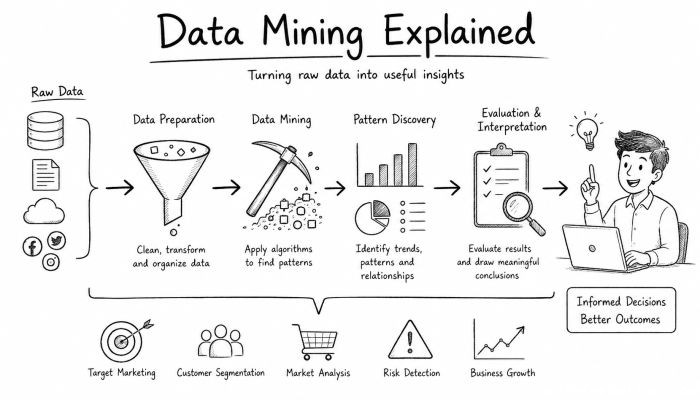
Data mining is the process of discovering patterns and knowledge from large amounts of data. Using methods from statistics, machine learning, artificial intelligence, and database systems, massive datasets can be explored and the insights discovered can be used to make smarter business decisions.
What is Data Mining?
Data mining is the practice of examining large databases in order to generate new information. The data is typically analyzed and processed using machine learning algorithms to build numerical models that identify patterns and correlations.
Mining knowledge from data is known as knowledge discovery in data (KDD).
Data mining is an automated process used to uncover patterns and correlations in large data sets. There are many tools and processes that fall under the data mining umbrella. With data mining, you can automate massive amounts of raw information to allow you to make intelligent business decisions.
Data Mining Examples
Examples of data mining include: When you shop at Amazon and receive recommendations on other items you may like based on your search.
Data mining includes text mining, web mining, audio mining, video mining, and social media mining.
Examples of Data Mining
Data Mining Meaning
Data mining is an automated method of searching for patterns in large datasets.
Data mining from the huge volume of data is expected to drive insights and allow analysts and data scientists to make predictions.
How Does Data Mining Work?
Data is collected and analyzed for patterns using machine learning algorithms.
You gather data, then figure out how to use it to make better decisions.
To start data mining, you must first compile data from a variety of sources.
Data mining is the process of examining large blocks of information to draw out patterns and details.
Data Mining Process
At a basic level, data mining involves first gathering information and then sorting through it to find usable details.
Using your business expertise, combine this new knowledge with what you already know to make better decisions.
Here are 5 steps to data mining:
Step 1: Gather Data
The first step of the data mining process is gathering information from one or more locations. This information can come from internal records such as sales data and customer profiles or external sources like social media websites and financial data feeds.
Step 2: Prepare the Data
Once you have gathered enough data, you must prepare it so that it can be analyzed. This preparation could mean filtering out data that you do not need or sorting everything into clearly defined categories.
Step 3: Analyze the Data
In this step, you will run your mass of information through computer algorithms to look for patterns. These patterns help identify trends and details that can be used to make better business decisions.
Step 4: Share Discovered Knowledge
In this step, you take the information you mined and distribute it to the people who can best use it. If you found that selling winter coats is significantly higher in Colorado than in Florida, you may want to send this new knowledge to your marketing department. They can use this information to decide where and when to advertise certain products.
Step 5: Act on Knowledge
The last step of the data mining process is using the knowledge you discovered to make your business better. Once again using the coat sales example, you may want to produce more coats before winter in Colorado and less in Florida.
Why is Data Mining Important?
Here are four reasons why data mining is important:
It allows you to make better decisions.
Provides answers to questions.
Makes the data mining process understandable to others.
Predicts future trends.
Without Data Mining?
Without data mining, organizations would be limited in their ability to understand data and make informed business decisions.
How Does Data Mining Benefit Me?
Here are four ways data mining can benefit you:
Helps you make better business decisions.
Predicts future trends.
Provides answers to your questions.
Allows you to share information easily.
Data Mining Techniques
Data mining techniques include cluster analysis, anomaly detection, classification, regression, and deviation detection.
Types of Data Mining
The four types of data mining are:
Association
Classification
Clustering
Regression
Best Data Mining Software
The best data mining software for you will depend on what you need. While there are dozens of different data mining applications, below are four of the best.
IBM SPSS Modeler
Rapid Miner
Weka
KNIME
Machine Learning and Data Mining
Machine learning powers data mining. Machine learning algorithms use lots of examples to train computing systems to produce models.
What Kind of Data Can be Mined?
Using data mining, you can take pretty much any type of data and sort through it to find useful information. Below is a list of data types that can be mined.
Customer
Financial
Sales
Website
Text
Audio
Video
Social Media Data
Data Mining Uses
Businesses use data mining for predictive marketing. In marketing, you want to figure out what your customers are likely to do next.
Benefits of Data Mining
Some benefits of data mining include:
Find hidden patterns and correlations
Make better decisions
Increase sales
Save time
Save money
Data Mining Methods
The data mining methods are cluster analysis, anomaly detection, classification, regression, and time-series analysis.
Is Data Mining Crazy?
Data mining is not crazy at all. In fact, it’s essential if your organization collects customer data.
Data Mining Vs. Machine Learning
Machine Learning is a branch of artificial intelligence that teaches computers to learn without being programmed. Data Mining is the exploration and analysis of huge blocks of information to discover meaningful patterns and rules.
Why is Data Mining Needed?
Without data mining, you would not be able to sort through all of your data to find useful information. Not only does data mining allow you to find patterns and details in your information, it also allows you to make better decisions.
What do Data Miners Do?
Data miners sort through masses of information to find patterns and details that can be used to make better decisions.
Who Uses Data Mining?
Data mining is used by businesses and organizations of all types. Any company that collects customer data should engage in some sort of data mining.
Who Uses Data Mining? Is Data Mining Used in Science?
Data mining can be used in the medical field to help doctors sort through patient records. If you work in science, data mining can be used to sort through years of information.
Data Mining Applications
Another application of data mining is in marketing. If you have an ecommerce website or physical store, you can use data mining to figure out what your customers are likely to do next.
Future of Data Mining
In the future, it is expected that data mining will be combined with artificial intelligence to create fully autonomous data mining programs.
Data Mining Careers
Anyone can learn to use data mining techniques. If you’re looking for a career in data mining, consider pursuing a degree in computer science, mathematics, or statistics.
Data Mining Jobs
Data Miner
GIS Analyst
Knowledge Miner
Web Analyst
Business Analyst
Data Scientist
Crime Data Analyst
Data Mining Books
Mining the Social Web: Data Building and Analytics
Real-Time Crime Forecasting
Data Mining Courses
Learn Data Mining
Apache Hive – Data Mining using Hive
What is Data Mining in Machine Learning?
Data mining is a process of exploring and analyzing huge blocks of information to glean meaningful patterns and rules.
Data Mining Tools
There are many different data mining tools available. While it may be difficult to decide on the best data mining software, here are four of the top programs:
10 Data Mining Interview Questions
1. What is Data Mining?
2. Give an example of data mining.
3. How does data mining work?
4. Who uses data mining?
5. Is data mining illegal?
6. Where can I learn data mining?
7. Why is data mining used?
8. Is data mining true?
9. Who pioneered data mining?
10. What are the four types of data mining?
Data Mining Tools
Data Mining Software
Related Data Mining Terms
Business Intelligence
Big Data
Hadoop
Cluster Analysis
Dummy Variable
Data Science
Data Analytics
Corporate Intelligence
Record Linkage
Knowledge Discovery in Data Mining
List of Data Mining Companies
Data Mining Articles
Knowledge Management
Web Analytics
Crowdsourcing
Neural Networks
Data Definition Language (DDL)
OLAP Cubes
Statistics Basics
Related Articles:
What is Data Mining? Understanding with Simple Examples
Data mining is commonly used to discover previously unknown patterns from huge amounts of stored data. Mining gigabytes of data may be automated; that is, it may be performed without direct human involvement. Machine learning and database theory are examples of fields that have contributed to the creation of methods for data mining.
Is Data Mining an Analysis?
Data mining is the general category that includes data analysis.
Data Mining Vs. Statistics
Data mining is rooted in statistics. Statistics often deals with the analysis of smaller data sets.
What is Data Mining Process?
Data mining is the act of sorting through large amounts of information in order to find previously unknown patterns or trends.
Data Mining Jobs with Salary
Data Scientist
Average Salary: $113,802
Number of Jobs: 25,072
Big Data Engineer
Average Salary: $119,064
Number of Jobs: 4,322
Business Intelligence Analyst
Average Salary: $66,486
Number of Jobs: 20,320
Data Analyst
Average Salary: $67,190
Number of Jobs: 71,721
Knowledge Discovery Analyst
Average Salary: $86,105
Number of Jobs: 812
Click the link for more Data Mining Jobs.
Conclusion
Data mining helps uncover patterns and details that can help you make better business decisions.
Related Questions
What is data mining simple words?
Data mining is the practice of examining large amounts of information to draw out information and patterns.
What is data mining example?
An example of data mining is when you shop at Amazon and receive recommendations on other items you may like based on the item you searched.
What are the 3 purposes of data mining?
Three purposes of data mining are to manage, analyze, and optimize large databases. Additionally, data mining can be used to uncover new patterns.
How do you explain data mining?
Data mining is the process of searching large databases for new information. Mining systems can work automatically or with minimal human intervention.
Is data mining hard?
Difficulty – ModerateBeing a data miner is a very difficult job. It requires patience, skill, and the ability to work with computers and technology.
Who came up with data mining?
A woman named Patricia Selinger was responsible for developing data mining with her partner Larry Eisenstat at IBM Research’s AI department.
What comes first data mining or data analysis?
Data mining should always be done before you perform any type of analysis. It is the process of extracting information from a large database.
Is data mining real?
Yes! Data mining is a real job that involves sorting through large amounts of data in order to find useful information. Data miners help companies make better business decisions by uncovering patterns and trends.
Is data mining useful?
Yes. Data mining is useful for uncovering trends and details.
What kind of math do you need for data mining?
Mathematics used for data mining include calculus, linear algebra, and statistics.
What are the disadvantages of data mining?
One disadvantage of data mining is that many people interpret data mining as spying. People feel that their private data is being mined when it’s really being sorted through.
Does data mining need coding?
Yes and no. While data mining itself does not need to you to know how to code, many data miners do know how to code. Learning how to code will allow you to understand the automated reports your data mining program provides.
What jobs use data mining?
Careers in data mining include computer engineers, field service engineers, and IT consultants.
Where do data miners work?
Any business that collects information on their customers should perform some sort of data mining. Data miners work in a variety of settings.
Learn Data Mining
Take our free introductory class to Data Mining to learn how to use data mining to find patterns in data.
Thank you for reading our what is data mining article
 How to Make the Most of Your Holiday Break
 The Best Winter Destinations for a Cozy Getaway
 How to Organize Your Holiday Travel Plans with Ease
 The Ultimate Guide to Cooking for a Crowd
 How to Make Healthy Comfort Food Without the Guilt
 5 Delicious Vegan Breakfast Ideas You Can Make in Minutes