How to start writing unit tests
In the fast-paced world of software development, delivering high-quality, reliable code is paramount. Unit testing, the practice of writing automated tests for individual components or functions in your code, has become an indispensable tool for developers aiming to improve code robustness and maintainability. Despite its clear benefits, many programmers find starting with unit tests daunting due to unfamiliarity or perceived complexity. This article offers a comprehensive, step-by-step guide to help developers embark on the journey of writing effective unit tests. Whether you are a beginner eager to integrate testing into your workflow or a developer seeking to polish your skills, this article will define unit tests, explain their importance, and provide practical advice on how to write your first tests with confidence and clarity.
- Understanding Unit Tests: What Are They?
- Why Writing Unit Tests Matters
- Setting Up Your Testing Environment
- Choosing What to Test First
- Writing Your First Unit Test: A Simple Example
- Understanding Assertions and Test Failures
- Best Practices for Writing Effective Unit Tests
- Handling Dependencies with Mocks and Stubs
- Integrating Unit Tests into Your Development Workflow
- Common Pitfalls and How to Avoid Them
- Measuring Success: When Are Your Unit Tests “Good Enough”?
- Continuing Your Unit Testing Journey
- Conclusion
- More Related Topics
Understanding Unit Tests: What Are They?
Unit tests are small, automated tests written to verify that specific sections of code — typically individual functions or methods — behave exactly as expected. Unlike integration or end-to-end tests that examine larger pieces of software or entire systems, unit tests focus narrowly on the smallest testable parts. This granularity allows developers to quickly identify bugs and regressions without running through complex workflows. Unit tests act as documentation, illustrating how each component is supposed to function, and they become a safety net, alerting the team when changes inadvertently break features.
Why Writing Unit Tests Matters
Writing unit tests brings tangible benefits to every stage of the software development lifecycle. First, unit tests improve code quality by enforcing correctness at a granular level. They reduce defects early, saving time otherwise spent hunting bugs in later stages. Second, tests facilitate safer refactoring and updates by verifying that changes don’t break existing functionality. Third, unit tests simplify debugging since test failures narrow down potential problem areas immediately. Additionally, having a solid suite of unit tests boosts developers’ confidence and encourages a more modular programming style, resulting in cleaner, more maintainable codebases.
Setting Up Your Testing Environment
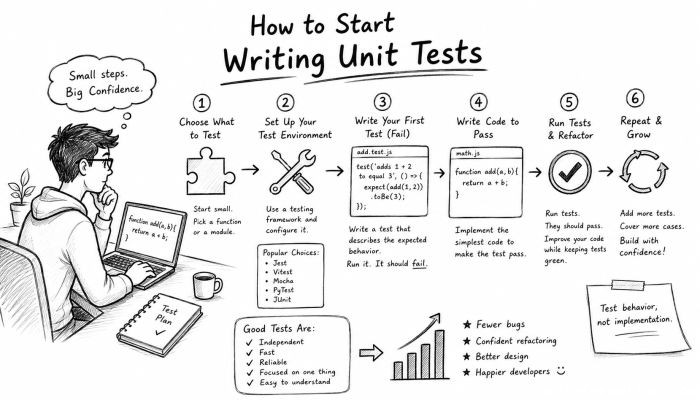
Before you can start writing unit tests, you need to set up a proper testing environment tailored to your programming language and project. Most modern programming languages offer dedicated testing frameworks — for example, JUnit for Java, pytest for Python, or Jest for JavaScript. These frameworks provide essential tools such as test runners, assertion libraries, and reporting functionalities. To set up your environment, you typically install the relevant testing libraries using package managers (e.g., npm, pip, Maven), configure your IDE to recognize test files, and ensure your project structure supports easy test organization.
Choosing What to Test First
When starting out, it’s important to prioritize what parts of your code to write unit tests for. Focus on core functions that perform critical operations or handle complex logic, as these are more susceptible to bugs. Start by testing pure functions — those without side effects — because they are easier to validate and help you understand the testing process. You can also target functions that return values based on inputs or those suspected of causing issues. Avoid writing tests for trivial code such as simple getters or setters initially, and instead concentrate on functions that perform meaningful computations or data transformations.
Writing Your First Unit Test: A Simple Example
Let’s illustrate how to write a basic unit test. Suppose you have a function that adds two numbers. Using a testing framework like pytest, your test might look like this:
```python
def test_add():
assert add(2, 3) == 5
```
This test verifies that calling `add(2, 3)` returns `5`. The test is clear, focused, and automated — you can run it frequently to check your function behaves correctly. Starting with such simple cases builds your confidence in writing tests and understanding testing mechanics like assertions, test naming, and running tests automatically.
Understanding Assertions and Test Failures
Assertions are the core of unit testing; they check whether a certain condition holds true. If an assertion fails, it means the test has detected a defect or unexpected behavior in your code. For example, asserting `result == expected_value` confirms output correctness. Learning to write meaningful assertions that properly capture expected behavior is crucial. Additionally, when tests fail, the testing framework typically provides diagnostic information, such as which assertion failed and what values were received, helping you quickly identify and fix bugs.
Best Practices for Writing Effective Unit Tests
To maximize the benefits of unit tests, consider several best practices. Write tests that are independent and do not rely on external state or previously run tests. Each test should have a single responsibility, checking just one thing per test to simplify debugging. Use descriptive test names that clearly communicate the purpose of the test, enhancing readability and maintainability. Avoid complex logic inside tests themselves, keeping them straightforward and easy to understand. Also, aim for high test coverage, but prioritize quality over quantity — well-written tests are more valuable than many superficial ones.
Handling Dependencies with Mocks and Stubs
Often, your code relies on external systems or other modules that are inconvenient or slow to include in unit tests. This is where mocking and stubbing come into play. Mocks simulate the behavior of dependencies, allowing controlled interaction during testing without relying on real implementations. Stubs provide predetermined responses for external calls. Using these techniques helps isolate the unit under test, ensuring tests remain fast and deterministic. Most testing frameworks or libraries have built-in or companion tools for mocking, such as unittest.mock in Python or Sinon.js in JavaScript.
Integrating Unit Tests into Your Development Workflow
Once you start writing unit tests, integrating them seamlessly into your development process is essential. Run tests frequently — ideally, after every meaningful code change — to catch problems early. Many IDEs and code editors support features like test runners and live feedback to streamline this process. Consider automated test runs via continuous integration (CI) pipelines, which execute your tests on remote servers every time you push code changes. This practice ensures that issues are detected before code reaches production, fostering a culture of quality and accountability within your team.
Common Pitfalls and How to Avoid Them
While unit testing is powerful, beginners often stumble upon common pitfalls. Writing brittle tests that break frequently due to tight coupling with implementation details can cause frustration. To avoid this, focus tests on observable behavior and outcomes, not internal code specifics. Neglecting test maintenance is another issue — as code evolves, tests may become outdated or irrelevant. Periodically review and refactor your tests to keep them aligned with code changes. Lastly, don’t underestimate test readability; poorly written tests can become as confusing as the code itself. Invest time in writing clean and understandable tests.
Measuring Success: When Are Your Unit Tests “Good Enough”?
Assessing the quality and sufficiency of your unit tests requires a balanced approach. While high test coverage (the percentage of code executed by tests) is a useful indicator, it’s not the sole measure of efficacy. Tests should cover critical paths, boundary cases, and edge conditions relevant to your application. They also need to be reliable — passing consistently without flaky failures — and maintainable over time. Regularly solicit feedback from peers and use code reviews to ensure your tests meet project standards. Remember, the goal is not to write tests for every line of code but to build a safety net that enables confident development.
Continuing Your Unit Testing Journey
Starting with unit tests is just the beginning of a continuous improvement journey toward software quality excellence. Once comfortable with basic tests, explore more advanced topics such as parameterized tests, code coverage tools, and integrating testing with behavior-driven development (BDD). Engage with community resources, tutorials, and forums to learn evolving best practices. Over time, writing unit tests will become a natural and integral part of how you build software, ultimately leading to more stable releases and happier, less stressed development cycles.
Conclusion
Unit testing is a foundational practice that empowers developers to deliver robust, maintainable software. By breaking down complex systems into small units and verifying each one independently, developers gain instant feedback that improves code quality and developer confidence. Starting is easier than many think: begin by understanding what unit tests are, set up your environment, write simple tests focusing on key functions, and expand gradually. Embrace best practices like clear assertions, test isolation, and meaningful naming while leveraging tools like mocks and CI pipelines. Avoid common pitfalls by focusing on test relevance and readability. Ultimately, integrating unit testing into your workflow transforms how you build software, providing an effective safeguard against defects and accelerating development. With patience and practice, writing unit tests evolves from a chore to a powerful ally in your programming toolkit.
 How to Make the Most of Your Holiday Break
 The Best Winter Destinations for a Cozy Getaway
 How to Organize Your Holiday Travel Plans with Ease
 The Ultimate Guide to Cooking for a Crowd
 How to Make Healthy Comfort Food Without the Guilt
 5 Delicious Vegan Breakfast Ideas You Can Make in Minutes