How to Make Your Own Hand-Poured Candles
There’s something deeply calming about the warm glow of a candle. It softens a room, slows your breathing, and creates an atmosphere that feels intentional and comforting. But what if you could go beyond buying candles and actually create your own? Learning how to make your own hand-poured candles is more than just a DIY craft—it’s a creative ritual. It allows you to customize scents, colors, containers, and ingredients while producing something beautiful and functional. Whether you want eco-friendly soy candles, luxurious scented gifts, or a relaxing hobby, hand-pouring candles is surprisingly accessible. You don’t need a professional studio—just the right materials, a little patience, and attention to detail. In this complete guide, you’ll discover step-by-step techniques, safety tips, creative ideas, and expert insights to help you craft candles that look professional and burn beautifully.
- Why Make Your Own Hand-Poured Candles?
- Choosing the Right Wax for Your Candles
- Selecting Wicks That Burn Evenly
- Fragrance Oils vs. Essential Oils
- Gathering Essential Candle-Making Supplies
- Preparing Your Workspace for Safety
- Step-by-Step: How to Make Your Own Hand-Poured Candles
- Customizing Color and Design
- Avoiding Common Candle-Making Mistakes
- Testing Your Candle Before Gifting or Selling
- Making Eco-Friendly and Sustainable Candles
- The Emotional Benefits of Candle Crafting
- Conclusion
- More Related Topics
Why Make Your Own Hand-Poured Candles?
Making your own candles offers control, creativity, and cost savings. Store-bought candles can be expensive and sometimes contain synthetic additives. When you make candles yourself, you choose natural waxes, clean-burning wicks, and fragrances you truly love. It also becomes a meaningful handmade gift idea or even a small business opportunity. Beyond practicality, candle-making provides a calming, almost meditative experience.
Choosing the Right Wax for Your Candles
The type of wax you choose significantly affects the final result. Soy wax is popular for its clean burn and eco-friendly properties. Beeswax burns slowly and emits a natural honey scent. Paraffin wax is affordable and holds fragrance well but is less natural. Coconut wax blends offer smooth finishes and excellent scent throw. For beginners, soy wax is often the easiest starting point.
Selecting Wicks That Burn Evenly
Wicks determine how well your candle burns. Cotton wicks are common and reliable, while wooden wicks create a gentle crackling sound for a cozy feel. Wick size matters—too small and the candle tunnels; too large and it burns too quickly. Always match wick size to container diameter for optimal performance.
Fragrance Oils vs. Essential Oils
Scent plays a powerful role in candle appeal. Fragrance oils offer a wide variety of complex scents and strong throw. Essential oils provide natural aromas but may not always hold scent as effectively in wax. If you prefer natural options, choose high-quality essential oils designed for candle-making to ensure safety and longevity.
Gathering Essential Candle-Making Supplies
Before starting, gather your tools: wax, wicks, fragrance or essential oils, thermometer, double boiler (or heat-safe bowl), stirring utensil, containers, and adhesive for wick placement. Having everything ready ensures a smooth process. Safety equipment like heat-resistant gloves and a clean workspace are equally important.
Preparing Your Workspace for Safety
Candle-making involves hot wax, so safety is essential. Work on a stable, heat-resistant surface. Keep flammable materials away. Never leave melting wax unattended. Use a thermometer to avoid overheating—most waxes melt between 120°F and 180°F depending on type. Controlled temperatures improve both safety and quality.
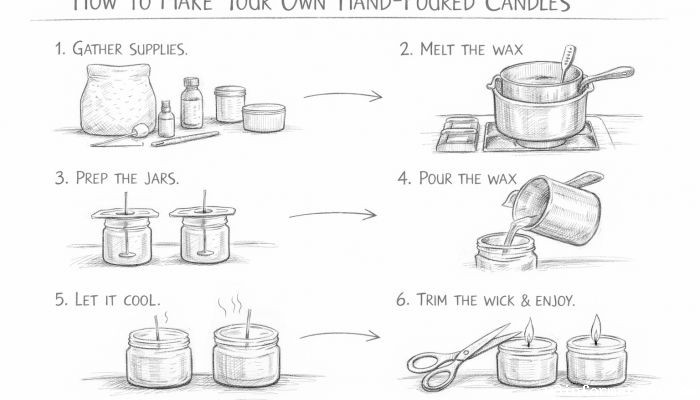
Step-by-Step: How to Make Your Own Hand-Poured Candles
- Measure and Melt Wax: Use a double boiler to melt wax slowly and evenly. Stir occasionally.
- Prepare Containers: Secure the wick to the bottom center using adhesive.
- Monitor Temperature: Allow wax to cool slightly before adding fragrance (usually around 170°F for soy wax).
- Add Fragrance: Stir gently for even distribution.
- Pour Carefully: Pour wax slowly into the container, leaving space at the top.
- Center the Wick: Use a wick holder or chopsticks to keep it upright.
- Let It Cure: Allow candles to cool and cure for 24–48 hours before trimming the wick and testing.
Customizing Color and Design
Adding color elevates your candles visually. Use candle-safe dye chips or liquid dyes for consistent results. You can create layered candles by pouring different colors sequentially after each layer sets. Keep designs simple at first—precision improves with practice.
Avoiding Common Candle-Making Mistakes
New candle makers often encounter issues like sinkholes, uneven tops, or tunneling. To prevent sinkholes, pour at the correct temperature and avoid drafts. To fix uneven surfaces, use a heat gun gently across the top. Testing small batches helps you refine technique before scaling up.
Testing Your Candle Before Gifting or Selling
Before sharing your candles, conduct a burn test. Observe how evenly it burns, how strong the scent throw is, and whether the wick size is correct. A proper test ensures safety and performance. Trim wicks to about ¼ inch before each burn to prevent soot.
Making Eco-Friendly and Sustainable Candles
Sustainability is increasingly important. Choose soy or beeswax for renewable options. Reuse glass jars or repurpose vintage containers. Avoid synthetic dyes when possible. Small eco-conscious decisions make your candles both beautiful and environmentally responsible.
The Emotional Benefits of Candle Crafting
Candle-making isn’t just about the final product—it’s about the process. Melting wax, blending scents, and watching the pour settle into something tangible is deeply satisfying. The ritual slows you down and encourages creativity. Lighting a candle you made yourself adds an extra layer of warmth and pride.
Conclusion
Learning how to make your own hand-poured candles is a creative, rewarding skill that blends artistry with practicality. From selecting the right wax and wick to customizing scents and designs, every step allows you to create something uniquely yours. Beyond the glow and fragrance, handmade candles carry a sense of intention and craftsmanship that store-bought products simply can’t replicate. Whether you’re crafting for relaxation, gifting, or building a business, the process offers both tangible beauty and personal satisfaction. With patience, practice, and attention to detail, you can master the art of candle-making—and fill your home with warmth that you created yourself.
 Big O Notation Explained for Beginners
 AI in Gaming: Smarter NPCs and Environments
 Understanding Bias in AI Algorithms
 Introduction to Chatbots and Conversational AI
 How Voice Assistants Like Alexa Work
 Federated Learning: AI Without Sharing Data