Virtual Reality in Classrooms: The Next Big Thing
Education never stands still. As new frontiers of teaching and learning expand, archaic chalk-and-talk classroom experiences are gradually replaced by effective learning methods that catalyze interactions and information retention among students. Leveraging digital technologies such as virtual reality (VR), augmented reality (AR), and artificial intelligence (AI) to educate students is not just the norm, but it is also the inevitable future. In the hands of innovative teachers, VR creates a revolution in the classroom with boundless opportunities. VR is immersive in 3D interactive environments where every object, phenomenon, or process can be touched, modified, and closely investigated. In an educational context, it makes difficult-to-grasp knowledge fascinating and evokes pupils’ imagination by complementing abstract notions with their real-world images. VR is being increasingly used in classrooms around the world to make difficult or abstract topics come alive for students.
Teachers have realized that VR can bring 21st-century learning into reality, engage both visual and auditory learners, and help younger generations not just study the textbooks, but go beyond them to master both simple and complex information. In 2025, VR in class is rapidly expanding as hardware becomes cheaper and more readily available while educational content in digital marketplaces is getting more diversified.
- What is VR in Education?
- Boosting Engagement and Concentration
- Bridging Theory and Practice
- Creating an Inclusive Environment
- Developing 21st-Century Skills
- Helping to Visualize Abstract Concepts
- Stimulating the Curiosity with Real-Life Experience
- Breaking the Geographical Boundaries
- Supporting Teachers’ Training
- Aligning VR with the Curriculum
- Addressing the Potential Drawbacks
- The Future of VR in Classrooms
- Conclusion
- More Related Topics
What is VR in Education?
Virtual Reality (VR) is a computer-generated digital environment in which students experience the feeling of presence. It is simulated by a VR system with the help of electronic devices that make users feel like they are in that digital reality. In contrast to Augmented Reality (AR), VR does not display information in the real environment: it takes the students into an interactive 3D virtual world.
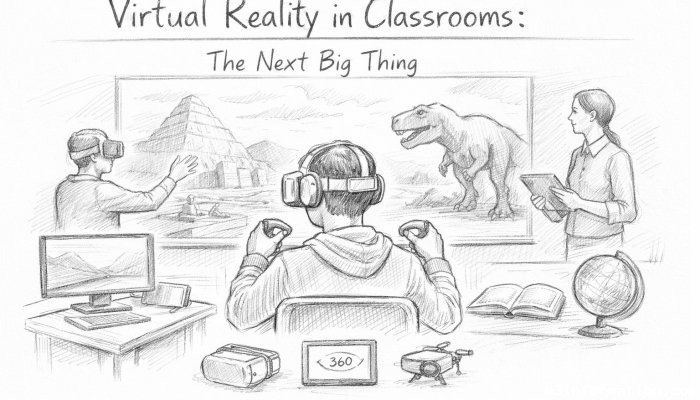
For example, in a VR classroom, pupils explore buildings they could only have read about in their history textbooks. In VR, a student is actually there inside the Colosseum, wandering around, getting a feel for the place, before learning about it in a more traditional way. Another great advantage of VR in the classroom is making intangible abstract concepts tangible and visual. For instance, to learn about the anatomy of the human heart or molecules structure, a student just has to pick a 3D model in a VR software and look at it from all sides to get a sense of depth and space.
In 2025, VR in the classroom is expanding from experimental and demonstration stages to being a regular learning and teaching aid, especially for middle and high school children. It is a tool to be used for active learning, problem-solving tasks, and experiential education methods.
Boosting Engagement and Concentration
Attention is a scarce and precious resource in the classroom. Whether learning is a visual, kinesthetic, or auditory activity, students are easily distracted from the lesson by the classroom murmur, birds chirping outside, or by hunger. VR makes it almost impossible to be distracted and makes learning fun, interactive, and thus memorable. Pupils in VR are not just passively receiving information from the teacher, but are an active part of the learning process, and have the ability to explore, discover, and interact with educational content in multiple ways. The research shows that VR in class helps increase students’ retention rate up to 75%.
Bridging Theory and Practice
School and university courses often call for an application of theory to practice, however, young learners struggle to do that when they have never experienced a practical side of that knowledge in real life. VR brings practice into the classroom and allows students to try things in the real world: for example, medical students can practice surgeries in a virtual hospital to hone their skills, without real consequences. VR for engineering students allows them to test out their creations before actually building them in a real-life setting. Art students can take virtual tours to visit art museums and historical monuments.
In 2025, VR allows students to use their theoretical knowledge in a safe, controlled, and repeatable environment to enhance their practical skills and build their confidence.
Creating an Inclusive Environment
VR in education creates new opportunities for pupils with physical disabilities, social anxieties, or other learning differences, making the classroom a more inclusive place for all of them. For example, pupils with mobility problems or who cannot afford expensive trips have a VR opportunity to visit historical landmarks, museums, and other places of educational interest. Shy students also benefit from the virtual environment where they can be more outgoing and interact without fear of being judged by their peers.
VR in the classroom provides students with different learning needs equal access to knowledge through immersive and interactive digital experiences.
Developing 21st-Century Skills
The modern educational system also sets an increasing emphasis on the development of 21st-century skills in students: problem-solving, critical thinking, creativity, teamwork, communication, and digital literacy. VR helps develop those skills in children organically. Working on a VR project, students have to practice teamwork and collaboration in order to achieve a goal: they have to communicate and coordinate with each other, solve problems as they arise, and innovate creative solutions to the challenges they are tasked with. VR also promotes 21st-century skills in learners and develops those attributes in them naturally.
Helping to Visualize Abstract Concepts
VR in the classroom is especially effective in such subjects as physics, chemistry, mathematics, which often involve working with rather abstract concepts that can be hard to visualize. VR in class allows students to manipulate objects and see them in three dimensions, which makes learning easier and more fun. For example, in the VR environment, physics students can visualize electromagnetic waves or play with geometric shapes, while chemistry students can manipulate atoms and molecules, getting a sense of their 3D composition and structure.
Stimulating the Curiosity with Real-Life Experience
Learning by doing is one of the most effective ways of absorbing knowledge: through the use of VR, it is made possible. Pupils learn by immersing themselves in the VR environment and exploring the real-life experience: for example, history lessons turn into time travel simulations, biology classes can be exciting explorations inside the human body, or geography studies can be walking through rainforests or deserts.
In 2025, an increasing number of teachers use VR simulations to bring the real-life experience to the classroom.
Breaking the Geographical Boundaries
VR experience in class also allows to remove the geographical limitations: with the help of VR, it is becoming increasingly possible to visit museums in other countries, or explore places of research interest for science projects around the world. VR for geography students allows them to see the world and explore global research sites to study firsthand whatever they need. In 2025, through VR, students in rural areas can virtually tour international museums or visit scientific research centers and labs and observe the scientific processes in real time.
VR is a democratizing tool that levels the playing field for students everywhere.
Supporting Teachers’ Training
VR in the classroom can be used not only for students, but for teachers as well. VR simulations can help them to practice, explore various teaching strategies and classroom management methods or learn the subject of the curriculum in an interactive way. Professional development courses that make use of VR enable the teachers to practice and feel confident in the use of the technology, improve their instruction methods and be prepared to guide the students in the most innovative and beneficial ways.
Aligning VR with the Curriculum
A key to effective learning is to align all aspects of a course to the curricular goals. VR in class is no different: it should be used in a supplementary way to support the textbooks, lectures, and assessments. In 2025, teachers are supplementing the curricular standards with VR modules that can either reinforce what has been taught in class or serve as enrichment, remediation, or differentiation opportunities for the children of different learning styles.
Addressing the Potential Drawbacks
The increasing popularity of VR in the classroom does not mean that there are no potential drawbacks. The high cost of VR headsets and limited content are some of the main issues at the moment, as well as some individual limitations of the technology itself. For example, it can be quite fatiguing to the eyes or cause motion sickness in some children after long exposure.
Screen time and individual guidance are crucial when using VR in the classroom. In order to make VR accessible to every child, it is important to find schools or districts that already have a VR program and the appropriate hardware. The more practice teachers have in using VR, the better their training and guidance will be for the students.
The Future of VR in Classrooms
VR in education has an immense potential, and it is yet to be tapped. With improvements in artificial intelligence algorithms and machine learning, haptic VR feedback and cloud-based VR software, VR simulations will become even more realistic and adaptive. In 2025, it is likely that VR will become a regular component in most middle and high school classrooms across the country, supplementing all areas of STEM instruction to support personalized and interactive learning. VR will also allow for global collaboration and online school interaction in educational projects or 3D environments built for such a purpose.
VR is transforming the educational landscape by supporting and empowering a range of teaching and learning strategies.
Conclusion
VR is much more than a cool technology that can make your class look “futuristic”. It is an immersive 3D interactive environment with boundless educational opportunities: from increasing pupils’ attention, engagement, and participation to making the content of various complex disciplines more relatable and interesting for students. VR provides effective learning methods that catalyze interactions and information retention among students and develops both digital and 21st-century skills in learners. VR is transforming the educational landscape by supporting and empowering a range of teaching and learning strategies and an increasing number of teachers around the world are including it in their classroom plans. In 2025, the implementation of VR into education is expanding rapidly, as hardware becomes cheaper and more readily available and as educational VR content is getting more diversified. All this suggests that the future of VR in the classroom is bright and, if thoughtfully adopted by educators, it will help create an environment that truly inspires, empowers, and supports students on their paths to success.
 How to Make the Most of Your Holiday Break
 The Best Winter Destinations for a Cozy Getaway
 How to Organize Your Holiday Travel Plans with Ease
 The Ultimate Guide to Cooking for a Crowd
 How to Make Healthy Comfort Food Without the Guilt
 5 Delicious Vegan Breakfast Ideas You Can Make in Minutes