The Growing Importance of Data Analytics in Business Decisions
In an era of hyper-competition and rapid market changes, decision-making by pure intuition is no longer an option. To make sound business decisions, companies need to supplement experience with real-time data and precise predictions. The use of data analytics to support strategic choices has become not just desirable but a necessity for businesses looking to succeed. In this article, we will discuss the key aspects of data analytics, including its tools, applications, benefits, and challenges, and explain why data is becoming a defining factor for winning companies.
- Understanding Data Analytics
- The Business Significance of Big Data
- Predictive Analytics for Business Planning
- Customer Experience Analytics
- Operational Analytics for Efficiency
- Analytics: The Source of Competitive Advantage
- Analytics for Risk Management and Fraud Detection
- Marketing Analytics
- AI and Machine Learning in Data Analytics
- Barriers and Challenges of Data Analytics
- The Future of Business Analytics
- Conclusion
- More Related Topics
Understanding Data Analytics
Data analytics is a process of collecting and examining raw information to reveal patterns, correlations, and trends that allow for better-informed decisions. The use of data for strategic purposes covers a wide range of activities. These include gathering data from internal systems, external sources, and third parties; processing, cleaning, and standardizing it; and applying various statistical or computational techniques to generate insights. A common misconception is that analytics is the same as reporting. On the contrary, while reporting is backward-looking and summarizes past performance, analytics is used to create forward-looking intelligence, which is necessary to make strategic decisions. Business analytics is aimed at spotting business opportunities, risks, and inefficiencies by interpreting information. It can tell businesses what they already know or provide new and potentially valuable insights into customer behavior, market trends, financial data, and operational efficiency, all of which are essential for making business decisions.

The Business Significance of Big Data
Companies nowadays collect and process more and more information from social media, e-commerce platforms, IoT devices, employee systems, and other sources. This so-called big data is changing the way businesses look at their own activities and that of the world around them. Big data is usually characterized by its volume, velocity, and variety. By combining advanced statistical tools with machine learning and other artificial intelligence (AI) methods, companies are able to process and analyze the data at a scale and at a speed that were unthinkable just a few years ago. This capability allows businesses to spot patterns that would not be visible to the naked eye. This, in turn, allows to segment customers more precisely, forecast demand, optimize supply chains, and, ultimately, make better business decisions. Analytics has become a source of competitive advantage for forward-thinking companies, who are using it to make decisions that are faster, better, and more strategic than their competitors.
Predictive Analytics for Business Planning
Predictive analytics is one of the branches of business analytics, which uses historical data and machine learning techniques to forecast future trends. Predictive models are particularly useful for decision-making, as they allow companies to anticipate customer behavior, market changes, and operational issues. Retailers can use predictive analytics to determine which products will be in high demand during a particular season; financial companies can use predictive risk assessment to make lending decisions. Predictive analytics, in general, is shifting the focus of business decision-making from reaction to prediction, thus reducing the uncertainty of modern business.
Customer Experience Analytics
Analyzing and understanding customer behavior is one of the central goals of any successful company. Customer experience analytics is a type of analytics that focuses on this task. By analyzing purchase history, product searches, and interactions with support, businesses can improve their offerings, services, and marketing messages to meet their customers’ needs better. Personalization is the key here; by delivering relevant and timely offers and customizing services, companies can increase customer engagement and loyalty. Moreover, analytics also allows to see where the pain points are, how to optimize user experiences, and what customers might want in the future. As a result, businesses are able to increase customer satisfaction and retention by gaining more intimate knowledge of their customer base.
Operational Analytics for Efficiency
Data analytics can be used not only to understand customers but also to transform internal processes. Workflow optimization, resource allocation, and production planning and control can all be done better with analytics. Businesses can analyze all of their internal operations with the help of data and find areas for improvement. For example, a logistics company can reduce fuel consumption and improve timeliness by using data to optimize delivery routes. Manufacturing businesses can also use predictive maintenance to predict machinery breakdown and reduce downtime. Businesses that are able to use operational data can increase their productivity, eliminate waste, and stay leaner and more agile.
Analytics: The Source of Competitive Advantage
In a rapidly evolving data-driven world, businesses that do not use data analytics at all or only at a superficial level put themselves at a serious disadvantage. Firms that adopt analytics as a tool for making better business decisions can gain a serious competitive edge over the companies that do not. Real-time information allows companies to make informed, fast decisions to stay ahead of the market changes, anticipate customers’ needs, and innovate ahead of the competition. Analytics also allows spotting new opportunities and trends early and making informed, fast moves to get a strategic edge. A data-driven approach to business turns business intelligence into a vital source of competitive advantage.
Analytics for Risk Management and Fraud Detection
Business analytics can also be used to prevent, detect, and respond to various types of business risks. By monitoring transactional and operational data in real-time, companies can detect anomalies, fraud, or possible compliance issues. Financial companies use data analytics to detect fraudulent activities, while insurance companies use it to forecast loss claims. Analytics can also be used to do scenario planning or stress testing to better prepare for adverse conditions. Risk management and fraud detection in business are increasingly using analytics to help companies respond quickly to emerging threats.
Marketing Analytics
Marketing is one of the business areas that have seen the most radical changes and benefits from using data analytics. Marketers use it to analyze demographic data, customer engagement, and conversion metrics to create highly targeted marketing campaigns. By testing messages, isolating high-value customer segments, and prioritizing opportunities, marketers can get a much better return on investment. Social media analytics allows businesses to track brand sentiment in real-time and pivot their campaigns to take maximum advantage of current conditions. Data-driven marketing approaches make sure that promotional efforts are strategic, measurable, and aligned with company goals.
AI and Machine Learning in Data Analytics
AI and ML are becoming increasingly important for business analytics. These technologies have the ability to process the information that is too complex, noisy, and large to be useful for decision-makers. AI and ML algorithms can recognize patterns in data and make predictions with increasing accuracy. Over time, machine learning algorithms can learn from new information and improve their forecasting, personalization, and decision-making. AI is also useful for automating some of the more routine analytics tasks, like report generation or anomaly detection. Automating some of the lower-value work with AI helps human workers focus on more strategic tasks. AI and ML are making businesses more efficient, more accurate, and insightful.
Barriers and Challenges of Data Analytics
The use of analytics comes with a number of challenges and barriers. These can include data quality and integrity problems, integration issues, skill shortages, or a lack of buy-in from decision-makers. Even good data can be less than useful, if it is not properly collected, cleaned, or integrated across different systems and business units. Many businesses are also concerned about the privacy of their data and that of their customers, as well as how to comply with data privacy regulations. All of these barriers can be solved if the organization is willing to invest in data governance and the skills and capabilities needed to get value from the information. In short, adopting data analytics in business is not easy, but the benefits for those companies that are willing to overcome these barriers are well worth the effort.
The Future of Business Analytics
The future of business decision-making is going to be more and more data-driven. As technologies like AI, IoT, and cloud computing develop, more and more data will become available and more sophisticated and precise recommendations will be made. With advanced technologies being available to non-specialists, data is going to become democratized and inform decision-making at all levels. This will not just allow optimizing current business but will also make companies more agile and help to see the trends, prepare for them, and innovate with more confidence and precision. Business analytics is going to become more and more powerful and pervasive.
Conclusion
Analytics, and the information that it can process, is becoming a central part of business decision-making. Supplementing intuition with the help of data has become a necessity for sound business decisions. By revealing patterns and trends that are useful for business, organizations can improve their offerings, optimize their operations, detect and manage risk, and gain a serious competitive edge. Predictive and AI-enhanced analytics also allows for building business strategies that are proactive rather than reactive, thus reducing the uncertainty of business in the 21st century. The use of analytics does not come without challenges, but companies that are willing to invest in it and the accompanying infrastructure will be the ones to succeed. In 2025, data-driven decision-making will be less an advantage and more a necessity for business survival and success.
 Big O Notation Explained for Beginners
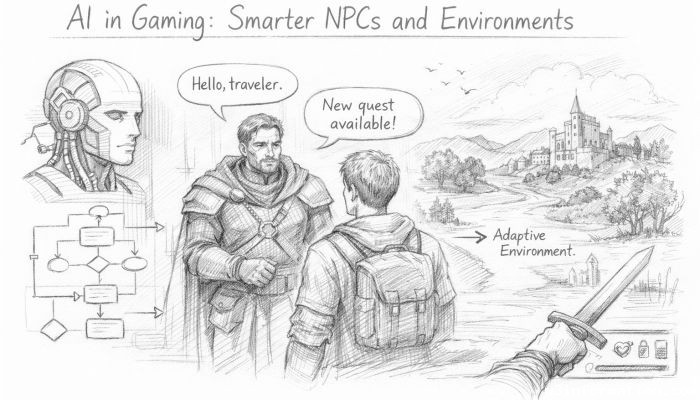 AI in Gaming: Smarter NPCs and Environments
 Understanding Bias in AI Algorithms
 Introduction to Chatbots and Conversational AI
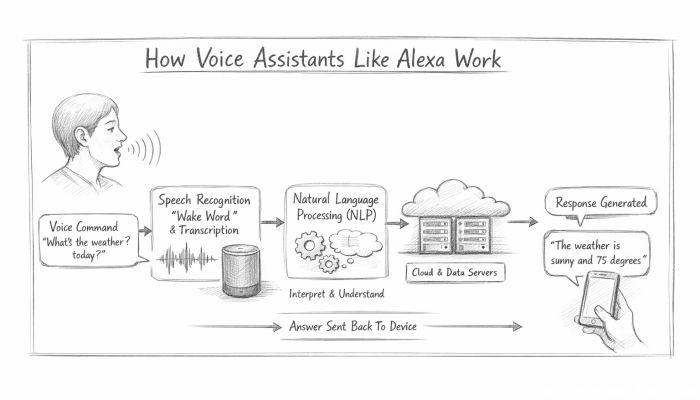 How Voice Assistants Like Alexa Work
 Federated Learning: AI Without Sharing Data