How to Make Learning Fun With Interactive Tools
In an era where technology continuously reshapes the way we acquire knowledge, the importance of making learning engaging and enjoyable has never been more evident. Traditional teaching methods, while still valuable, often fall short in capturing the attention of today’s learners, especially when competing with the allure of digital gadgets and entertainment. Enter interactive tools—innovative resources designed not only to educate but also to captivate and motivate students through active participation. This article delves into how educators, parents, and learners themselves can leverage these tools to transform the learning experience from a passive undertaking into an exciting adventure. By exploring various strategies, technologies, and practical applications, we will uncover the secrets to making education both effective and enjoyable.
- Understanding the Importance of Interactive Learning
- The Role of Technology in Modern Education
- Gamification: Turning Learning Into Play
- Utilizing Educational Apps and Software
- Incorporating Virtual and Augmented Reality
- Collaborative Learning Through Online Platforms
- Interactive Whiteboards and Smartboards
- Leveraging Multimedia Content
- Designing Interactive Quizzes and Assessments
- Creating Customizable Learning Paths
- Encouraging Maker Education and Hands-on Projects
- Overcoming Challenges in Implementing Interactive Tools
- Measuring the Impact of Interactive Learning
- The Future of Interactive Learning Tools
- Conclusion: Transforming Education Through Engagement
- More Related Topics
Understanding the Importance of Interactive Learning
Interactive learning is rooted in the principle that learners engage more deeply when they actively participate in the educational process. Unlike passive listening or rote memorization, interactive learning demands critical thinking, problem-solving, and collaboration. This active engagement helps reinforce concepts, improves retention, and cultivates a love for discovery. By integrating interactive tools, educators can bridge the gap between theory and practice, making abstract ideas tangible and relevant.
The Role of Technology in Modern Education
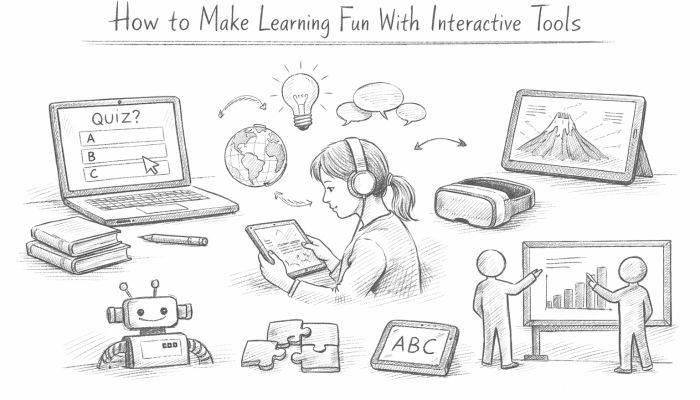
Technology has revolutionized education by providing tools that cater to diverse learning styles and preferences. From visual learners who benefit from animations and videos to kinesthetic learners who thrive on hands-on activities, interactive technologies cater to all. Tablets, smartphones, and computers serve as gateways to a wide range of educational apps and platforms. These technologies not only provide immediate feedback but also allow for personalized pacing—essential elements in maintaining learner motivation.
Gamification: Turning Learning Into Play
Gamification involves applying game-design elements—such as points, badges, leaderboards, and challenges—to educational content. This strategy transforms learning tasks into engaging challenges that reward progress and effort, thereby increasing motivation. Interactive tools that utilize gamification make subjects like math, language arts, and science feel like fun adventures, encouraging learners to keep pushing their limits without the burden of traditional assessments.
Utilizing Educational Apps and Software
A plethora of educational apps now exists to support interactive learning across age groups and subjects. Apps like Kahoot!, Quizlet, and Duolingo use quizzes, flashcards, and language exercises to engage learners actively. Many of these applications employ adaptive learning technologies to tailor content complexity according to user performance, ensuring that learners are neither bored nor overwhelmed.
Incorporating Virtual and Augmented Reality
Virtual Reality (VR) and Augmented Reality (AR) take interactivity to an immersive level by allowing learners to enter simulated environments or overlay digital information on the real world. Imagine exploring the Roman Colosseum or conducting chemistry experiments in a virtual lab—all from the classroom or home. These technologies stimulate curiosity and provide experiential learning that is difficult to achieve through textbooks alone.
Collaborative Learning Through Online Platforms
Interactive tools often encourage collaboration, helping learners share ideas, solve problems collectively, and develop communication skills. Platforms like Google Classroom, Microsoft Teams, and Padlet enable students and educators to engage in discussions, group projects, and peer assessments in real-time, regardless of geographical barriers. This social dimension of learning boosts motivation and replicates real-world teamwork scenarios.
Interactive Whiteboards and Smartboards
Interactive whiteboards, or smartboards, bring lessons to life by allowing users to draw, write, and manipulate digital content using touch or stylus input. These tools support multi-sensory learning by combining visual, auditory, and kinesthetic elements. Educators can easily integrate videos, diagrams, and quizzes into their lessons, encouraging participation from every student.
Leveraging Multimedia Content
Using multimedia—videos, animations, podcasts, and infographics—adds variety and depth to learning materials. Interactive tools that incorporate multimedia can cater to diverse learning preferences while breaking down complex concepts into digestible pieces. Interactive video platforms, such as Edpuzzle, allow learners to engage with video content actively by answering embedded questions, making the experience both informative and interactive.
Designing Interactive Quizzes and Assessments
Traditional assessments often induce anxiety and fail to promote deep understanding. Interactive quizzes offer a low-pressure environment where learners can test their knowledge and receive immediate feedback. Tools like Socrative and Quizizz provide dynamic question formats—multiple choice, drag-and-drop, and matching exercises—that make evaluations playful and insightful.
Creating Customizable Learning Paths
Interactive tools increasingly offer features that allow educators to customize learning experiences according to individual learner needs. Adaptive learning systems analyze learner responses to suggest tailored activities or adjust difficulty levels. This personalization empowers learners to progress confidently and maintain enthusiasm by working at an appropriate challenge level.
Encouraging Maker Education and Hands-on Projects
Incorporating maker spaces and DIY projects powered by interactive tools fosters creativity and problem-solving. Using kits like Arduino, Raspberry Pi, or LEGO Mindstorms, learners can combine coding, engineering, and design in fun, interactive projects. These experiential activities make abstract STEM concepts tangible and build essential 21st-century skills.
Overcoming Challenges in Implementing Interactive Tools
While interactive tools offer numerous benefits, challenges such as limited access to technology, lack of training, and resistance to change can hinder their implementation. Addressing these issues requires investment in infrastructure, professional development for educators, and cultivating a mindset that embraces innovation. When managed effectively, these obstacles can be overcome, leading to enriched learning environments.
Measuring the Impact of Interactive Learning
Evaluating the effectiveness of interactive tools helps educators refine their approach and demonstrate value. Metrics such as learner engagement, performance improvement, and feedback can provide insights into success. Research consistently shows that interactive learning increases motivation and retention, reinforcing the argument for its widespread adoption.
The Future of Interactive Learning Tools
As artificial intelligence and machine learning evolve, interactive tools will become even more sophisticated, offering hyper-personalized experiences and real-time analytics. Emerging technologies like holographic displays and brain-computer interfaces promise to redefine engagement further. Preparing for this future means embracing continual learning and being open to experimentation in educational practices.
Conclusion: Transforming Education Through Engagement
Making learning fun with interactive tools is not merely about integrating the latest gadgets; it's about transforming the educational experience to foster curiosity, creativity, and collaboration. By harnessing technology’s potential and adopting innovative strategies, educators can ignite a passion for learning that endures beyond the classroom. From gamification to virtual reality, these tools make abstract concepts accessible and lessons memorable. As the landscape of education continues to evolve, prioritizing interactivity ensures that learning remains a dynamic, inclusive, and joyful journey for all.
 Big O Notation Explained for Beginners
 AI in Gaming: Smarter NPCs and Environments
 Understanding Bias in AI Algorithms
 Introduction to Chatbots and Conversational AI
 How Voice Assistants Like Alexa Work
 Federated Learning: AI Without Sharing Data