How to Become a Full Stack Developer in 2025
In today’s digital-first world, full stack developers are among the most sought-after professionals. They don’t just build websites—they create complete, seamless experiences from the front end users see to the back end systems that power everything behind the scenes. But if you’re starting from scratch, the path can feel confusing. There are countless technologies, frameworks, and tools to learn, and it’s easy to get lost. The truth is, becoming a full stack developer in 2025 isn’t about learning everything—it’s about learning the right things in the right order. With a clear roadmap, consistent practice, and a project-driven approach, anyone can break into this field. In this guide, we’ll walk you through every step you need to take to become a confident and job-ready full stack developer.
- Understanding What a Full Stack Developer Does
- Start with the Basics: HTML, CSS, and JavaScript
- Learn Modern Frontend Frameworks
- Master Backend Development
- Understanding Databases (SQL and NoSQL)
- Building RESTful APIs and Integration Skills
- Version Control with Git and GitHub
- Understanding Deployment and DevOps Basics
- Work on Real-World Projects
- Learn Problem Solving and Data Structures
- Stay Updated with Industry Trends in 2025
- Conclusion
- More Related Topics
Understanding What a Full Stack Developer Does
Before diving into coding, it’s important to understand the role itself. A full stack developer works on both the front end (what users see) and the back end (server, database, and application logic).
This means you’ll handle everything—from designing user interfaces to managing databases and APIs. In 2025, companies value developers who can think end-to-end, solve problems holistically, and communicate across teams. Understanding this broad responsibility early helps you approach learning with clarity instead of confusion.
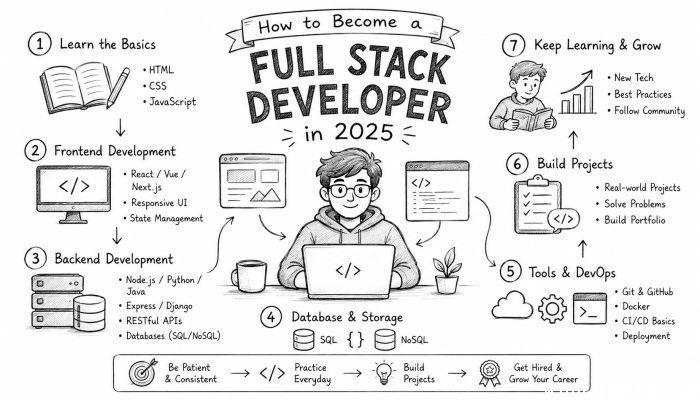
Start with the Basics: HTML, CSS, and JavaScript
Every full stack journey begins with the fundamentals. HTML structures your content, CSS styles it, and JavaScript makes it interactive.
Focus on:
- Writing semantic HTML
- Understanding CSS layouts (Flexbox, Grid)
- Mastering JavaScript basics (variables, functions, DOM)
These are not just beginner skills—they are the foundation of everything you’ll build later. Strong fundamentals make advanced concepts much easier to grasp.
Learn Modern Frontend Frameworks
Once you're comfortable with JavaScript, the next step is learning a frontend framework. In 2025, frameworks like React continue to dominate.
Frameworks help you:
- Build scalable applications
- Manage UI efficiently
- Improve performance
Understanding component-based architecture is key. It allows you to build reusable and maintainable code, which is critical in real-world development.
Master Backend Development
The backend is where the logic lives. It handles data processing, authentication, and communication with databases.
Popular backend technologies include:
- Node.js (JavaScript-based)
- Python (Django/Flask)
- Java (Spring Boot)
Choose one and go deep. Learn how servers work, how APIs are built, and how applications handle requests. Backend skills are what make your applications truly functional.
Understanding Databases (SQL and NoSQL)
Data is at the core of every application. As a full stack developer, you need to know how to store, retrieve, and manage it.
Learn:
- SQL (MySQL, PostgreSQL) for structured data
- NoSQL (MongoDB) for flexible data storage
Understanding when to use each type of database is more important than just learning syntax. This knowledge helps you design efficient and scalable applications.
Building RESTful APIs and Integration Skills
APIs are the bridge between frontend and backend. They allow different parts of an application to communicate.
Learn how to:
- Create REST APIs
- Handle HTTP requests (GET, POST, PUT, DELETE)
- Work with JSON data
In 2025, integration skills are crucial. Applications rarely work in isolation—they connect with third-party services, payment gateways, and cloud platforms.
Version Control with Git and GitHub
Every professional developer uses version control. Git helps you track changes, collaborate with teams, and manage code efficiently.
Key concepts:
- Commits and branches
- Merging code
- Pull requests
Hosting your projects on GitHub also builds your portfolio and shows recruiters your coding style and consistency.
Understanding Deployment and DevOps Basics
Building an application is only half the job—deploying it is equally important.
Learn:
- Hosting platforms (Vercel, Netlify, AWS)
- CI/CD basics
- Environment variables
Knowing how to take your project live makes you stand out. It shows you understand the complete lifecycle of application development.
Work on Real-World Projects
Projects are where learning becomes real. Start building applications as early as possible.
Ideas include:
- E-commerce website
- Blog platform
- Task management app
Projects help you:
- Apply your knowledge
- Solve real problems
- Build confidence
They also become your strongest asset when applying for jobs.
Learn Problem Solving and Data Structures
While building applications is important, problem-solving skills are equally critical for interviews.
Focus on:
- Arrays, strings, and linked lists
- Recursion and sorting
- Basic algorithms
Platforms like LeetCode or HackerRank can help. Strong problem-solving skills improve your logical thinking and coding efficiency.
Stay Updated with Industry Trends in 2025
Technology evolves quickly. In 2025, trends like AI integration, serverless architecture, and microservices are shaping development.
Stay updated by:
- Following tech blogs
- Watching tutorials
- Exploring new tools
Being adaptable is more valuable than mastering a single technology. The best developers are lifelong learners.
Conclusion
Becoming a full stack developer in 2025 is not about rushing through technologies—it’s about building a strong foundation, learning step by step, and applying your knowledge through real-world projects. The journey may seem long, but every small step brings you closer to your goal.
What makes this field exciting is its endless growth. There’s always something new to learn, new problems to solve, and new opportunities to explore. If you stay consistent, curious, and focused, you can build a successful career as a full stack developer.
Start today. Don’t wait for the “perfect time.” The best way to learn is by doing—and your future as a developer begins with your first line of code.
 How to Make the Most of Your Holiday Break
 The Best Winter Destinations for a Cozy Getaway
 How to Organize Your Holiday Travel Plans with Ease
 The Ultimate Guide to Cooking for a Crowd
 How to Make Healthy Comfort Food Without the Guilt
 5 Delicious Vegan Breakfast Ideas You Can Make in Minutes