How to Build a Healthy Lifestyle on a Busy Schedule
If you’re busy, you’re not alone. Between work deadlines, family responsibilities, social commitments, and the constant pull of digital life, health often becomes something we promise ourselves we’ll focus on “later.” Later, unfortunately, rarely comes. The idea that a healthy lifestyle requires endless free time, strict routines, or perfection is one of the biggest myths holding people back. In reality, health isn’t built in empty calendars—it’s built in real life, right alongside busy schedules.
Learning how to build a healthy lifestyle on a busy schedule is not about doing more. It’s about doing better with the time and energy you already have. This guide is designed for real people with full lives. We’ll explore practical, sustainable strategies that fit into hectic days—helping you feel stronger, more energized, and more balanced without adding stress. Health isn’t a luxury. It’s a support system for the life you’re already living.
- Redefine What a “Healthy Lifestyle” Really Means
- Accept That Busy Is the Baseline, Not the Obstacle
- Focus on Energy, Not Perfection
- Build Micro-Habits That Fit Into Existing Routines
- Simplify Nutrition Without Sacrificing Health
- Stop Thinking of Exercise as “All or Nothing”
- Design Movement That Matches Your Lifestyle
- Protect Sleep as a Health Foundation
- Learn to Manage Stress, Not Eliminate It
- Plan for Your Worst Days, Not Your Best Ones
- Let Go of Guilt and Start Building Momentum
- Think Long-Term, Not Short-Term Results
- Conclusion: Health Should Support Your Life, Not Compete With It
- More Related Topics
Redefine What a “Healthy Lifestyle” Really Means
Many people abandon healthy habits because they’re chasing an unrealistic version of wellness. A healthy lifestyle does not require daily workouts, perfectly clean meals, or rigid routines.
True health is about consistency, not intensity. It’s about small actions repeated regularly—choosing movement when possible, nourishing your body most of the time, managing stress, and sleeping well when you can. When health feels flexible instead of fragile, it becomes sustainable.
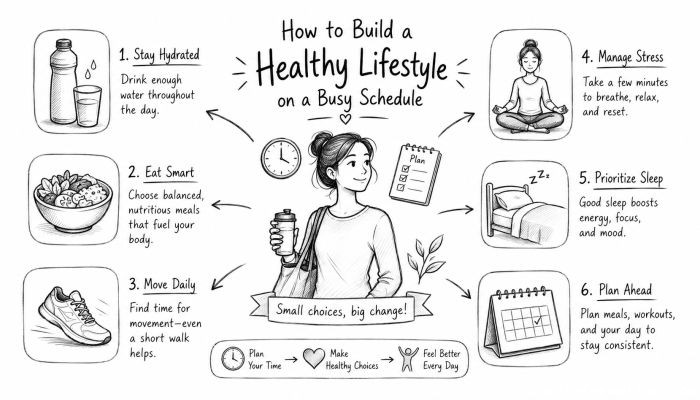
Accept That Busy Is the Baseline, Not the Obstacle
Waiting for life to slow down before prioritizing health is a losing strategy. For most adults, busy isn’t a phase—it’s the baseline.
The goal is not to eliminate busyness, but to design habits that work within it. When health habits are realistic for your busiest days, they naturally stick on easier ones too. Acceptance removes guilt and creates momentum.
Focus on Energy, Not Perfection
On a busy schedule, energy is your most valuable resource. Health habits should give you more of it—not drain what little you have left.
Instead of asking, “What’s the perfect routine?” ask, “What helps me feel better today?” Sometimes that’s a workout. Sometimes it’s rest. Health built around energy is responsive, compassionate, and far more effective than rigid plans.
Build Micro-Habits That Fit Into Existing Routines
When time is limited, small habits matter more than big plans. Micro-habits—actions that take five minutes or less—are powerful because they’re easy to repeat.
Stretch while your coffee brews. Walk during phone calls. Prep vegetables while dinner cooks. These habits stack onto things you already do, removing the need for extra time or motivation.
Simplify Nutrition Without Sacrificing Health
Healthy eating doesn’t require gourmet cooking or constant meal prep. On a busy schedule, simplicity is key.
Focus on repeatable meals, basic ingredients, and balanced combinations—protein, fiber, and healthy fats. Keep healthy staples available. When nutrition is simplified, decision fatigue disappears and consistency improves.
Stop Thinking of Exercise as “All or Nothing”
One of the biggest barriers to fitness on a busy schedule is the belief that workouts must be long or intense to matter.
Ten minutes of movement counts. A walk counts. Stretching counts. Consistent movement throughout the day often matters more than one long workout you struggle to schedule. Fitness is cumulative.
Design Movement That Matches Your Lifestyle
The best exercise is the one you’ll actually do. If gym sessions feel unrealistic, explore alternatives: home workouts, walking, yoga, bodyweight exercises, or active hobbies.
Movement should feel accessible, not intimidating. When exercise aligns with your preferences and schedule, it becomes something you look forward to—not another obligation.
Protect Sleep as a Health Foundation
Sleep is often the first thing sacrificed when schedules are packed—but it’s also the foundation of physical and mental health.
Poor sleep affects energy, mood, appetite, and decision-making. Even small improvements—consistent bedtimes, reduced screen use, calming routines—can dramatically improve how you feel. Sleep is not optional self-care; it’s essential maintenance.
Learn to Manage Stress, Not Eliminate It
Stress isn’t always avoidable—but how you respond to it matters. Chronic stress quietly undermines health, even when diet and exercise are “on track.”
Simple stress-management tools—deep breathing, short walks, journaling, or moments of silence—help regulate your nervous system. You don’t need long meditation sessions. You need regular pauses.
Plan for Your Worst Days, Not Your Best Ones
Many health plans fail because they’re designed for ideal days. Busy schedules demand systems that work on hard days.
Ask yourself: What’s the smallest healthy action I can take when everything feels overwhelming? That answer becomes your anchor. Health habits that survive chaos are the ones that last.
Let Go of Guilt and Start Building Momentum
Guilt is one of the biggest enemies of a healthy lifestyle. Missing a workout or eating off-plan doesn’t erase progress—but guilt often stops people from continuing.
Health is built forward, not punished into existence. Momentum comes from returning to habits without judgment. Progress grows when compassion replaces criticism.
Think Long-Term, Not Short-Term Results
A healthy lifestyle isn’t a 30-day challenge—it’s a relationship you build with yourself over time. Busy seasons will come and go, but habits rooted in flexibility endure.
When you focus on long-term well-being instead of quick results, pressure decreases and consistency increases. Health becomes part of your identity, not a task on your to-do list.
Conclusion: Health Should Support Your Life, Not Compete With It
Building a healthy lifestyle on a busy schedule isn’t about doing everything right—it’s about doing what’s realistic, repeatable, and kind to yourself. When health habits fit into your actual life instead of fighting against it, they become sources of energy rather than stress.
You don’t need more time. You need clearer priorities, simpler systems, and permission to start small. Health doesn’t demand perfection—it responds to consistency. One mindful choice, one small habit, one intentional pause at a time, you create a lifestyle that supports your goals, your responsibilities, and most importantly, you.
Because the purpose of health isn’t to control your life—it’s to help you live it fully, even when it’s busy. 🌿💪
 How to Make the Most of Your Holiday Break
 The Best Winter Destinations for a Cozy Getaway
 How to Organize Your Holiday Travel Plans with Ease
 The Ultimate Guide to Cooking for a Crowd
 How to Make Healthy Comfort Food Without the Guilt
 5 Delicious Vegan Breakfast Ideas You Can Make in Minutes