How to Improve Your Mental Health by Practicing Gratitude
In a world that constantly asks for more—more productivity, more success, more comparison—it’s easy for the mind to drift toward what’s missing rather than what’s present. Mental health often suffers not because life is entirely bad, but because our attention is trained on stress, fear, and dissatisfaction. Gratitude offers a gentle but powerful shift. It doesn’t deny hardship or force positivity; instead, it teaches the mind to notice what is steady, supportive, and meaningful alongside challenges. Practicing gratitude is not about pretending everything is perfect—it’s about recognizing what’s good enough and good right now. This article explores how gratitude can improve your mental health in practical, human ways. You’ll learn why it works, how to practice it realistically, and how small, consistent habits of appreciation can transform your emotional well-being over time.
- Understanding Gratitude Beyond Positive Thinking
- The Science Behind Gratitude and Mental Health
- Why the Mind Naturally Focuses on the Negative
- Gratitude as a Daily Mental Health Practice
- How Gratitude Reduces Anxiety and Overthinking
- Using Gratitude to Rebuild Emotional Resilience
- Simple Gratitude Practices That Actually Work
- Gratitude During Difficult or Low Moments
- How Gratitude Improves Relationships and Social Connection
- Letting Go of Comparison Through Appreciation
- Making Gratitude Sustainable, Not Performative
- Combining Gratitude With Other Mental Health Supports
- Common Misconceptions That Block Gratitude
- Conclusion
- More Related Topics
Understanding Gratitude Beyond Positive Thinking
Gratitude is often misunderstood as forced optimism. In reality, it’s a form of awareness. It allows you to hold two truths at once: that life can be hard and that there are moments, people, or abilities worth appreciating. This balanced awareness reduces emotional extremes and creates mental steadiness. Gratitude isn’t about ignoring pain; it’s about widening your lens so pain doesn’t become the whole picture.
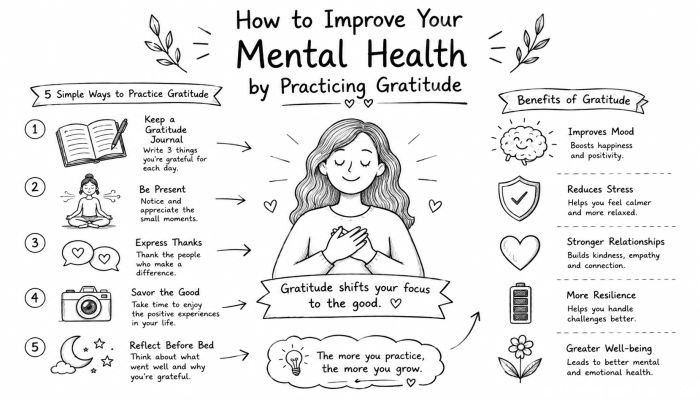
The Science Behind Gratitude and Mental Health
Research consistently shows that gratitude practices are linked to lower levels of depression and anxiety, improved sleep, and greater emotional resilience. When you focus on appreciation, your brain reduces stress hormones and strengthens neural pathways associated with calm and reward. Over time, this rewires attention away from constant threat scanning and toward a sense of safety and sufficiency. Gratitude literally trains the brain to rest.
Why the Mind Naturally Focuses on the Negative
The human brain evolved to notice danger first—it’s a survival mechanism. While helpful in emergencies, this negativity bias can dominate modern life, where threats are often emotional or imagined. Gratitude gently counterbalances this bias. By intentionally noticing what’s working, you give your mind evidence that not everything is wrong. This doesn’t erase problems, but it prevents them from consuming your inner world.
Gratitude as a Daily Mental Health Practice
Mental health improves most through small, repeatable actions. Gratitude works best when it becomes a daily habit rather than an occasional exercise. Even a minute or two of intentional appreciation can shift your emotional baseline. Over time, these moments accumulate, creating a calmer, more grounded mental state that’s easier to return to during stress.
How Gratitude Reduces Anxiety and Overthinking
Anxiety thrives on uncertainty and imagined futures. Gratitude anchors attention in the present. When you notice what’s real and supportive right now—a breath, a conversation, a small comfort—your nervous system calms. This present-moment focus interrupts cycles of rumination and catastrophic thinking, offering the mind a place to rest.
Using Gratitude to Rebuild Emotional Resilience
Resilience isn’t about never feeling overwhelmed; it’s about recovering more quickly. Gratitude strengthens this recovery by reminding you of internal and external resources. When you regularly acknowledge moments of strength, kindness, or progress, you build confidence in your ability to cope. This makes future challenges feel more manageable, even when they’re difficult.
Simple Gratitude Practices That Actually Work
You don’t need elaborate rituals to benefit from gratitude. Writing down three things you appreciate, naming one good moment from the day, or silently thanking someone in your mind are all effective. The key is specificity. “I’m grateful for my coffee” is less powerful than “I’m grateful for the warmth and quiet of my first sip this morning.” Specificity deepens emotional impact.
Gratitude During Difficult or Low Moments
One of the most common questions is whether gratitude is appropriate during pain. The answer is yes—but gently. Gratitude doesn’t mean being thankful for suffering; it means noticing what supports you through it. During hard days, gratitude might look like appreciating rest, a supportive message, or the fact that the day eventually ends. These small acknowledgments create emotional breathing room.
How Gratitude Improves Relationships and Social Connection
Gratitude doesn’t only affect how you feel—it changes how you relate to others. When you express appreciation, relationships deepen. Feeling seen and valued strengthens trust and emotional safety. Even silently acknowledging the efforts of others reduces resentment and increases compassion. Stronger relationships are one of the most powerful protective factors for mental health.
Letting Go of Comparison Through Appreciation
Comparison is a major source of mental distress. Gratitude redirects attention from what others have to what you have. This shift doesn’t eliminate desire or ambition; it grounds them in self-respect. When appreciation becomes a habit, comparison loses its emotional grip, and self-worth becomes less dependent on external measures.
Making Gratitude Sustainable, Not Performative
Gratitude should feel supportive, not obligatory. If it becomes a checklist or something you feel guilty for skipping, it loses its benefit. Some days, gratitude flows easily; other days, it doesn’t. That’s okay. Sustainability comes from kindness toward yourself. Gratitude is a tool, not a rule.
Combining Gratitude With Other Mental Health Supports
Gratitude works best as part of a broader mental health approach. It complements therapy, medication, mindfulness, movement, and social support. Think of it as a stabilizer rather than a cure. When combined with other supports, gratitude amplifies their effectiveness by creating a more receptive mental environment.
Common Misconceptions That Block Gratitude
Many people avoid gratitude because they fear it will minimize their pain or make them complacent. In reality, gratitude and growth coexist. You can want more and still appreciate what’s here. Letting go of these misconceptions allows gratitude to become a source of strength rather than resistance.
Conclusion
Improving your mental health doesn’t always require dramatic change. Sometimes it begins with a subtle shift in attention—from what’s missing to what’s present, from constant pressure to quiet acknowledgment. Gratitude offers that shift. Practiced consistently and gently, it calms the nervous system, softens anxiety, and builds emotional resilience over time. It doesn’t demand perfection or deny pain—it simply invites awareness of support, meaning, and moments of goodness that already exist. In choosing gratitude, you’re not settling for less; you’re learning to live more fully with what is. And that choice, made daily, can transform how your mind experiences the world.
 How to Make the Most of Your Holiday Break
 The Best Winter Destinations for a Cozy Getaway
 How to Organize Your Holiday Travel Plans with Ease
 The Ultimate Guide to Cooking for a Crowd
 How to Make Healthy Comfort Food Without the Guilt
 5 Delicious Vegan Breakfast Ideas You Can Make in Minutes