How to Document Your Travel Adventures Through Photography
Travel is more than just visiting new places—it’s about collecting moments, emotions, and stories that stay with you long after the journey ends. But memories can fade, and that’s where photography becomes powerful. A single photograph can bring back the sound of ocean waves, the smell of street food, or the feeling of standing in a place you once dreamed of. In today’s digital age, documenting your travel adventures through photography is not just about taking pictures—it’s about telling your story in a way that feels real, personal, and timeless. Whether you're using a smartphone or a professional camera, this guide will help you capture meaningful travel moments and turn them into a visual narrative you’ll cherish forever.
- Understanding the Purpose of Travel Photography
- Choosing the Right Equipment
- Learning Basic Photography Composition
- Capturing Authentic Moments
- Telling a Story Through Your Photos
- Using Natural Light Effectively
- Editing Without Overdoing It
- Documenting People and Culture Respectfully
- Organizing and Storing Your Photos
- Sharing Your Travel Story Online
- Creating a Personal Photography Style
- Staying Present While Capturing Moments
- Conclusion
- More Related Topics
Understanding the Purpose of Travel Photography
Before you start clicking pictures, take a moment to ask yourself: Why do I want to document this journey? Travel photography is not just about capturing beautiful places—it’s about preserving experiences.
Some people photograph to share on social media, while others do it to create personal memories. When you understand your purpose, your photography becomes more intentional. You start focusing on moments that matter rather than just taking random shots.
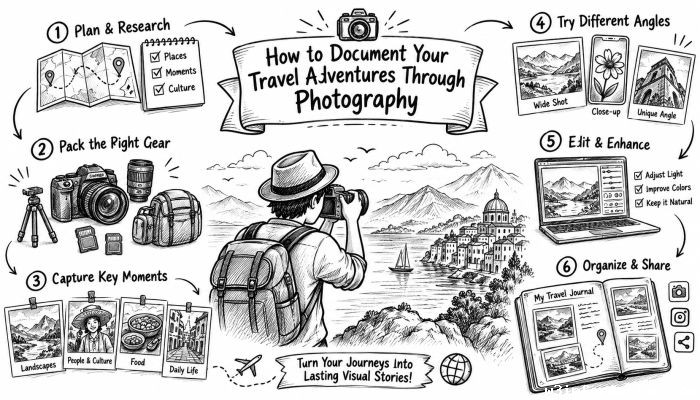
Choosing the Right Equipment
You don’t need expensive gear to capture amazing travel photos. In fact, some of the most powerful images are taken on smartphones.
If you’re just starting out:
- Use your smartphone with a good camera
- Learn basic camera settings (ISO, shutter speed, aperture)
- Consider lightweight gear for travel
The key is comfort and convenience. Carrying heavy equipment can sometimes make you miss spontaneous moments. Choose tools that allow you to stay present in your journey.
Learning Basic Photography Composition
Composition is what turns an ordinary photo into something visually appealing. Understanding simple rules can make a huge difference.
Focus on:
- Rule of thirds
- Leading lines
- Framing
- Symmetry
These techniques guide the viewer’s eye and make your photos more engaging. Over time, composition becomes instinctive, and your photos start to feel more professional.
Capturing Authentic Moments
The best travel photos are often unplanned. A street vendor smiling, children playing, or a quiet sunrise—these moments tell real stories.
Instead of staging every shot, observe your surroundings. Be patient. Let moments unfold naturally. Authenticity creates emotional connection, making your photos more meaningful and memorable.
Telling a Story Through Your Photos
Think of your travel photography as a story rather than a collection of images.
A complete story might include:
- Wide shots (location)
- Medium shots (activities)
- Close-ups (details)
When combined, these create a narrative. Someone looking at your photos should feel like they experienced the journey with you.
Using Natural Light Effectively
Lighting can make or break a photograph. Natural light, especially during sunrise and sunset (golden hour), creates soft and beautiful tones.
Avoid harsh midday sunlight when possible, as it creates strong shadows. Instead, use early morning or late evening light to add warmth and depth to your images.
Learning to work with light will elevate your photography more than any expensive equipment.
Editing Without Overdoing It
Editing enhances your photos, but over-editing can ruin their authenticity.
Use tools like:
- Lightroom
- Snapseed
- VSCO
Adjust brightness, contrast, and colors subtly. The goal is to enhance the natural beauty of the image, not to completely change it. A good edit should feel invisible.
Documenting People and Culture Respectfully
Travel photography is not just about places—it’s also about people. Capturing local culture adds depth to your story.
Always:
- Ask for permission when photographing individuals
- Respect cultural norms
- Avoid intrusive behavior
When done respectfully, photos of people can be the most powerful and emotional part of your travel documentation.
Organizing and Storing Your Photos
After your trip, organizing your photos is just as important as taking them.
Create folders by:
- Location
- Date
- Theme
Backup your photos using cloud storage or external drives. This ensures your memories are safe and easy to access in the future.
Sharing Your Travel Story Online
Sharing your photos allows others to experience your journey and can inspire them to travel.
Platforms like:
- Personal blogs
- Portfolio websites
When sharing, add captions that tell the story behind the image. This adds context and makes your photos more engaging.
Creating a Personal Photography Style
Over time, you’ll develop your own unique style. This could be in:
- Color tones
- Composition
- Subjects
Don’t try to copy others completely. Experiment, learn, and let your personality reflect in your work. Your style is what makes your photography truly yours.
Staying Present While Capturing Moments
It’s easy to get so focused on taking photos that you forget to actually experience the moment.
Balance is important. Take your shots, then put the camera down and enjoy the experience. The best photographers are those who feel the moment, not just capture it.
Conclusion
Documenting your travel adventures through photography is about more than just taking pictures—it’s about preserving emotions, stories, and experiences that define your journey. With the right mindset, basic skills, and a focus on authenticity, anyone can create meaningful travel photography.
As you continue exploring new places, remember that every photo you take is a piece of your story. It’s not about perfection—it’s about connection. The laughter, the quiet moments, the unexpected experiences—all deserve to be captured.
So travel, observe, and capture with intention. Because one day, those photos won’t just be images—they’ll be memories that take you back to the moments that truly mattered.
 How to Make the Most of Your Holiday Break
 The Best Winter Destinations for a Cozy Getaway
 How to Organize Your Holiday Travel Plans with Ease
 The Ultimate Guide to Cooking for a Crowd
 How to Make Healthy Comfort Food Without the Guilt
 5 Delicious Vegan Breakfast Ideas You Can Make in Minutes