The Most Fuel-Efficient Cars You Can Buy in 2025
With rising fuel prices and growing environmental awareness, choosing a fuel-efficient car is no longer just a smart option—it’s a necessity. In 2025, car buyers are more conscious than ever about mileage, running costs, and sustainability. Whether you’re a daily commuter navigating city traffic or someone who enjoys long road trips, fuel efficiency directly impacts your budget and driving experience. But with so many options available—petrol, diesel, hybrid, and electric—it can be confusing to decide which car truly offers the best value. This guide explores the most fuel-efficient cars you can buy in 2025, along with practical insights to help you choose a vehicle that balances performance, cost, and eco-friendliness.
- Why Fuel Efficiency Matters More Than Ever
- Understanding Mileage: What Does It Really Mean?
- Petrol vs Diesel vs Hybrid vs Electric
- Top Fuel-Efficient Petrol Cars in 2025
- Best Diesel Cars for Long-Term Efficiency
- Hybrid Cars: The Perfect Balance
- Electric Vehicles: The Future of Efficiency
- Factors That Affect Fuel Efficiency
- Technology That Improves Fuel Economy
- Cost vs Efficiency: Finding the Right Balance
- Choosing the Right Car for Your Lifestyle
- The Future of Fuel Efficiency in the Automotive Industry
- Conclusion
- More Related Topics
Why Fuel Efficiency Matters More Than Ever
Fuel efficiency is not just about saving money—it’s about making smarter, more sustainable choices. With fluctuating fuel prices and increasing urban congestion, cars that consume less fuel offer significant long-term benefits.
Efficient vehicles reduce your carbon footprint, lower emissions, and contribute to a cleaner environment. For many buyers, this is now as important as comfort or performance. In 2025, fuel efficiency has become a key factor influencing purchasing decisions across all segments.
Understanding Mileage: What Does It Really Mean?
Mileage, often measured in kilometers per liter (km/l) or miles per gallon (mpg), indicates how far a car can travel on a specific amount of fuel.
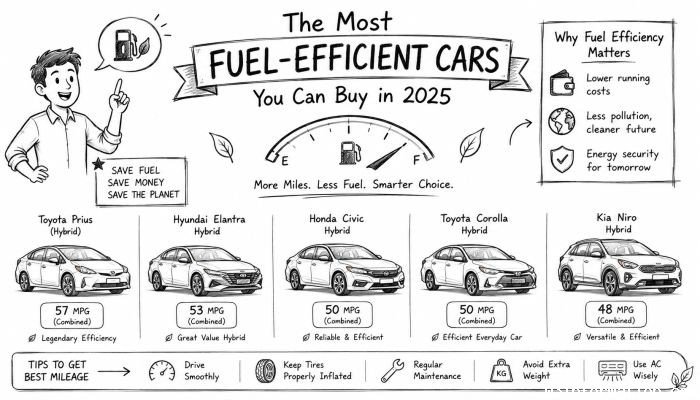
However, real-world mileage can differ from manufacturer claims due to driving habits, road conditions, and maintenance. Understanding this helps you set realistic expectations and choose a car that performs efficiently in your everyday environment.
Petrol vs Diesel vs Hybrid vs Electric
Choosing the right fuel type is crucial when considering efficiency.
- Petrol cars: Ideal for short city drives and lower initial cost
- Diesel cars: Better for long-distance driving and higher mileage
- Hybrid cars: Combine fuel and electric power for superior efficiency
- Electric vehicles (EVs): Zero fuel cost and eco-friendly
Each option has its pros and cons. Your choice should depend on your driving pattern and budget rather than trends.
Top Fuel-Efficient Petrol Cars in 2025
Petrol cars have become more efficient thanks to advancements in engine technology.
Popular models in 2025 offer impressive mileage while maintaining performance. Compact hatchbacks and sedans dominate this category, making them perfect for urban users.
These cars are affordable, easy to maintain, and ideal for daily commuting, especially in cities with heavy traffic.
Best Diesel Cars for Long-Term Efficiency
Diesel cars continue to be a strong choice for those who drive long distances regularly.
They offer better mileage than petrol cars and are more fuel-efficient on highways. In 2025, modern diesel engines are quieter and more refined than ever before.
Although they come with a higher initial cost, their long-term savings make them a preferred option for frequent travelers.
Hybrid Cars: The Perfect Balance
Hybrid cars are gaining popularity as they combine the benefits of fuel and electric power.
They automatically switch between engine and battery, optimizing fuel consumption. This makes them highly efficient, especially in stop-and-go traffic.
Hybrids are ideal for users who want better mileage without fully switching to electric vehicles.
Electric Vehicles: The Future of Efficiency
Electric vehicles (EVs) are redefining fuel efficiency by eliminating fuel altogether.
With zero emissions and lower running costs, EVs are becoming a top choice in 2025. Improvements in battery technology have increased range and reduced charging time.
While the initial cost may be higher, government incentives and long-term savings make EVs an attractive option for many buyers.
Factors That Affect Fuel Efficiency
Even the most efficient car can perform poorly if not used correctly.
Key factors include:
- Driving habits (aggressive acceleration reduces efficiency)
- Traffic conditions
- Vehicle maintenance
- Tire pressure
Understanding these factors helps you maximize your car’s efficiency and get the best value from your investment.
Technology That Improves Fuel Economy
Modern cars come equipped with advanced technologies designed to enhance fuel efficiency.
Features like:
- Start-stop systems
- Eco driving modes
- Lightweight materials
- Aerodynamic designs
These innovations ensure that cars in 2025 are more efficient than ever before, even in traditional fuel categories.
Cost vs Efficiency: Finding the Right Balance
While fuel-efficient cars save money in the long run, it’s important to balance efficiency with overall cost.
A highly efficient car with a very high price tag may not always be the best choice. Calculate total ownership cost, including purchase price, fuel savings, and maintenance.
The goal is to find a car that offers the best value, not just the highest mileage.
Choosing the Right Car for Your Lifestyle
Fuel efficiency should align with your lifestyle.
- City drivers may benefit from petrol or hybrid cars
- Highway travelers may prefer diesel
- Eco-conscious users may choose electric
Your daily usage pattern plays a major role in determining which car will be most efficient for you.
The Future of Fuel Efficiency in the Automotive Industry
The future of fuel-efficient cars is exciting and rapidly evolving. Automakers are investing heavily in electric and hybrid technologies, aiming for sustainability and innovation.
In the coming years, we can expect:
- More affordable EVs
- Improved battery technology
- Greater focus on eco-friendly designs
Fuel efficiency will continue to be a driving force in shaping the automotive industry.
 How to Make the Most of Your Holiday Break
 The Best Winter Destinations for a Cozy Getaway
 How to Organize Your Holiday Travel Plans with Ease
 The Ultimate Guide to Cooking for a Crowd
 How to Make Healthy Comfort Food Without the Guilt
 5 Delicious Vegan Breakfast Ideas You Can Make in Minutes