How Voice Assistants Like Alexa Work
In today’s fast-paced world, voice assistants have become an integral part of our daily lives, seamlessly bridging the gap between technology and human interaction. Among these, Amazon’s Alexa stands out as one of the most popular and widely-used AI-powered voice assistants, quietly transforming how we manage our homes, access information, and engage with digital devices. But how exactly do voice assistants like Alexa work behind the scenes? Understanding this requires delving into a sophisticated blend of hardware, software, artificial intelligence, natural language processing, and cloud computing. This article will guide you through the fascinating architecture and processes that enable Alexa to understand spoken commands, interpret context, and respond meaningfully, offering a comprehensive look at the technological marvels making modern voice assistants not just possible, but remarkably effective.
- The Evolution of Voice Assistants
- Components of a Voice Assistant
- Wake Word Detection: Listening Without Intrusion
- Automatic Speech Recognition: Turning Sounds into Text
- Natural Language Understanding: Comprehending User Intent
- The Role of Dialog Management
- Cloud Computing: The Power Behind Alexa
- Text-to-Speech: Creating Natural Responses
- Privacy and Security Considerations
- Expanding Alexa’s Capabilities through Skills
- The Role of Machine Learning and Continuous Improvement
- Challenges in Voice Assistant Technology
- The Future of Voice Assistants
- Conclusion
- More Related Topics
The Evolution of Voice Assistants
Voice assistants have come a long way since their inception. Early speech recognition technology was cumbersome and limited, primarily reactive and often inaccurate. The evolution began with simple command-based systems and has swiftly moved toward more intuitive conversational agents capable of understanding complex language and context. Companies like Amazon, Google, and Apple invested heavily in AI research, natural language understanding, and large-scale cloud computing infrastructure. Alexa, launched in 2014 with the Amazon Echo, capitalized on advances in machine learning and cloud connectivity to provide a highly responsive and interactive user experience. This evolutionary trajectory paved the way for today’s smart assistants, integrating a wide variety of capabilities to serve users in homes and workplaces worldwide.
Components of a Voice Assistant
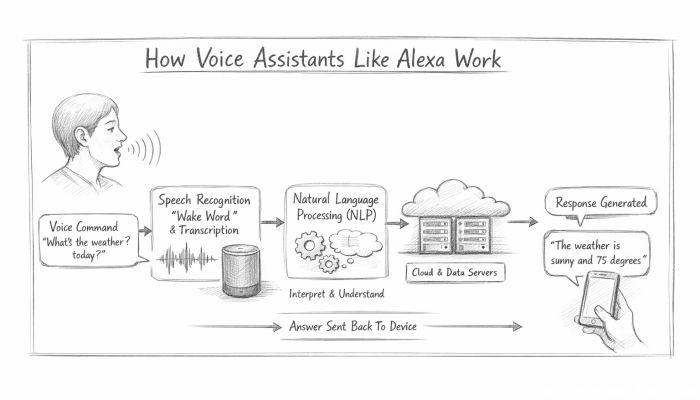
At its core, a voice assistant like Alexa consists of multiple interdependent components that work together to process voice input and generate appropriate responses. These components include the wake word detector, automatic speech recognition (ASR), natural language understanding (NLU), dialog management, and text-to-speech (TTS) systems. Each plays a distinct role: the wake word detector listens continuously for a designated phrase like “Alexa,” ASR converts spoken words into text, NLU interprets the meaning and intent behind the text, dialog management determines how to respond logically, and TTS converts the response text back into audio. This modular approach ensures efficiency and flexibility, allowing Alexa to handle a wide range of tasks while maintaining smooth and natural interactions.
Wake Word Detection: Listening Without Intrusion
A critical first step in how Alexa works is wake word detection — a technology that continuously scans ambient sound for the specific “wake word” (e.g., “Alexa”). This process needs to be both highly accurate and privacy-conscious. The device uses a small, low-power chip embedded inside the Echo or other devices that listens locally without sending data to the cloud. When it detects the wake word, it activates the remainder of the system and starts streaming audio to Amazon’s servers for further processing. This local filtering limits unnecessary data transmission and respects user privacy by only capturing conversations after the command initiation phrase is detected.
Automatic Speech Recognition: Turning Sounds into Text
Once Alexa hears the wake word, the device captures the voice command and sends it to the cloud, where Automatic Speech Recognition (ASR) technology transforms the audio waveform into text. Modern ASR uses deep learning models, particularly end-to-end neural networks trained on vast amounts of voice data, to handle different accents, speech speeds, background noises, and languages. These systems work by breaking down spoken language into phonemes and matching them against probability models that produce the most likely text interpretation. The accuracy of ASR is crucial because any errors made here cascade through the rest of the system, potentially leading to misinterpretation and wrong responses.
Natural Language Understanding: Comprehending User Intent
After the voice command is transcribed into text, Alexa’s Natural Language Understanding (NLU) subsystem analyzes it to decipher the user’s intent and identify relevant entities. Unlike simple keyword spotting, NLU focuses on context, sentence structure, semantics, and even the user’s history to understand what action is requested. For instance, the phrase “play music by Taylor Swift” requires Alexa to recognize “play music” as the intent and “Taylor Swift” as the entity or parameter. Advances in machine learning have greatly enhanced the accuracy of NLU, enabling Alexa to handle complex queries, ambiguous statements, and multi-turn conversations.
The Role of Dialog Management
Dialog management is the brain that guides the interaction flow between Alexa and the user. It decides how to respond to the user’s query in a coherent and contextually appropriate manner. This component manages user sessions, maintains context across multiple turns, asks clarifying questions if needed, and facilitates more natural conversational flow. For instance, if a user asks “What’s the weather like in New York?” followed by “How about tomorrow?” dialog management ensures Alexa understands the second query references the weather in New York on the following day. This dynamic management is essential for making interactions feel personal and engaging rather than robotic.
Cloud Computing: The Power Behind Alexa
Unlike isolated voice recognition devices of the past, Alexa relies heavily on cloud computing to provide its capabilities. After initial audio processing on the device, most computationally intensive tasks — ASR, NLU, dialog management, and response generation — happen in Amazon’s cloud servers. The cloud provides extensive processing power, access to vast datasets, and continuous updates that improve Alexa’s skills and expand functionality. Moreover, cloud-based design allows integration with third-party services and “skills,” enabling Alexa to control smart home devices, manage calendars, provide news updates, and much more. This cloud-centric approach is vital for scalability and ongoing enhancement.
Text-to-Speech: Creating Natural Responses
Once a response is generated, Alexa must communicate back to the user in a clear and pleasant voice. This is the role of Text-to-Speech (TTS) synthesis technology. Modern TTS leverages deep neural networks producing natural-sounding speech that varies tone, pitch, and speed based on context. Unlike older robotic voices, today’s systems can simulate human-like intonation and even personality quirks, making interactions feel warmer and more relatable. Alexa’s voice is continuously refined to improve clarity and user friendliness, playing a key role in overall user satisfaction.
Privacy and Security Considerations
Given that voice assistants constantly listen for wake words and process personal data, privacy and security are major concerns. Alexa and other assistants incorporate multiple safeguards: local wake word detection reduces unnecessary cloud data transmissions, all recorded audio data is encrypted during transit and storage, and users have control over their voice recordings via Amazon’s app with options to review and delete. Amazon also regularly updates its security measures to address vulnerabilities. Transparent privacy policies and user controls are essential in maintaining trust and encouraging adoption of these increasingly ubiquitous devices.
Expanding Alexa’s Capabilities through Skills
Alexa’s functionality extends far beyond basic queries thanks to its ecosystem of “skills,” or third-party applications that users can enable for customized experiences. These skills allow Alexa to integrate with a multitude of services, whether controlling smart appliances, ordering food, booking rides, or playing interactive games. Developers build and submit skills to the Amazon Skills Store, where users search for and activate them. Alexa routes relevant voice commands to the appropriate skill, invoking specialized backend logic before responding. This extensibility is a major factor in Alexa’s popularity, creating an ever-growing platform tailored to diverse user needs.
The Role of Machine Learning and Continuous Improvement
Voice assistants like Alexa are not static products; they continuously improve through machine learning and user feedback. Amazon collects anonymized interaction data (with user consent) to identify errors, refine language models, and bolster intent recognition. The system adapts to individual user speech patterns over time, enhancing accuracy. Furthermore, Alexa regularly receives software updates that optimize performance and add new features. This iterative learning process ensures Alexa evolves alongside changing language use, new devices, and user expectations, keeping it relevant and effective.
Challenges in Voice Assistant Technology
Despite remarkable advances, voice assistants face several ongoing challenges. Background noise, overlapping speech, accents, dialects, and ambiguous phrasing can still impede understanding. Maintaining user privacy while leveraging cloud-based AI remains a delicate balance. Additionally, a seamless conversational experience requires complex contextual understanding and error recovery strategies. Designing natural, human-like interactions that feel equally intuitive to users of all ages and technical skills is an ongoing focus in the field. These challenges drive continual research and development, pushing the boundaries of interface design and AI capabilities.
The Future of Voice Assistants
Looking ahead, voice assistants like Alexa are expected to become even more deeply integrated into our everyday environments. Advances in edge computing may enable more processing on-device, reducing latency and enhancing privacy. Multimodal interfaces that combine voice with gestures, facial recognition, and augmented reality will create richer interaction experiences. Personalized assistants that anticipate needs based on context and preferences are on the horizon. Additionally, expanded language support and improved emotional intelligence could make voice assistants indispensable companions, both at home and on the go, transforming how we relate to technology and information.
Conclusion
Voice assistants like Alexa exemplify the remarkable convergence of hardware innovation, sophisticated algorithms, artificial intelligence, and cloud computing. By enabling natural, hands-free interaction with technology, they have redefined convenience and accessibility in our digital lives. Behind the simple phrase “Alexa,” a complex array of wake word detection, speech recognition, language understanding, cloud processing, and speech synthesis takes place — all orchestrated with precision. As these systems continue to learn, adapt, and expand their capabilities, voice assistants will not only become smarter but more personally attuned to users’ needs. Understanding how Alexa works reveals both the incredible technological feats achieved and the exciting possibilities that lie ahead in voice-enabled AI. Whether for controlling smart homes, accessing information, or enhancing productivity, voice assistants are set to play an even larger role in shaping the future of human-computer interaction.
 Big O Notation Explained for Beginners
 AI in Gaming: Smarter NPCs and Environments
 Understanding Bias in AI Algorithms
 Introduction to Chatbots and Conversational AI
 Federated Learning: AI Without Sharing Data