How Technology is Transforming Auto Shows in 2025
Auto shows are the glitzy, high-profile platforms where car brands showcase the latest and greatest models, concepts, and technology to an audience of enthusiasts and buyers. For decades, auto shows have traditionally been defined by rows of gleaming metal vehicles under bright lights, bustling crowds, and manufacturers vying to get the best prime display locations. From a corporate perspective, auto shows are a valuable opportunity for car companies to launch new products, publicize press releases, demonstrate technologies, and hold media and industry conferences. The show floor atmosphere is exhilarating, with high-energy crowds eagerly scrutinizing each angle of an automobile and its many features. Yet, at the same time, there is business-like, transactional undercurrent as deals are being made and new commercial relationships forged. Beyond exhibiting the latest vehicle models, there is often an element of spectacle to auto shows, with giant displays, celebrity appearances, entertainment shows, and special test-drive events. The auto show is simultaneously an exhibition, commercial showcase, and immersive interactive spectacle all rolled into one.
- Key Takeaways
- Virtual and Augmented Reality Applications
- Hybrid and Virtual Auto Shows
- AI-Powered Personalization and Chatbots
- Holographic Displays and 3D Imaging
- Connectivity and IoT Integration
- Sustainability and Green Tech
- Biometric Security and Access Control
- Autonomous and Electric Vehicle Showcases
- Social Media and Streaming Tech
- Big Data Analytics
- Virtual Workshops and Collaboration
- 5G and Enhanced Connectivity Solutions
- Conclusion
- More Related Topics
Key Takeaways
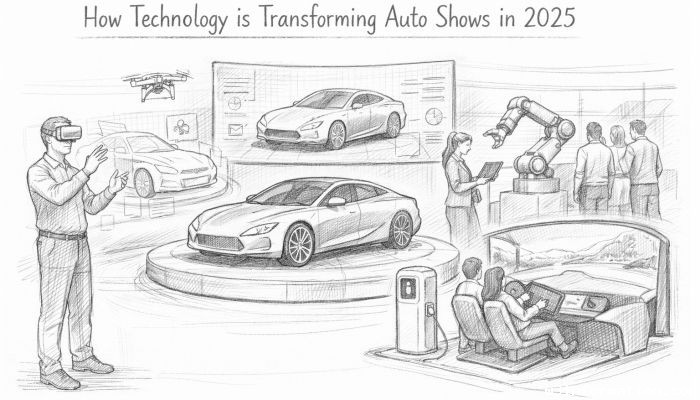
In recent years, technology has come to play an ever-increasing central role at auto shows, and by 2025, digital and physical experiences will be thoroughly integrated. Here are some of the key ways that auto shows are being changed by technology in 2025:
* Virtual Reality (VR) and Augmented Reality (AR) technologies let visitors interactively explore vehicles in new dimensions.
* Hybrid auto shows increasingly mix in-person and digital elements through live streaming and online engagement tools.
* AI-powered personalization tailors experiences and content for individual show attendees.
* Holographic imaging and 3D displays add futuristic aesthetics and wow-factor to exhibits.
* IoT connectivity in cars and at the event enables smart features demonstrations and crowd management.
* Sustainability is a focus, with digital technologies supporting energy efficiency and waste reduction.
* Next-generation connectivity solutions like 5G power many real-time digital experiences at shows.
* Autonomous and electric vehicle demonstrations are a core part of today’s auto shows.
* Social media and live streaming expand shows’ reach to online followers.
* Big data analytics is increasingly leveraged by organizers, brands, and visitors for insights and decision-making.
Virtual and Augmented Reality Applications
VR and AR are particularly popular at auto shows because they can offer an entirely new type of engagement, not only in car dealerships but at home. In 2025, both VR and AR technology are well-established features of the average auto show. Visitors can download apps or use their own smartphones and devices to experience these interactive features. Augmented reality apps have become very common for allowing visitors to point their mobile devices at a physical vehicle and see overlays of interactive information, visualizations, or customization tools. For example, one can view engine or safety features in action or change paint colors, wheels, or accessories on the fly to see these changes applied to the real vehicle in real time. Virtual Reality, on the other hand, allows one to put on a headset and have a fully immersive simulated experience. These technologies make it possible to sit “inside” a vehicle from a first-person perspective or take simulated test drives on different tracks. One of the most exciting benefits of this technology is that it can also be used to experience these offerings from home or remotely if one doesn’t want to travel to an auto show or visit a dealership. By the same token, these technologies have made it possible for anyone in the world to engage with auto shows digitally. This has both positive and negative implications; on the one hand, it’s helped democratize access to information, but on the other, it means greater competition for attracting physical in-person attendance and engagement.
Hybrid and Virtual Auto Shows
The in-person auto show has long been the default standard for how brands, press, and consumers interact with each other. Yet, as technology has improved over time, these events have evolved to include more and more virtual and digital elements. By 2025, hybrid auto shows have become very common. There are often digital platforms associated with many in-person shows that host live streaming of presentations, interviews, workshops, and panel discussions. Virtual auto shows are also on the rise, where there is no physical in-person experience at all and the show is fully digital. This can take the form of a 3D-rendered interactive map of an event floor where users can navigate and explore at will, attend product launches and press events, and interact with virtual exhibitors through bots or live video conferencing. At the same time, the live in-person auto show remains very popular and these shows increasingly provide options for at-home or remote engagement to reach wider audiences.
AI-Powered Personalization and Chatbots
AI technology is playing an increasingly important role in helping visitors to auto shows by providing intelligent automation and contextual information at the point of engagement. At auto shows in 2025, AI-powered virtual assistants are commonly available for helping visitors get around the event, providing answers to questions, and troubleshooting issues. Chatbots can give advice about specific models, specifications, or product offerings. In some cases, AI can provide more personalized recommendations by analyzing user profiles or visiting history and suggesting certain vehicles or sessions that may be of interest. AI-powered tools are also available to help brands and manufacturers analyze and measure engagement at shows to optimize booth layouts or displays or tailor in-the-moment presentations to better meet audience needs. Chatbots can also help customer service at these shows by scheduling appointments or test drives and following up automatically.
Holographic Displays and 3D Imaging
Auto shows have always been about visual spectacle and grandiose displays and holographic and 3D imaging technology are perfect for adding to this. Life-sized 3D holograms of vehicles are becoming very popular and they have been used by automakers to create “floating” models of cars that people can walk around and view from every angle. This can also include interactive elements that show off parts of the car in motion or instantly switch out colors and trim features, among many other possibilities. Holograms are becoming more popular as they help save on the space and costs of transporting physical units to auto shows. They also create a visually impressive futuristic aesthetic that enhances the show floor experience for visitors.
Connectivity and IoT Integration
Connected cars and IoT integration are major themes in the auto industry in 2025. These technologies have also been integrated into the auto show experience by allowing visitors to interact with connected cars and see some of the ways that IoT technology can be used to power smart features. Cars can be connected to one another or to the infrastructure of the auto show to enable specific demos of technologies like automated parking, vehicle-to-vehicle communication, or other real-time diagnostic tools and data analytics. IoT technology is also leveraged to make auto shows themselves “smarter.” Sensors, beacons, and other connected devices are integrated into event venues to make them more interactive, adaptive to crowds, and efficient. Connected cars can send content directly to a visitor’s mobile device or browser as well, such as pushing information about the car one is viewing.
Sustainability and Green Tech
Environmental considerations and sustainability are an increasingly important issue and focus at auto shows. Organizers have been integrating energy-efficient and sustainable practices, such as LED lighting and renewable energy sources for powering events and displays. The use of digital technologies and virtual event elements also help to reduce the carbon footprint of auto shows and make them more sustainable. At the same time, this also gives more space on the show floor for actual vehicles and exhibits. Automakers are also beginning to highlight their green technologies and innovation in the automotive space, including hybrid and electric powertrains, through their use of data analytics and simulation displays at shows.
Biometric Security and Access Control
Auto shows have a lot of valuable property and access control is a critical concern for organizers. In 2025, biometric security technology, such as facial recognition and fingerprint scanning systems, are standard at most auto shows. These technologies provide a fast, efficient, and secure means of granting access to the event. Biometric security systems also make it possible to link certain privileges and information to a particular registered visitor. For example, it may be possible to personalize one’s visit or unlock certain interactive features or digital content on a mobile device through biometrics.
Autonomous and Electric Vehicle Showcases
Autonomous and electric vehicles are by far the biggest trend in the auto industry right now, so they have a major focus at auto shows. New EV and autonomous vehicle models are getting launched all the time and auto shows are a key place to demonstrate their features, capabilities, and software updates. Showcases for these cars are common and often involve controlled test-drive tracks where one can experience autonomous driving features and functions first-hand. Battery performance or range tests are also common, which are often enhanced with simulation software tools or digital dashboards in the cars.
Social Media and Streaming Tech
Social media and live streaming are another major aspect of today’s auto shows. Technology is used to livestream many sessions and panels at auto shows in 2025, along with allowing access to different media channels, multi-angle views, and special access areas like behind the scenes or with influencers and celebrity guests. Augmented reality filters and other gamification features are commonly used to generate engagement on social media during auto shows and encourage user-generated content from visitors. Advanced analytics solutions are used to track these social media metrics, along with engagement metrics within apps and on platforms, to inform future shows and strategies.
Big Data Analytics
Big data and data analytics technology are also becoming more prevalent in auto shows in 2025. These solutions are being used by show organizers, brand and media participants, and even visitors to collect and analyze large amounts of data about visitor behavior, preferences, and feedback. This data is then used to make more informed decisions about future events and strategies. Data analytics can also be used to power advanced AI-based predictive analytics to help with things like gauging audience interest, optimizing booth placement and layouts, and even personalizing marketing outreach for visitors post-show.
Virtual Workshops and Collaboration
Auto shows have also become a place for more community building and collaboration within the automotive industry in 2025. Digital technology is being used to host virtual workshops, webinars, and networking events. Participants from anywhere in the world can join these to discuss industry topics such as innovations in the automotive space, sustainability challenges, or new legislation and regulation that affect auto manufacturers and buyers. Interactive tools are often used for audience participation, including Q&A sessions, polling, and breakout discussions to enable idea-sharing.
5G and Enhanced Connectivity Solutions
Connectivity has long been important in the automotive industry and event space. The widespread availability and deployment of 5G networks in 2025 is also having a major impact on auto shows and how they are able to deploy technology. 5G supports enhanced connectivity solutions that enable real-time data transmission, high-quality video streaming, and interactive experiences. 5G networks also support faster and more reliable IoT connectivity for all the smart devices and sensors on the show floor, leading to smarter venues and experiences.
Conclusion
The auto show experience has been completely revolutionized and transformed by digital technologies in 2025. From using virtual and augmented reality to create new types of engagement, to integrating more green technologies and sustainability-focused innovations, technology has redefined auto shows for the better. AI-powered personalization and virtual assistants are making it easier than ever for visitors to enjoy auto shows by getting information at the point of need, receiving recommendations, and even troubleshooting any problems that may arise. Holographic and 3D imaging have helped create more immersive and interactive experiences. Connectivity and IoT are being leveraged both by connected cars and smart venues to create more interactive auto shows. Data analytics and AI are also beginning to play more critical roles in planning auto shows and measuring engagement. 5G has provided a boost to all these technologies, making it possible for automakers and show organizers to leverage them and deliver more impressive digital experiences. The future of auto shows will continue to be shaped by technology as long as the industry moves toward more sustainable mobility solutions.
 How to Make the Most of Your Holiday Break
 The Best Winter Destinations for a Cozy Getaway
 How to Organize Your Holiday Travel Plans with Ease
 The Ultimate Guide to Cooking for a Crowd
 How to Make Healthy Comfort Food Without the Guilt
 5 Delicious Vegan Breakfast Ideas You Can Make in Minutes